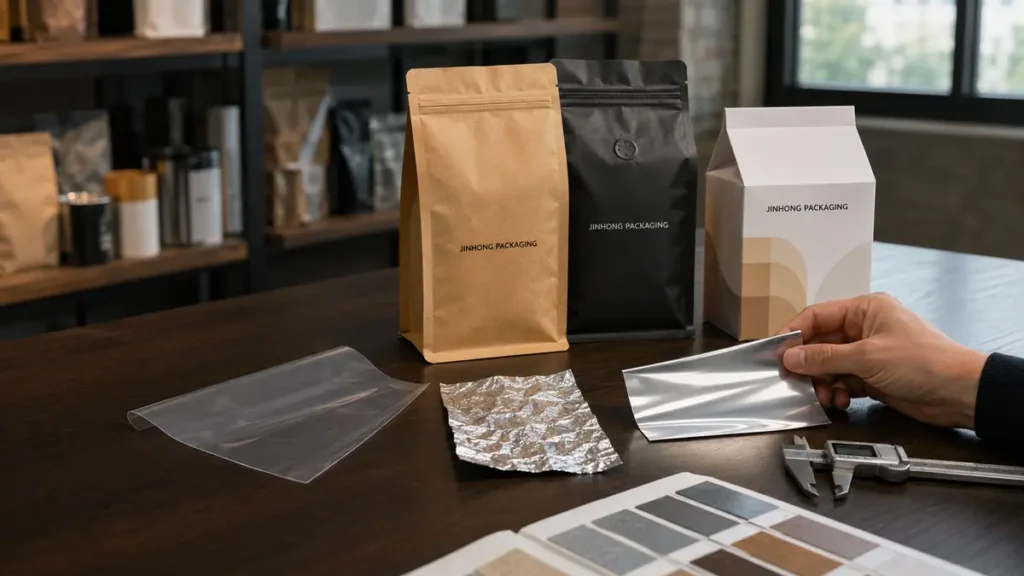
Selecting packaging materials for food and coffee involves more than choosing an attractive pouch, box, or label. The material structure must protect the product against the conditions that can reduce its quality during filling, storage, transportation, retail display, and consumer use.
Oxygen, moisture, light, aroma loss, grease, temperature, handling, and expected shelf life can all influence the final specification. A suitable structure for roasted coffee may not be appropriate for frozen food, baked products, oily snacks, powders, or liquid food. Even products within the same category can require different packaging because their recipes, distribution channels, and storage conditions are different.
This guide explains the main packaging materials for food and coffee, how common barrier layers work, and what information should be confirmed before requesting samples or quotations. Brands comparing rigid formats can also refer to our packaging box materials guide, while businesses evaluating a broader range of formats can review our custom food packaging options.
How to Choose Packaging Materials for Food and Coffee
Packaging selection should begin with the product rather than with a preferred material name. A practical assessment considers the characteristics of the food, the expected shelf life, the filling process, and the conditions the package will experience after filling.
The main questions include:
• Is the product dry, moist, oily, acidic, frozen, powdered, or liquid?
• Is it sensitive to oxygen, humidity, ultraviolet light, or aroma loss?
• Will the package be filled at room temperature, while hot, or under frozen conditions?
• Does the product contain sharp edges that could puncture a thin film?
• Is the package expected to stand upright, lie flat, or fit inside a secondary carton?
• Will consumers open and close it repeatedly?
• What transport distance, storage temperature, and retail environment are expected?
• What food-contact requirements apply in the destination market?
• Is the priority maximum protection, lower material use, recyclability compatibility, premium appearance, or a balance among these factors?
Material selection is therefore a specification decision. The same visible pouch format can be produced from very different structures, and two packages that look similar may provide very different levels of oxygen, moisture, light, and puncture resistance.
Understanding the Main Barrier Requirements
Oxygen Barrier
Exposure to oxygen can accelerate oxidation, reduce aroma quality, affect color, and shorten shelf life. Roasted coffee, nuts, oily snacks, powdered ingredients, and some dehydrated foods often need meaningful oxygen protection.
Materials such as PET, PA, EVOH, aluminum foil, and certain coated or metallized films can contribute to oxygen barrier performance. However, the performance of the complete package also depends on film thickness, seals, closures, valves, printing and converting quality, and storage conditions.
Barrier values should be evaluated using relevant test data rather than visual appearance alone. A shiny or thick package is not automatically a high-barrier package.
Moisture Barrier
Moisture can enter or leave a package. Crispy snacks may lose their texture when they absorb humidity, while baked products may become dry if moisture escapes. Powders can clump, and frozen products can be affected by moisture loss or ice formation.
PE and PP are commonly used where moisture resistance and sealability are important. The appropriate level depends on the product’s water activity, expected shelf life, and storage environment.
Light Barrier
Light can affect the flavor, color, nutrients, and stability of sensitive products. Aluminum foil, metallized films, opaque printed layers, and some paper-based combinations can reduce light exposure.
A transparent window may improve product visibility, but it also reduces light protection in that area. The marketing benefit of a window should therefore be balanced against the product’s sensitivity and shelf-life target.
Aroma and Odor Protection
Coffee and strongly flavored foods need packaging that helps retain desirable aromas while limiting the transfer of external odors. Aroma protection depends on the complete structure and seal integrity, not only the outer material.
Material compatibility is especially important for products containing oils, spices, or strong flavor compounds. Samples should be assessed with the actual product whenever possible.
Paper and Paperboard Packaging
Paper and paperboard are widely used for folding cartons, sleeves, takeaway packaging, corrugated shipping cases, labels, and secondary packaging. They offer good printability, structural presentation, and a familiar appearance that many consumers associate with paper-based packaging.
Common options include:
• Folding boxboard for printed retail cartons
• Kraft paper for natural-looking bags, wraps, and cartons
• Solid bleached board for clean graphics and premium presentation
• Corrugated board for transportation and ecommerce packaging
• Specialty paper for decorative finishes, textures, and labels
Paper alone usually provides limited resistance to grease, moisture, gases, and liquid contact. Depending on the application, it may require a coating, liner, laminated layer, internal pouch, or separate primary package.
A paper outer layer does not automatically make the complete package recyclable. Coatings, adhesives, windows, barriers, inks, and laminated layers can affect how the package is collected and processed. Environmental claims should reflect the complete structure and the recycling systems available in the intended market.
For direct food contact, the relevant paper, coating, adhesive, ink, and other components must be evaluated for the intended application. The required documentation depends on the market, food type, contact conditions, and package design.
Common Plastic Films Used in Food Packaging
Plastic films are frequently combined because each polymer contributes different properties. The abbreviations on a material specification identify the layers, but they do not by themselves confirm the performance or regulatory suitability of the finished package.
Polyethylene (PE)
PE is commonly used as a sealing layer and for moisture resistance. Different grades can provide flexibility, toughness, or low-temperature performance.
It is frequently used in pouches, liners, frozen-food packaging, and sealant layers within laminated structures. The selected PE grade must suit the filling temperature, sealing equipment, product contact, and storage conditions.
A predominantly PE structure may be considered when compatibility with polyethylene recycling streams is a project objective. However, the actual recyclability claim depends on the complete package, local collection and processing systems, inks, adhesives, valves, zippers, and applicable claim guidance.
Polypropylene (PP)
PP offers moisture resistance, clarity, and useful heat-related properties. BOPP, or biaxially oriented polypropylene, is often used as a printable outer web in snack, confectionery, bakery, and other flexible packaging.
CPP, or cast polypropylene, can be used as a sealing layer in certain structures. PP-based packages are not interchangeable with PE-based packages, and sealing conditions must be matched to the selected film.
Polyethylene Terephthalate (PET)
PET is commonly used as an outer layer because it offers clarity, dimensional stability, printability, and resistance to handling. It can help protect graphics and provide strength to laminated structures.
PET is often combined with PE, CPP, metallized film, foil, or another barrier layer. A PET laminate can provide strong packaging performance, but a multi-material laminate may be difficult to process through conventional recycling systems. Performance and end-of-life goals should therefore be considered together.
Polyamide (PA or Nylon)
PA provides toughness, puncture resistance, and durability. It may be used for products with sharp edges, vacuum applications, frozen food, or packages exposed to demanding handling conditions.
Its barrier performance can change with humidity, so PA is normally selected as part of a complete structure rather than assessed in isolation. It can be combined with PE or other materials when both puncture resistance and sealability are required.
Aluminum Foil and Metallized Film
Aluminum foil and metallized film are different materials and should not be described as interchangeable.
Aluminum Foil
Aluminum foil is a continuous metallic layer. When properly converted and protected within a laminate, it can provide very strong protection against oxygen, moisture, light, and aroma transfer.
Foil is often considered for sensitive products or longer shelf-life requirements. However, it can be affected by flex cracking, pinholes, sharp folds, and demanding handling. The complete laminate must be designed to protect the foil and maintain seal integrity.
Foil structures also require careful evaluation when recyclability is a project priority because they are commonly combined with plastic or paper layers.
Metallized Film
Metallized film is generally a plastic film with a very thin deposited metal coating. Metallized PET and metallized BOPP are common examples.
It offers an opaque metallic appearance and improved barrier compared with many uncoated films, but it does not normally provide the same barrier performance as intact aluminum foil. Actual results depend on the base film, coating quality, thickness, converting process, and finished package.
The choice between foil and metallized film should be based on required barrier data, appearance, flexibility, cost, package construction, and end-of-life considerations—not simply on whether the material looks silver.
Why Multilayer Structures Are Common
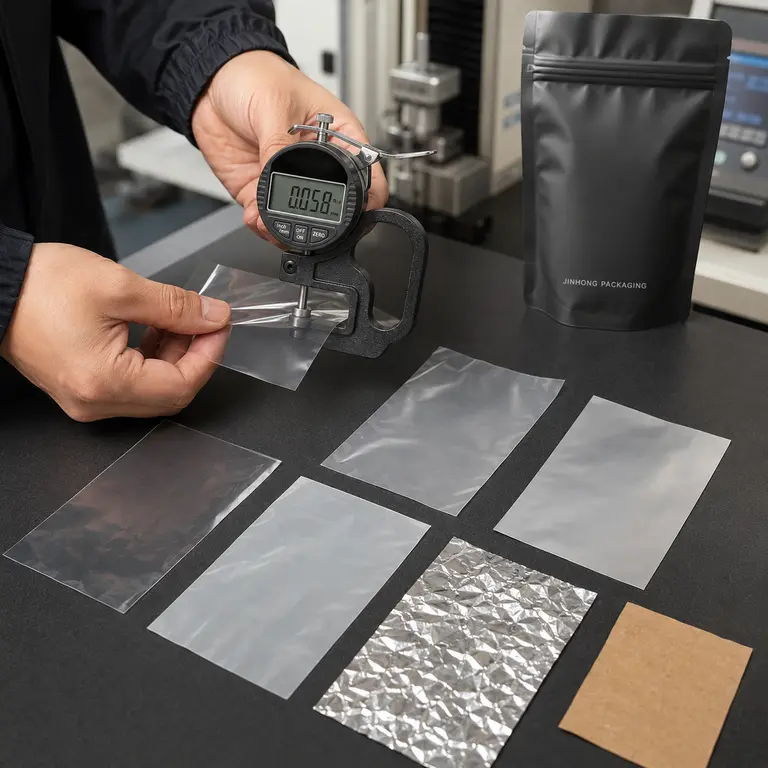
A single material does not always provide all the properties required for printing, barrier performance, toughness, sealing, and food contact. Multilayer packaging combines materials so that each layer performs a specific function.
A typical structure may include:
• An outer layer for printing, stiffness, and abrasion resistance
• A barrier layer for oxygen, moisture, aroma, or light protection
• A structural layer for puncture resistance or durability
• An inner sealant layer suitable for the intended food contact and sealing process
For example, a PET-based outer layer may support printing and handling, while a metallized layer improves barrier performance and a PE inner layer provides sealing. The exact structure should be selected according to the product and verified through appropriate testing.
More layers do not automatically mean better packaging. An unnecessarily complex structure may increase cost and material use without providing a meaningful benefit. The objective is to use a structure that meets the required protection, processing, and distribution needs without unnecessary specification.
Materials for Different Food Applications
Snack Packaging
Chips, nuts, crackers, dried fruit, and similar snacks often require moisture and oxygen protection. Oily products may need stronger oxygen resistance, while products with sharp edges may require additional puncture strength.
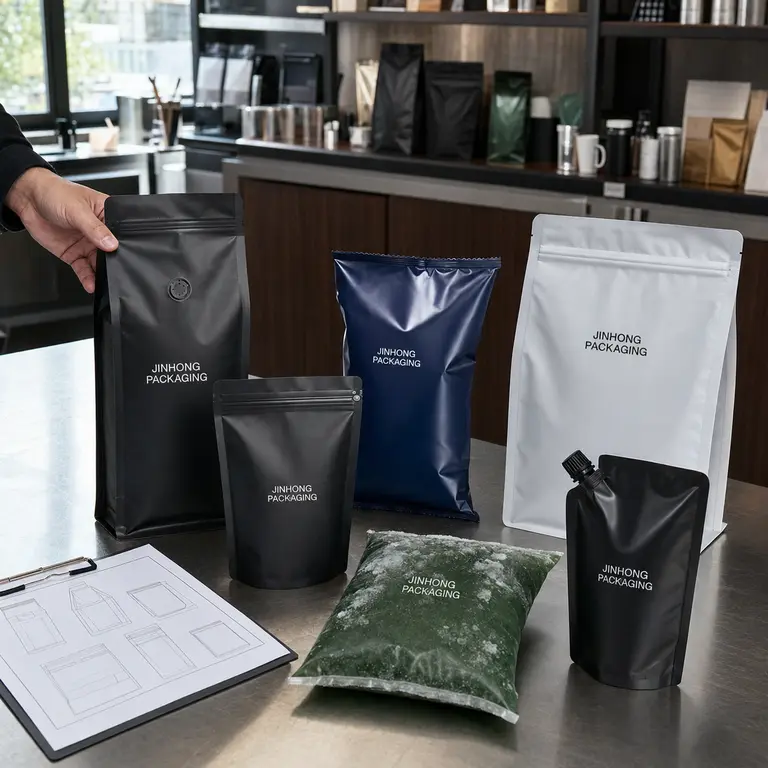
Stand-up pouches, pillow bags, flat pouches, and rollstock are common options. Nitrogen flushing may also be part of the packing process, but the package must be designed for the actual filling equipment and residual gas targets.
A transparent window can support product presentation, although it may reduce light and barrier protection. Brands should confirm whether product visibility or maximum protection is the higher priority.
Powder Packaging
Protein powders, drink mixes, flour blends, spices, and powdered ingredients need protection against humidity and contamination. Fine powders can interfere with sealing if they enter the seal area, so filling control and seal design are important.
The package may require a wide opening, scoop access, zipper, or tamper-evident feature. Powder weight, bulk density, and tendency to generate dust should be included in the specification.
Bakery and Confectionery Packaging
Bread, cookies, chocolate, and confectionery products have different moisture and temperature sensitivities. Crisp cookies need protection from moisture ingress, while soft baked goods may need a structure that reduces moisture loss.
Chocolate can be sensitive to heat, light, odors, and temperature changes. Grease resistance may also be important for products containing butter, oils, or fillings. Material selection should reflect the actual recipe and storage conditions.
Frozen Food Packaging
Frozen vegetables, fruit, seafood, prepared meals, and other frozen products need materials that remain durable at low temperatures. The package may also require puncture resistance, moisture protection, and seals that withstand freezing, transportation, and consumer handling.
A structure that performs well at room temperature may become brittle or lose seal performance when frozen. Freezer testing with the intended product, fill weight, and distribution conditions is therefore important.
Liquid and Semi-Liquid Food Packaging
Sauces, purees, oils, condiments, and liquid foods require strong seals and material compatibility with the product. Acidity, oil content, filling temperature, pasteurization, and shelf-life requirements can influence the structure.
Spouted pouches may provide controlled dispensing, but the spout, cap, seal area, and laminate must function as one system. Hot-fill, retort, or aseptic applications require specialized materials and validated processes; a standard room-temperature pouch should not be assumed suitable.
Businesses reviewing flexible formats can compare our custom food packaging bags, including available pouch styles and project considerations.
Packaging Materials for Whole-Bean and Ground Coffee
Roasted coffee is sensitive to oxygen, moisture, light, and aroma loss. It also releases carbon dioxide after roasting, particularly during the earlier stages of degassing.
Whole-bean coffee commonly uses high-barrier flexible pouches with a secure heat seal. Flat-bottom, side-gusset, quad-seal, and stand-up pouch formats can all be considered depending on filling equipment, retail presentation, pack size, and distribution requirements.
Ground coffee generally has more exposed surface area than whole beans and may lose aroma faster. This can increase the importance of oxygen barrier, seal integrity, and the packing method. Vacuum packaging or modified-atmosphere processes may be used in some applications, but the package structure must be compatible with the selected process.
Coffee packaging should be specified according to:
• Whole-bean or ground coffee
• Roast level and degassing behavior
• Filling date and target shelf life
• Pack weight and dimensions
• Hand filling or automatic filling
• Need for a zipper or other reclosure
• Desired light and oxygen barrier
• Valve type, placement, and application method
• Distribution distance and storage conditions
Our coffee packaging solutions provide an overview of pouch formats and specification support for roasted coffee brands.
The Role of a One-Way Degassing Valve
A one-way degassing valve is designed to allow gas from freshly roasted coffee to leave the sealed package while limiting the entry of outside air under the valve’s intended operating conditions.
A valve does not replace a suitable barrier structure or reliable heat seal. Valve performance can be affected by the package format, internal pressure, coffee degassing rate, valve specification, application quality, and storage conditions.
Not every coffee product requires the same valve. The decision should consider roast timing, filling schedule, packaging process, shelf-life target, and whether the coffee is whole or ground. Brands evaluating this feature can review our coffee bags with valves.
Food-Contact Compliance and Documentation
Terms such as “food grade” and “FDA approved” are often used too broadly. A material name alone does not establish that a complete package is suitable for every food or every condition of use.
In the United States, the regulatory status of food-contact substances and their intended conditions of use should be considered. The FDA resource Packaging and Food Contact Substances explains the applicable framework and provides access to inventories, notifications, and information on food types and conditions of use.
For the European Union, food-contact material legislation includes general safety and inertness principles, specific rules for certain materials, good manufacturing practice requirements, migration limits, documentation, and traceability obligations. Requirements can vary according to the material, food type, contact time, and temperature.
A packaging project may require documents such as:
• Material specifications
• Statements or declarations relevant to the intended food-contact use
• Migration test reports where applicable
• Information about inks, adhesives, coatings, and sealant layers
• Traceability or production records
• Market-specific declarations of compliance
• Testing based on the intended food type and time-temperature conditions
The buyer should identify the destination market and intended application before production. A document prepared for one material, market, or condition of use should not be assumed to cover a different structure or application.
Recycled content requires particular care in direct food-contact applications. FDA guidance on recycled plastics in food packaging explains considerations associated with the source material, recycling process, contaminants, and intended use. Recycled content should not be selected or advertised solely on the basis of a percentage claim without confirming its suitability and supporting documentation.
Sustainability and Responsible Packaging Claims
Sustainability decisions should consider product protection, material use, package weight, transport efficiency, food waste prevention, collection systems, and the realistic end-of-life pathway.
Possible project directions include:
• Reducing unnecessary material or package dimensions
• Evaluating a mono-material-compatible structure where performance allows
• Using paper-based secondary packaging where appropriate
• Reviewing verified recycled content for suitable applications
• Designing components for separation when practical
• Avoiding decorative layers that do not provide a necessary function
• Comparing packaging performance before changing to a lower-barrier structure
A packaging change that causes product spoilage or a shorter usable shelf life may create additional impacts. Barrier reduction should therefore be supported by shelf-life and distribution testing.
Claims such as “recyclable,” “compostable,” “biodegradable,” and “eco-friendly” should not be used without evidence and appropriate qualifications. The FTC Green Guides explain that broad environmental claims can be misleading and that recyclable or compostable claims may require clear limitations based on the package and available facilities.
Collection and recycling systems differ by country and region. A structure that can technically be processed does not necessarily have widespread collection access. Final claims should be reviewed for the intended sales market and supported by the complete package specification.
Information to Confirm Before Requesting a Quote
Clear project information helps a packaging supplier compare suitable materials, coordinate sampling, and request more accurate pricing from selected manufacturing partners.
Before requesting a quotation, prepare the following:
• Product name and description
• Whole, ground, powdered, solid, frozen, oily, acidic, or liquid format
• Net weight or fill volume
• Approximate product density where relevant
• Required pouch or box style
• Finished dimensions
• Estimated order quantity
• Number of printed designs or SKUs
• Filling method and equipment
• Filling and sealing temperature
• Target shelf life
• Storage and transportation conditions
• Destination market
• Required barrier or test data
• Valve, zipper, window, spout, tear notch, or hang-hole requirements
• Printing colors and artwork status
• Required food-contact or market-specific documentation
• Sustainability targets and the evidence required for any claims
When barrier requirements are not yet defined, the existing packaging structure, product shelf life, and known storage conditions can provide a useful starting point. Physical samples and technical specifications are more reliable than a photograph alone.
Jinhong Packaging supports packaging sourcing, specification confirmation, sampling coordination, production coordination, documentation coordination, and delivery preparation. Final material selection should be confirmed against the actual product, filling process, regulatory market, and performance requirements.
Frequently Asked Questions
What is the best packaging material for food?
There is no single best material for every food product. The right choice depends on moisture, oxygen and light sensitivity, fat content, acidity, filling conditions, shelf life, storage temperature, distribution, and applicable food-contact requirements.
Is paper packaging suitable for direct food contact?
It can be suitable in certain applications when the paper and any coatings, inks, adhesives, or liners are appropriate for the intended food and conditions of use. Uncoated paper alone may not provide enough grease, moisture, gas, or liquid resistance.
Is aluminum foil the same as metallized film?
No. Aluminum foil is a continuous metallic layer, while metallized film usually consists of plastic film with a very thin deposited metal coating. Their barrier performance, flexibility, appearance, cost, and converting behavior are different.
Does every coffee bag need a degassing valve?
No. The need for a valve depends on the coffee, roast timing, degassing rate, filling process, package format, and shelf-life plan. Freshly roasted coffee commonly uses a one-way valve, but the complete packaging process should be assessed.
Does a thicker pouch always provide a better barrier?
No. Thickness can affect stiffness and durability, but barrier performance depends on the type and quality of each layer, coating, seals, closures, converting process, and storage conditions. Relevant barrier data is more useful than total thickness alone.
Can a multilayer food pouch be described as recyclable?
Only when the claim is supported for the complete structure and appropriately qualified for the intended market. Films, adhesives, inks, zippers, valves, coatings, and local collection systems can all affect recyclability.
What documentation should be requested for food packaging?
The required documents depend on the destination market, material structure, food type, contact time, temperature, and filling process. Material specifications, relevant declarations, migration reports, and supporting documentation may be needed.
Final Thoughts
Choosing packaging materials for food and coffee requires a balance of product protection, filling performance, appearance, cost, compliance, and realistic sustainability goals. Material names alone are not enough: the complete structure, seals, components, test data, and intended conditions of use must be considered together.
A clear specification reduces unnecessary sampling, improves quotation accuracy, and helps avoid selecting a package that looks suitable but does not provide the required performance.
Discuss Your Food or Coffee Packaging Project