Printed Powder Pouch Production Reference
This Printed Powder Pouch Production Reference examines printed stand-up pouches produced for a third-party project by one of our selected manufacturing partners. The reported production run involved approximately 500,000 pouches in several coordinated designs.
The project was not managed by Jinhong Packaging and is not presented as a Jinhong client order. Brand-identifying details, QR codes and barcodes have been concealed. The photographs are provided solely as a representative production reference for reviewing pouch structure, print coordination and specification considerations.
The confirmed reference information includes:
- Pouch dimensions: 18 × 25 + 4 cm
- Format: printed stand-up pouch
- Structure: PET / aluminum foil / PE
- Closure: concealed resealable zipper
- Application shown: powdered products
- Reported production quantity: approximately 500,000 pieces
- Design arrangement: multiple coordinated product variants
- Photograph source: third-party project customer
- Manufacturing source: selected manufacturing partner
Claims, certifications, ingredient statements and product information visible on the original packaging have not been independently verified by Jinhong Packaging and are not evaluated on this page.
Production Reference Overview
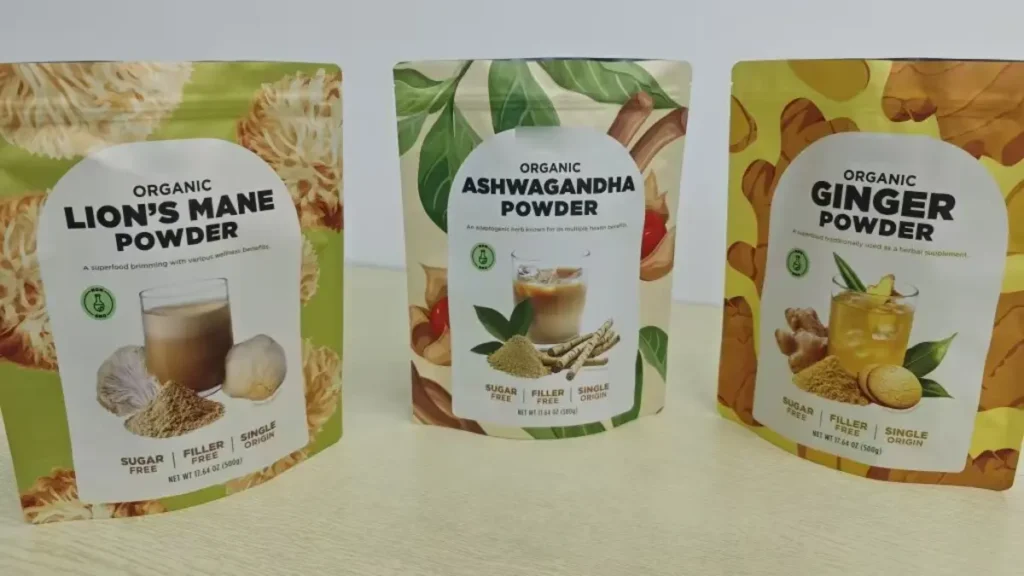
The photographs show three printed pouch variations using the same general packaging format. Each design maintains a consistent information hierarchy while using different colors, illustrations and product names to distinguish the individual products.
This type of coordinated packaging system can be useful when a brand sells several products within one range. A consistent pouch shape, label area and information structure can help create visual recognition, while color and product imagery help customers differentiate between variants.
For production planning, consistency should be confirmed across:
- Finished pouch dimensions
- Gusset depth
- Zipper position
- Top and side seal widths
- Material structure
- Print layout
- Color targets
- Front-panel alignment
- Back-panel information placement
- Packing method
A large reported production quantity does not remove the need for approved specifications and reference samples. The same control points remain important whether a project involves one design or several coordinated designs.
PET, Aluminum Foil and PE Structure
The manufacturing partner identified the pouch structure as PET / aluminum foil / PE.
Each layer has a different role within the laminated packaging structure.
PET Outer Layer
PET is commonly used as an outer layer because it can provide a printable surface, dimensional stability and resistance to handling during conversion, filling and distribution.
The required PET grade, thickness and print treatment should be confirmed in the final material specification.
Aluminum Foil Barrier Layer
Aluminum foil is different from metallized film. In this reference structure, the confirmed middle layer is aluminum foil.
A foil layer may be selected when a project requires a higher level of protection against oxygen, moisture and light. Actual barrier performance depends on the complete laminate, foil thickness, adhesive system, sealing quality and finished-package integrity.
The presence of aluminum foil should not be used to make an unconditional shelf-life claim. Product characteristics, filling conditions, storage and distribution must also be considered.
PE Sealing Layer
PE is used as the inner sealing layer in this structure. The appropriate PE grade and thickness should be selected according to the product, sealing method and required package performance.
For packaging intended to contact food or powdered consumables, the final purchaser should confirm the applicable food-contact documentation for the complete structure and destination market.
More information about common film and barrier options is available in our packaging materials for food and coffee guide.
Concealed Resealable Zipper
The pouches incorporate a concealed resealable zipper near the top opening area. Unlike a prominently exposed zipper track, this format integrates the closure into the upper pouch structure so that it is less visually dominant from the outside.
A resealable zipper can support repeated opening and closing after the original package seal has been opened. For powdered products, zipper performance should be evaluated carefully because fine powder may collect around the closure area.
Important review points include:
- Zipper alignment
- Zipper opening and closing force
- Distance from the top seal
- Available filling opening
- Powder contamination around the zipper
- Side-seal continuity
- Reclosure performance
- Consumer opening method
The zipper should be tested with the intended product rather than assessed only from an empty pouch. Powder particle size, filling level and handling conditions can affect practical zipper performance.
Pouch Dimensions and Bottom Gusset
The confirmed pouch dimensions are 18 × 25 + 4 cm. The “+4 cm” refers to the gusset measurement used in the stand-up pouch structure.
The bottom gusset allows the pouch base to expand after filling. The final standing shape depends on the amount and density of product, gusset opening, seal geometry and filling process.
Dimensions alone should not be used to promise a fixed filling capacity. Even when two powders use the same pouch size, their filling volume may differ because of:
- Bulk density
- Particle size
- Product aeration
- Target net weight
- Required headspace
- Filling equipment
- Desired shelf appearance
- Sealing allowance
A physical filling test is recommended before the final pouch dimensions are approved.
Multi-Design Printing Coordination
The photographs show several products using related packaging structures but different artwork. Coordinating multiple designs within one production project requires more than changing the product name.
Each artwork file should be checked for:
- Correct dimensions and dieline
- Front and back orientation
- Product name
- Variant color
- Image resolution
- Barcode and QR-code placement
- Nutrition or ingredient panel position
- Required legal text
- Safe margins
- Seal and zipper clearance
- Print registration
- Version identification
The approved artwork version should be clearly documented. File names, revision numbers and approval dates help reduce the risk of using an outdated design during production coordination.
Barcode and QR-code readability should be verified using the final printed sample. Their position should avoid seals, folds, gussets and strongly curved areas that may affect scanning.
Visible Print and Construction Review
The available photographs allow several visible production characteristics to be reviewed. A photographic review cannot replace physical inspection, laboratory testing or an approved specification, but it can identify points requiring closer confirmation.
Consistent Product Family
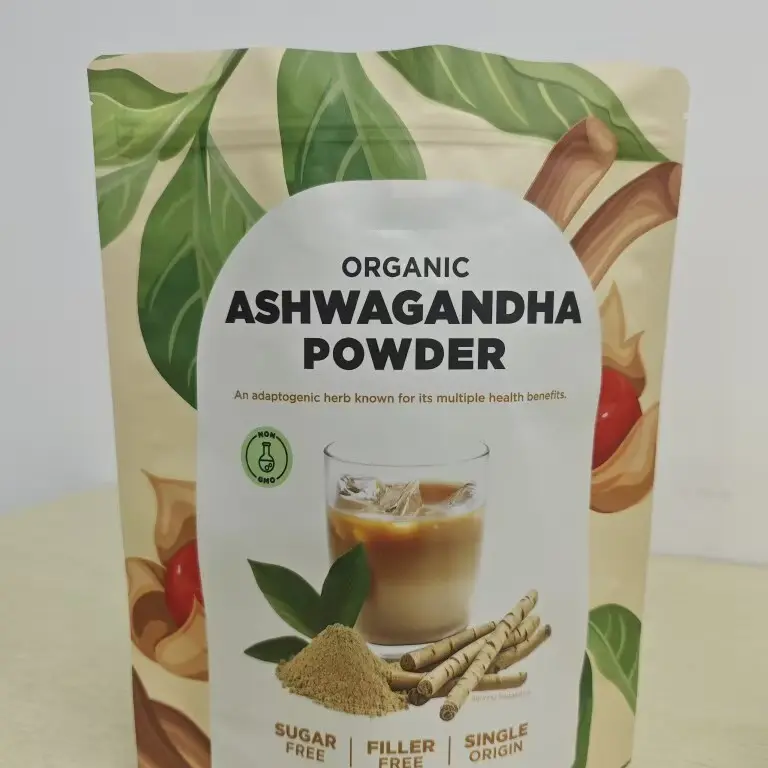
The three front designs use a consistent central information panel, bold product naming and coordinated product imagery. This creates a recognizable product family while maintaining clear visual differences between variants.
Front-Panel Alignment
The principal product information is positioned centrally on each pouch. During production, the relationship between the printed design, pouch edges and bottom gusset should be compared against the approved artwork and tolerance.
Back-Panel Information Layout
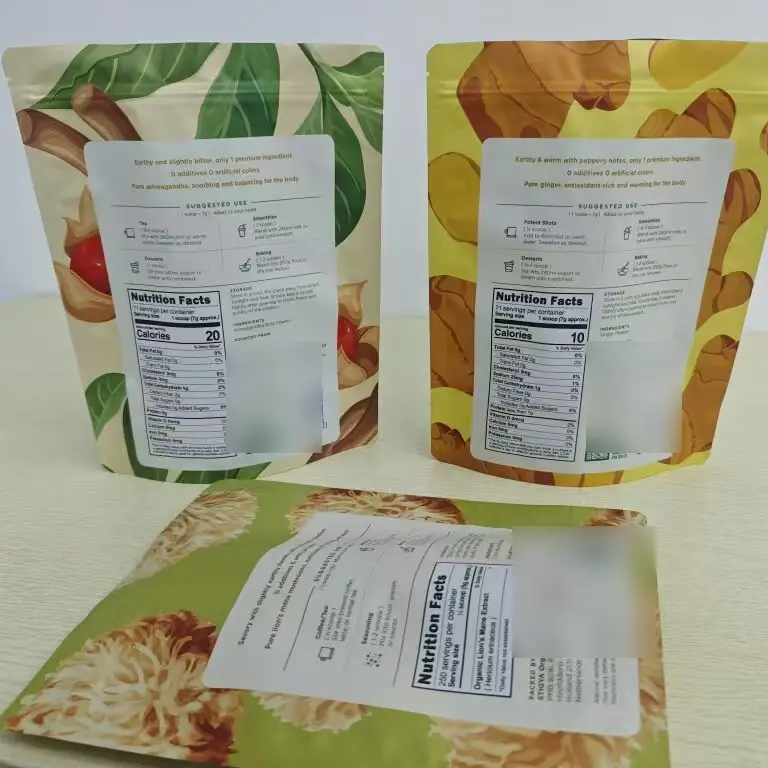
The back panels organize preparation guidance, product information, nutrition information and identification elements within a large light-colored area.
Final production review should confirm that small text remains legible and that no critical information enters the sealing or gusset areas.
Seal and Edge Areas
The visible side and top areas should be checked for consistent seal width and continuity. The concealed zipper and upper seal must be coordinated so sufficient space remains for filling and final closure.
Surface Appearance
The photographs show a printed flexible pouch with a relatively soft surface appearance. Exact finish, gloss level, color standard and acceptable visual variation should be confirmed using an approved physical sample rather than photographs alone.
Information to Confirm Before Quotation
To prepare a useful quotation for a similar printed powder pouch, provide:
- Product type
- Intended fill weight
- Bulk density, where available
- Required pouch dimensions
- Material structure
- Thickness of each layer or total nominal thickness
- Barrier requirements
- Zipper requirement
- Printing artwork
- Number of designs
- Quantity for each design
- Surface finish
- Destination country
- Required food-contact documentation
- Packing method
- Preferred production schedule
- Delivery requirements
For multiple designs, the quantity allocation for each artwork should be confirmed. A total order quantity does not automatically mean every design can be produced in any quantity without affecting printing, conversion and commercial arrangements.
Compliance and Packaging Claims
Packaging material selection and regulatory documentation should be evaluated for the intended product and destination market.
For projects involving food, beverage ingredients or powdered consumables, customers may review relevant information about Packaging and Food Contact Substances published by the U.S. Food and Drug Administration when the United States is the destination market.
Terms such as “food grade,” “recyclable,” “compostable,” “organic” or “eco-friendly” should not be used without appropriate support. Product claims printed on packaging remain the responsibility of the brand and relevant product specialists.
Jinhong Packaging does not verify the product, ingredient, nutrition or health claims displayed in this third-party production reference.
How Jinhong Packaging Can Support Similar Projects
Jinhong Packaging works with selected manufacturing partners to support packaging sourcing and project coordination.
For a similar printed powder pouch project, our support may include:
- Requirement collection
- Pouch format coordination
- Size and material specification confirmation
- Quotation coordination
- Sample arrangement
- Artwork information follow-up
- Multi-design quantity confirmation
- Printing requirement coordination
- Production schedule follow-up
- Inspection requirement coordination
- Documentation coordination
- Delivery preparation
The final structure, thickness, printing requirements, tolerances and documentation should be confirmed in writing before production begins.
Third-Party Production Reference Notice
The photographs on this page relate to a third-party project produced by a selected manufacturing partner. The project was not sourced, sold or managed by Jinhong Packaging.
The manufacturing partner reported that the production run involved approximately 500,000 pouches. Jinhong Packaging has not independently verified the order quantity or commercial terms.
Brand names, QR codes and barcodes have been concealed. The images are used only to illustrate a representative pouch structure, print arrangement and production-review process.
This Printed Powder Pouch Production Reference should not be interpreted as a client testimonial, Jinhong order history or claim of in-house manufacturing.
Discuss Your Printed Pouch Project
A successful printed pouch project requires coordination between product requirements, material structure, barrier protection, zipper performance, dimensions, artwork, production quantity and destination-market documentation.