
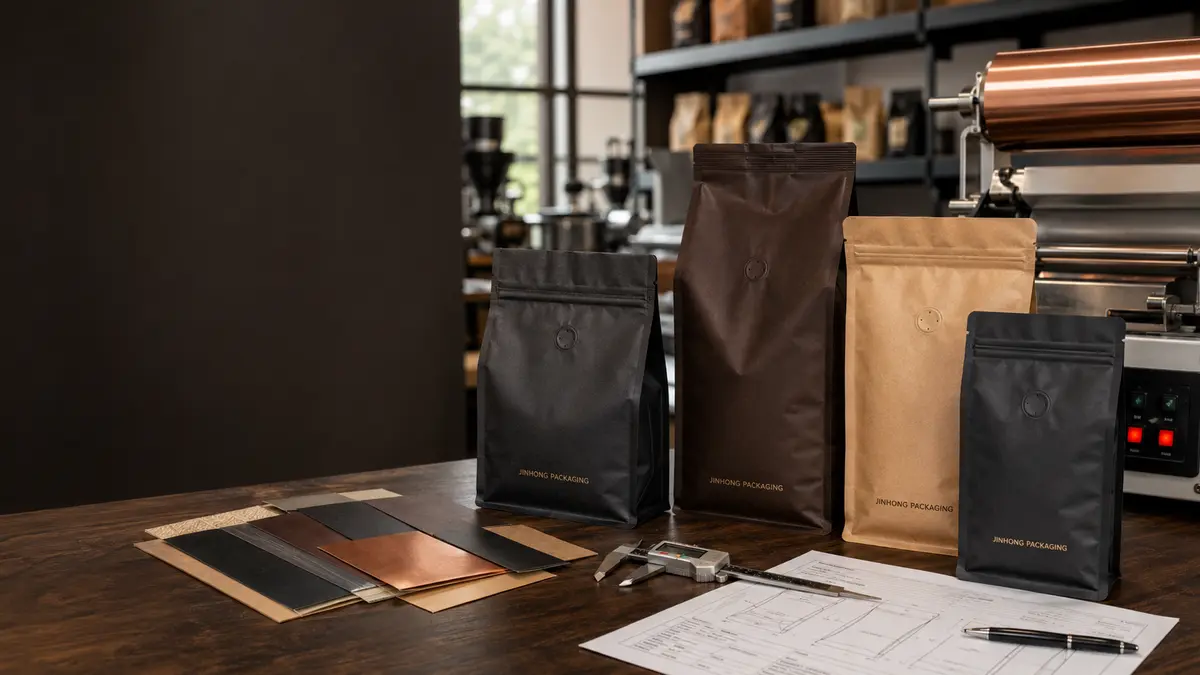
Coffee packaging must do more than present a brand attractively. It must protect roasted coffee against oxygen, moisture, light, aroma loss, and the conditions experienced during filling, storage, transportation, retail display, and consumer use.
Freshly roasted coffee also releases carbon dioxide. Depending on the roast, filling schedule, and package size, this may require a one-way degassing valve. Bag style, barrier structure, dimensions, zipper, seals, printing, and filling equipment must therefore be considered together.
This coffee packaging guide explains the main decisions coffee roasters and brands should make before requesting samples or quotations.
Start with the Coffee Product
Packaging selection should begin with the coffee rather than with a preferred bag appearance.
Confirm the following:
• Whole-bean or ground coffee
• Roast level
• Time between roasting and packing
• Expected degassing behavior
• Net weight
• Target shelf life
• Filling method
• Storage environment
• Retail, wholesale, subscription, or ecommerce distribution
• Number of varieties or printed designs
Whole-bean coffee and ground coffee may require different specifications. Grinding increases the surface area exposed to the package atmosphere, which can increase the importance of oxygen protection, seal integrity, and the packing process.
Recently roasted coffee may also release more gas after filling than coffee packed later. This affects valve selection, headspace, and sealing plans.
Coffee Packaging Guide to Barrier Protection
Oxygen Barrier
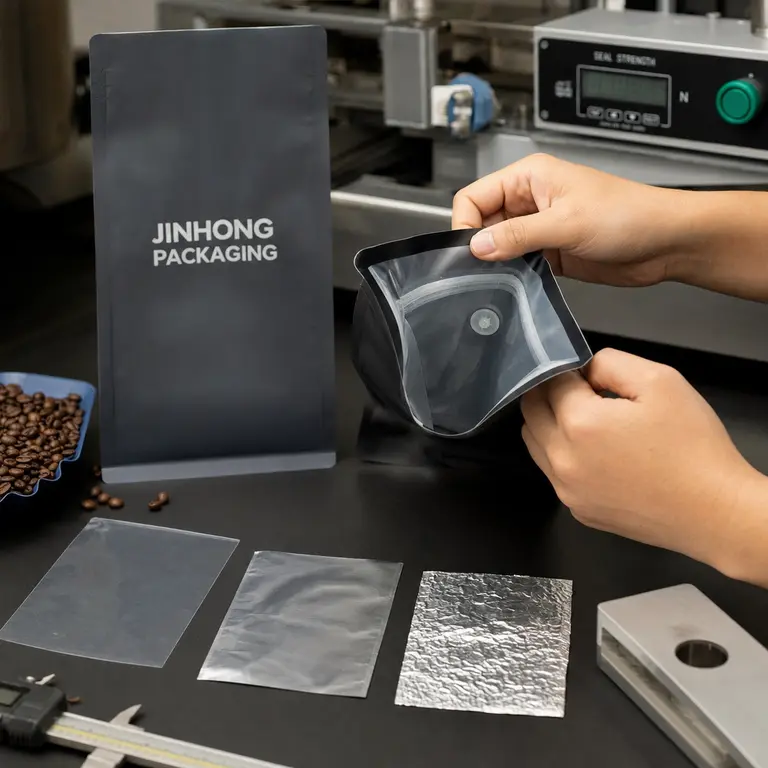
Oxygen exposure can contribute to the loss of desirable coffee aroma and flavor. Coffee packaging commonly uses a barrier structure designed to limit oxygen transmission during the intended shelf life.
Possible barrier materials include PET, metallized films, aluminum foil, EVOH-containing structures, and other coated or laminated films.
The appearance or total thickness of a pouch does not confirm its oxygen barrier. Performance depends on the complete structure, seals, zipper, valve, converting quality, and storage conditions.
Moisture Barrier
Roasted coffee should be protected from humidity. Moisture exposure may affect flavor stability and brewing performance.
PE, PP, aluminum foil, metallized films, and other layers can contribute to moisture resistance. The appropriate structure depends on the coffee, climate, shelf-life target, and distribution conditions.
Aroma Protection
Coffee contains volatile aroma compounds that can be lost during storage. Packaging should help retain desirable aromas while limiting the transfer of external odors.
A high-barrier film cannot compensate for an unreliable seal. The top heat seal, bottom seal, side seals, zipper, and valve installation all contribute to finished-package performance.
Light Protection
Opaque structures can protect coffee from light. Aluminum foil laminates, metallized films, and opaque printed layers are commonly considered where stronger light protection is required.
A transparent window may improve product visibility, but it reduces light protection in that area. Its marketing value should be balanced against the product’s sensitivity and shelf-life requirements.
Businesses comparing common film and paper structures can review our packaging materials for food and coffee guide.
Common Coffee Packaging Materials
Flexible coffee bags often combine several layers because one material may not provide all the required printing, barrier, strength, and sealing properties.
PET
PET is frequently used as an outer layer because it provides dimensional stability, printability, and resistance to handling. It may be combined with PE, foil, metallized film, or another barrier layer.
PE
PE is commonly used as an inner sealing layer and for moisture resistance. The selected grade should be compatible with the filling and heat-sealing process.
BOPP and CPP
BOPP can provide clarity, printability, and moisture resistance. CPP may be used as a sealing layer in selected structures. Their suitability depends on the complete package design.
Aluminum Foil
Aluminum foil is a continuous metallic layer. When properly protected within a laminate, it can provide strong oxygen, moisture, light, and aroma protection.
However, foil can be affected by flex cracking, pinholes, and sharp folds. The complete package should be developed and tested for its expected handling conditions.
Metallized Film
Metallized film is generally a plastic film with a thin deposited metal coating. It can improve barrier performance and provide an opaque metallic appearance, but it is not identical to aluminum foil.
The choice between foil and metallized film should be based on barrier data, appearance, flexibility, cost, package construction, and end-of-life priorities.
Kraft Paper Laminates
Kraft paper can create a natural presentation, but paper alone generally does not provide the barrier and sealability required for roasted coffee.
Many kraft coffee bags contain internal film or foil layers. The environmental characteristics of the complete structure should not be inferred from the visible paper surface alone.
One-Way Degassing Valves
Freshly roasted coffee continues releasing carbon dioxide after roasting. If it is sealed without an appropriate degassing strategy, gas may accumulate and cause the package to expand.
A one-way degassing valve is designed to allow gas to leave the sealed package while limiting the entry of outside air under its intended operating conditions.
Valve selection should consider:
• Whole-bean or ground coffee
• Roast level
• Time between roasting and filling
• Degassing rate
• Bag size and headspace
• Valve opening characteristics
• Filling and sealing process
• Storage and distribution conditions
A valve does not replace a suitable barrier material or secure heat seal. Valve performance also depends on its specification, placement, application quality, internal pressure, and package structure.
Not every coffee product requires the same valve. Brands can review our coffee bags with valves for common bag styles and project considerations.
Common Coffee Bag Formats
Flat-Bottom Coffee Bags
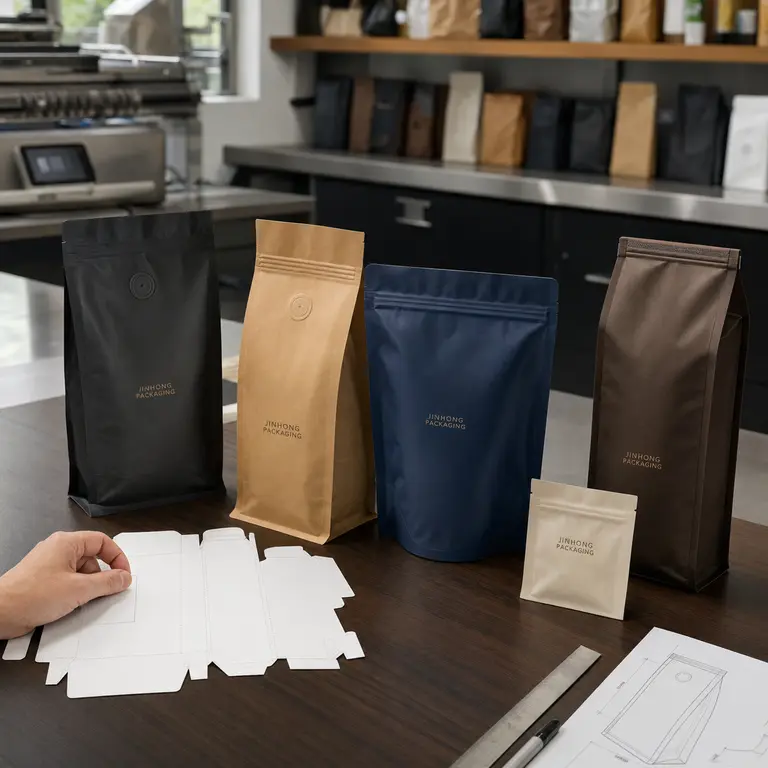
Flat-bottom bags have a stable base and defined front, back, and side panels. They provide strong shelf presentation and a large printable area.
They are commonly selected for specialty whole-bean coffee and premium retail products. Zippers and degassing valves can be added when required.
Available flat bottom coffee bags should be compared by fill weight, dimensions, material structure, closure, and filling method.
Side-Gusset Coffee Bags
Side-gusset bags expand along the sides and provide efficient filling capacity. They have a traditional coffee appearance and are often selected for medium or larger quantities.
Different top and bottom seal configurations are available. Side gusset coffee bags may also include valves according to the coffee and packing schedule.
Stand-Up Pouches
Stand-up pouches use a bottom gusset to remain upright. They are versatile, space-efficient, and suitable for whole-bean coffee, ground coffee, samples, and smaller retail packs.
They commonly include a zipper, tear notch, and optional degassing valve.
Quad-Seal Bags
Quad-seal bags use seals along the side corners to create additional structure and defined panels. They may be suitable for larger fill weights or brands seeking a more structured appearance.
Flat Pouches and Sample Packs
Small flat pouches are useful for samples, single portions, discovery sets, and promotional packs. Their limited internal volume means dimensions and seal areas should be confirmed carefully.
Our coffee packaging solutions provide a broader overview of available pouch formats and specification support.
How to Select the Correct Bag Size
Coffee bag dimensions should be based on product volume rather than weight alone. Two coffees with the same net weight can occupy different volumes because bean size, roast level, grind, and bulk density vary.
Before finalizing dimensions:
• Measure or test the actual product volume
• Confirm whether the coffee is whole or ground
• Allow space for filling and top sealing
• Consider zipper and valve positions
• Check whether the finished bag fits retail shelves and shipping cartons
• Avoid excessive empty headspace
• Confirm compatibility with filling equipment
An existing bag sample can provide a useful starting point, but a physical size sample filled with the actual coffee is more reliable.
Zippers, Seals and Opening Features
Resealable Zippers
A zipper improves convenience after opening. It can help consumers reclose a package used over several days or weeks.
The pouch should still receive an appropriate heat seal above the zipper before sale. A zipper alone should not be treated as the primary unopened-package seal.
Tear Notches
Tear notches help consumers open a heat-sealed package. Their position should be coordinated with the top seal and zipper.
Tin Ties
Tin ties are sometimes used for short-term or service-counter coffee packaging. They do not normally provide the same closure performance as a heat-sealed high-barrier pouch.
Seal Integrity
Reliable seals depend on material structure, seal temperature, pressure, dwell time, seal width, filling cleanliness, and equipment settings.
Coffee dust or beans entering the seal area can interfere with sealing. Samples should be tested under realistic filling conditions.
Printing Methods and Artwork
Coffee bags may be produced using digital, flexographic, or rotogravure printing.
Digital printing may be suitable for lower quantities, market testing, seasonal coffee, or multiple designs. Flexographic and rotogravure printing can become more economical for larger production quantities, depending on the structure and artwork.
Before approving artwork, check:
• Dieline dimensions
• Front, back, side, and bottom panels
• Zipper and top-seal areas
• Valve position
• Gusset folds
• Barcode size and quiet zone
• Roast and origin information
• Required labeling
• Color expectations
• Differences between SKUs
Digital proofs help check content and placement but may not reproduce the exact appearance of printing on the selected material. Physical printed samples provide a more representative reference.
Food-Contact Compliance and Documentation
Terms such as “food grade” and “FDA approved packaging” should not be used as broad, unconditional claims.
Suitability depends on the complete food-contact structure, intended food, contact conditions, temperature, and destination market.
The FDA resource Packaging and Food Contact Substances provides information about food-contact substances, regulatory status, food types, and conditions of use in the United States.
Depending on the market and package structure, buyers may need:
• Material specifications
• Relevant food-contact statements or declarations
• Migration reports where applicable
• Information about inks, adhesives, coatings, and sealant layers
• Supporting documentation for the intended use
• Traceability information
The required documentation should be confirmed before production rather than requested only after the packaging has been completed.
Sustainability Considerations
Sustainability decisions should consider product protection, material use, package weight, shipping efficiency, collection systems, and the realistic end-of-life pathway.
Possible directions include:
• Reducing unnecessary bag dimensions
• Avoiding material layers that do not provide a required function
• Evaluating mono-material-compatible structures where performance allows
• Reviewing verified recycled content for suitable applications
• Using refill formats within a genuine refill system
• Comparing barrier and shelf-life performance before changing materials
A package should not be described as recyclable, compostable, biodegradable, or eco-friendly without supporting evidence and appropriate qualifications.
The FTC Green Guides explain that broad environmental claims can be misleading and that recyclable or compostable claims may need limitations based on the package and available facilities.
What to Confirm Before Requesting a Quote
Prepare the following information:
• Whole-bean or ground coffee
• Roast level and roast-to-pack schedule
• Net weight
• Approximate product density
• Preferred bag style
• Finished dimensions
• Order quantity
• Number of designs
• Filling method
• Target shelf life
• Storage and distribution conditions
• Destination market
• Required material or barrier data
• Valve and zipper requirements
• Printing colors and finish
• Artwork status
• Required food-contact documentation
Jinhong Packaging supports packaging sourcing, specification confirmation, sampling coordination, production coordination, project follow-up, documentation coordination, and delivery preparation through selected manufacturing partners.
Frequently Asked Questions
What is the best material for coffee packaging?
There is no single best material for every coffee. The correct structure depends on whole-bean or ground format, roast-to-pack schedule, barrier requirements, shelf life, filling process, and storage conditions.
Does every coffee bag need a valve?
No. Valve requirements depend on degassing behavior, roast date, filling schedule, coffee format, bag size, and distribution plan.
Are foil and metallized coffee bags the same?
No. Aluminum foil is a continuous metallic layer, while metallized film generally uses a thin metal coating on plastic film. Their barrier performance and converting characteristics differ.
Can kraft coffee bags protect freshness?
A kraft-look bag can provide suitable protection when its complete laminated structure includes the required barrier and sealing layers. Kraft paper alone normally provides limited gas and moisture barrier.
Should coffee bags include zippers?
A zipper is useful for packages consumed over several occasions. The unopened package should still use an appropriate heat seal.
Can I use the same bag size for different coffees?
Not always. Different beans, roasts, and grinds can have different bulk densities. Test the actual coffee in a physical size sample before confirming dimensions.
Can coffee packaging be described as recyclable?
Only when the claim is supported for the complete package and appropriately qualified for the intended market. Films, valves, zippers, inks, adhesives, and local collection systems must be considered.
Final Thoughts
An effective coffee package balances freshness protection, valve performance, bag structure, filling efficiency, brand presentation, compliance, and realistic sustainability goals.
The best results come from confirming the coffee, dimensions, material structure, valve, zipper, printing, and documentation before production begins.