
ESD Packaging and Anti-Static Bags
Protect static-sensitive electronics, components and assemblies with ESD packaging selected according to handling, storage and shipping requirements.
Jinhong Packaging supports material comparison, bag and tray specifications, custom sizing, sampling and project coordination through selected manufacturing partners.
What Is ESD Packaging?
ESD packaging helps reduce the risk of electrostatic discharge during handling, assembly, storage and transportation. It is used for electronic components, circuit boards, sensors, precision instruments and other static-sensitive products.
Different materials provide different levels of protection. Some packaging mainly reduces static generation, while shielding structures are designed to help protect sensitive contents from electrostatic discharge outside the package.
The suitable option depends on the product’s sensitivity, handling process, package size, cushioning needs and required protection level. Material specifications and available test documentation should therefore be confirmed for each project.
ESD Packaging Options
ESD Shielding Bags
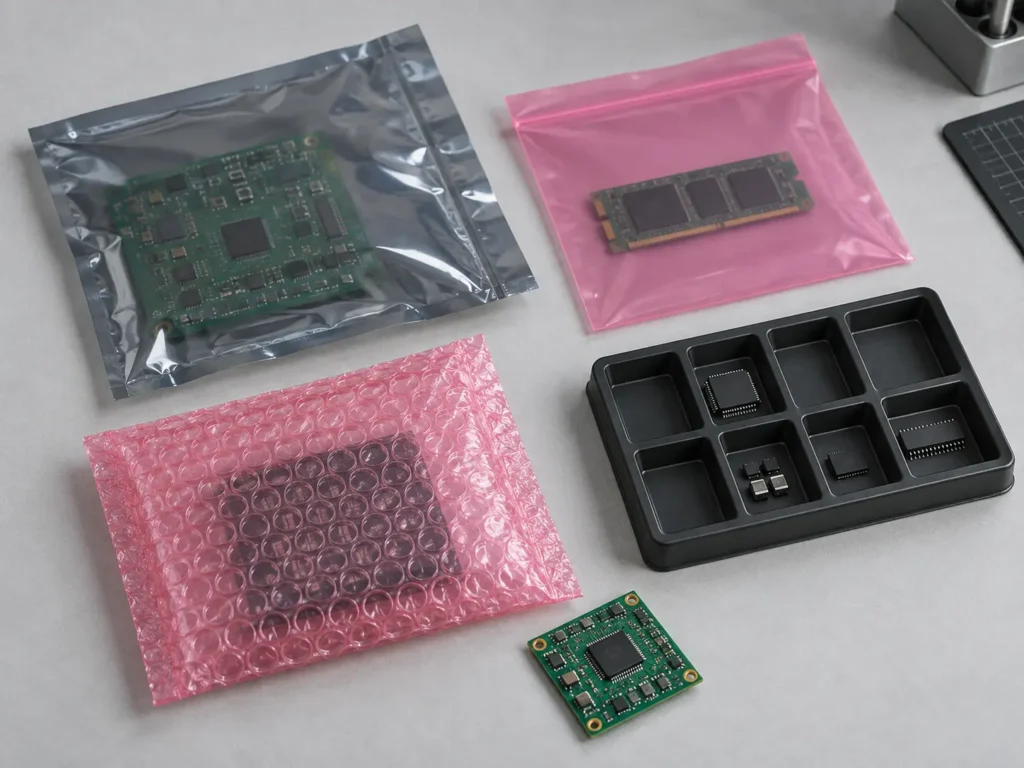
Metalized shielding bags are commonly used for circuit boards, electronic modules and static-sensitive components. Suitable structures can help reduce exposure to electrostatic discharge while also providing physical protection during handling and shipment.
Anti-Static Bags
Anti-static bags help reduce static generation caused by contact and movement. They may be suitable for components and materials that require basic static-control packaging rather than a complete shielding structure.
Anti-Static Bubble Bags
Anti-static bubble bags combine cushioning with static-control properties. They can help protect delicate components from impact, abrasion and static-related risks during internal handling and transportation.
ESD Trays and Cushioning
Conductive or anti-static trays, foam and cushioning materials can hold components in position and reduce movement inside outer packaging. Material and structure should be selected according to product geometry, weight and handling requirements.
How to Choose the Right ESD Packaging
The appropriate packaging depends on the component’s static sensitivity, handling process, required cushioning, storage conditions and transportation environment. The table below provides a practical starting point for comparing common options.
| Packaging Option | Primary Function | Typical Applications | Points to Confirm |
|---|---|---|---|
| ESD Shielding Bags | Helps shield static-sensitive contents from external electrostatic discharge. | Circuit boards, electronic modules, sensors and components. | Bag structure, dimensions, closure, shielding requirements and test documentation. |
| Anti-Static Bags | Helps reduce static generation during handling and movement. | Components requiring basic static-control packaging. | Material type, protection level, transparency, thickness and sealing method. |
| Anti-Static Bubble Bags | Combines static control with cushioning against impact and abrasion. | Delicate components, instruments and assembled electronic products. | Bubble size, bag dimensions, closure, cushioning level and static-control requirements. |
| ESD Trays and Cushioning | Holds components in position and reduces movement inside outer packaging. | Precision parts, component sets and products requiring organized handling. | Product dimensions, weight, cavity layout, material and handling process. |
| Moisture Barrier Bags | Adds moisture and environmental barrier protection when required. | Moisture-sensitive electronics, assemblies and precision components. | Barrier structure, WVTR requirements, desiccant, humidity indicator card and sealing process. |
Some projects require more than one protective function. For example, an ESD shielding bag may be combined with cushioning or placed inside a moisture barrier system. Final specifications should be confirmed according to the product and packing process.
Applications for ESD and Anti-Static Packaging
ESD packaging is used when electronic components, precision parts or assemblies may be affected by electrostatic discharge, movement, surface contact or environmental exposure during handling, storage and transportation.
1. Electronic Components
Packaging for circuit boards, semiconductors, connectors, sensors and other static-sensitive components during storage and shipment.
2. PCB Assemblies
Shielding bags, trays and cushioning options for assembled printed circuit boards and related modules.
3. Precision Components
Protective packaging for small precision parts that require controlled handling, organized placement or surface protection.
4. Industrial Electronics
Packaging options for electronic controls, modules, instruments and replacement parts moving through industrial supply chains.
5. Cleanroom Handling
Selected bag and tray options may be prepared for projects requiring controlled handling or clean packaging conditions. Cleanliness requirements and available documentation must be confirmed for each project.
6. Export and Long-Term Storage
ESD protection may be combined with moisture barrier packaging, desiccants, humidity indicator cards or outer cushioning when products face extended storage or international transportation.
Information Needed for an ESD Packaging Project
ESD packaging should be selected according to the product, packing process and required level of protection. Providing the following information helps us compare suitable options and prepare a more accurate quotation.
1. Product Information
Describe the component, assembly or instrument being packed, including its dimensions, weight and sensitivity to static or physical damage.
2. Required Protection
Confirm whether the project requires anti-static control, electrostatic shielding, cushioning, moisture protection or a combination of functions.
3. Bag or Packaging Format
Specify whether you need flat bags, resealable bags, bubble bags, trays, cushioning materials or another packaging format.
4. Size and Thickness
Provide the required internal or external dimensions, material thickness and any tolerance requirements. A product drawing or existing packaging sample can also be helpful.
5. Packing and Sealing Process
Explain whether the packaging will be heat sealed, zip closed, taped or placed inside an outer carton, and whether manual or automated packing is used.
6. Quantity and Destination
Provide the estimated order quantity, delivery country and any required supporting documents. Minimum order quantities depend on the selected product, dimensions and customization.
If the complete specification is not yet available, send us the product dimensions, application and required protection first. We can help organize the remaining questions before sampling.
Sampling, Documentation and Order Coordination
After the required packaging type and preliminary specifications have been identified, we can coordinate material confirmation, sample preparation and quotation with suitable production partners.
Available samples may include an existing-size sample for initial material review or a custom sample prepared according to the required dimensions and structure. Sample availability, preparation time and cost depend on the selected packaging type and level of customization.
Supporting information may include material specifications, dimensions, available test reports, inspection records or other documents supplied for the selected product. Required documents should be confirmed before ordering because their availability differs between materials and production partners.
Minimum order quantities are not fixed across the complete ESD packaging range. They depend on the bag or tray format, dimensions, material structure, printing, tooling and production process.
Our Project Coordination Process
1. Requirement Review
We review the product, application, dimensions, protection requirements and target quantity.
2. Packaging Option Comparison
Suitable bag, tray or cushioning options are compared according to the required functions.
3. Specification Confirmation
Material structure, size, thickness, closure, printing and available documentation are confirmed.
4. Sampling and Evaluation
Available or custom samples are coordinated for dimensional, material and packing evaluation.
5. Production and Delivery Follow-Up
After approval, we coordinate order details, production progress, inspection information and delivery arrangements.
ESD Packaging Standards and Project Requirements
ESD packaging requirements should be defined according to the sensitivity of the product, its location inside or outside an electrostatic protected area, the handling process and the customer’s ESD control program.
The EOS/ESD Association explains that packaging may require low-charging, conductive, dissipative or discharge-shielding properties depending on how and where static-sensitive items are handled.
For each project, required standards, test methods, performance limits and supporting documents should be confirmed before sampling or production. Jinhong Packaging does not assume that every anti-static or shielding material meets the same specification.
How We Support ESD Packaging Projects
Specification Review
We organize the product, packaging and handling requirements before comparing suitable materials and formats.
Supplier and Material Coordination
We coordinate with selected manufacturing partners to compare suitable bag structures, trays, cushioning materials and available supporting information.
Sampling and Confirmation
Existing or custom samples can be arranged according to the selected packaging type. Dimensions, closure, material and required protective functions should be confirmed before production.
Production and Delivery Follow-Up
After specifications are approved, we follow the project schedule, production status, packaging details and delivery requirements.
Related ESD Packaging Guides
Learn more about anti-static, static-dissipative, shielding and moisture-control options in our guide to ESD bag types, materials and applications and our article on packaging for moisture-sensitive electronic components.
ESD Packaging FAQ
1. What is the difference between anti-static bags and ESD shielding bags?
Anti-static bags are generally used to help reduce static generation during handling, while ESD shielding bags are designed to provide additional protection for static-sensitive contents from electrostatic discharge. The appropriate option depends on the component and required protection level.
2. Which products commonly require ESD packaging?
ESD packaging is commonly considered for circuit boards, electronic components, sensors, modules, precision assemblies and other products that may be damaged by static electricity during handling, storage or transportation.
3. Can ESD packaging also provide moisture protection?
Some packaging systems can combine static-control and moisture-barrier functions, but these properties should not be assumed from appearance alone. The required structure, barrier performance, desiccant, humidity indicator card and sealing process should be confirmed for the project.
4. Can ESD bags be customized?
Depending on the selected material and production process, ESD bags may be developed in different dimensions, thicknesses, closures and printing configurations. Custom requirements should be reviewed before sampling and quotation.
5. What information is needed for a quotation?
Please provide the product type, dimensions, weight, required protection, preferred packaging format, bag size or drawing, quantity and delivery country. Existing packaging specifications or samples are also helpful when available.
6. Are samples and test documents available?
Existing or custom samples may be coordinated depending on the packaging type and specification. Available material information, test reports and inspection documents vary by product and production partner, so required documentation should be confirmed before ordering.
Explore our complete Protective and Clean Packaging Solutions for moisture barrier, ESD, cleanroom and medical clean non-sterile packaging options.
Discuss Your ESD Packaging Requirements
Send us your product dimensions, required protective functions, preferred packaging format, estimated quantity and delivery country. If your specification is incomplete, we can help organize the key questions before comparing suitable options.
MOQ, sample availability, lead time and supporting documents depend on the selected product, material structure and customization requirements.