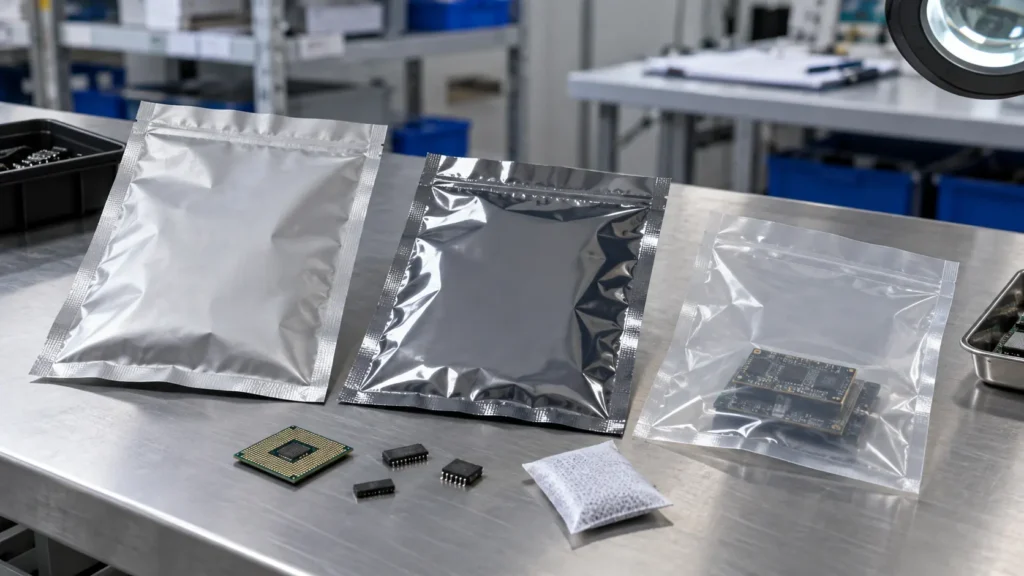
Moisture barrier bag materials should be selected according to the product’s moisture sensitivity, required storage period, transportation environment, sealing method and physical protection requirements. Choosing the thickest film or the structure with the most layers does not automatically provide the best protection.
For many projects, the most useful starting point is to define the required protection before comparing aluminum foil laminates, metallized films, nylon-PE structures or other barrier materials.
This guide explains the main material options, the performance information buyers should request and the practical questions that should be confirmed before sampling.
Quick Answer: Which Moisture Barrier Bag Material Should You Choose?
Aluminum foil laminates are often considered when a very high moisture and light barrier is required. Metallized films may provide a more economical balance of barrier performance, appearance and flexibility. Nylon-PE structures offer good toughness and puncture resistance but normally provide less moisture protection than foil-based structures. Standard polyethylene bags are suitable for basic dust and handling protection but should not automatically be treated as high-barrier packaging.
There is no single structure that is best for every product. Material selection should be based on the required water vapor transmission rate, storage conditions, package format, sealing process and physical demands of the application.
For an overview of available structures and formats, explore our Moisture Barrier and Aluminum Foil Bags.
What Makes a Bag a Moisture Barrier Bag?
A moisture barrier bag is designed to slow the movement of water vapor from the surrounding environment into the package. Its performance depends on the complete packaging system rather than the name of a single material.
Important factors include:
- The barrier layer used in the laminate
- The thickness and quality of each material layer
- The condition of the film after folding and handling
- Puncture and flex-crack resistance
- Sealant compatibility and sealing conditions
- Side-seal and bottom-seal integrity
- Closure design
- Bag size and total exposed surface area
- Storage temperature and relative humidity
A high-barrier film can still perform poorly if the package has weak seals, pinholes, damaged folds or an unsuitable closure. This is why film data should be considered together with the finished bag structure and intended packaging process.
Understand WVTR Before Comparing Materials
Water Vapor Transmission Rate, usually abbreviated as WVTR, indicates how much water vapor passes through a material under specified test conditions. A lower WVTR generally indicates better resistance to moisture transmission.
However, a WVTR number should never be compared without checking the test conditions. Temperature, relative humidity, test method, sample thickness and material construction can all affect the reported result.
When reviewing supplier data, ask for:
- The reported WVTR value
- The testing method
- Temperature and relative humidity conditions
- Film or laminate thickness
- Whether the result applies to the film or the finished bag
- The date and source of the test report
ASTM F1249 is one recognized method for determining water vapor transmission through flexible barrier materials using a modulated infrared sensor. The buyer and supplier should still agree on the relevant test conditions, sampling method and acceptance criteria for the specific project.
WVTR is an important comparison point, but it should not be the only selection criterion. A material with an excellent laboratory barrier value may not be suitable if it tears, cracks or cannot be sealed reliably during actual use.
Common Moisture Barrier Bag Materials
1. Aluminum Foil Laminates
Aluminum foil laminates are commonly selected for products that require a very high barrier against moisture, oxygen and light.
A typical structure combines an outer protective layer, an aluminum foil barrier layer and an inner heat-seal layer. The exact structure may vary according to the required strength, sealing method, product contact requirements and handling conditions.
Possible advantages include:
- Very strong moisture barrier
- Strong oxygen and light barrier
- Opaque appearance
- Compatibility with heat-sealed packaging
- Suitability for long-term storage applications when properly specified
Points to confirm include:
- Foil thickness
- Laminate construction
- Flex-crack resistance
- Puncture resistance
- Sealant material
- Heat-sealing range
- Whether vacuum packing is required
- Finished bag integrity
Foil laminates can provide excellent barrier performance, but repeated bending, sharp product edges or rough handling may create cracks or pinholes. Heavier or irregularly shaped components may therefore require additional puncture-resistant layers, protective wrapping or a different bag construction.
2. Metallized Film Laminates
Metallized films use a thin deposited metal layer, commonly applied to a polymer film. They are different from solid aluminum foil laminates.
Metallized structures may be considered when a project requires improved moisture and light protection but does not need the highest barrier level associated with a suitable foil laminate.
Possible advantages include:
- Lower weight than many foil laminates
- Flexible handling
- Metallic appearance
- Moderate to high barrier options
- Potential cost advantages for suitable applications
Points to confirm include:
- Actual WVTR and oxygen barrier data
- Metal-layer consistency
- Flexibility and durability
- Sealant compatibility
- Required storage period
- Whether full light blocking is necessary
Metallized film should not automatically be described as equivalent to aluminum foil. The actual barrier difference depends on the complete structure, material quality, coating consistency and test conditions.
3. Nylon-PE Laminates
Nylon-PE laminates combine the toughness and puncture resistance of nylon with the sealing properties of polyethylene.
These structures may be suitable for products that need strong physical protection, vacuum packaging or resistance to puncture during handling. They can also provide a better barrier than a basic single-layer polyethylene bag, depending on the exact construction.
Possible advantages include:
- Good puncture resistance
- Good mechanical strength
- Flexible handling
- Heat-sealing capability
- Suitability for some vacuum-packaging applications
However, nylon-PE should not automatically be treated as a substitute for an aluminum foil moisture barrier bag. If long-term moisture protection is important, obtain the actual WVTR data and compare it with the project requirement.
4. Transparent High-Barrier Laminates
Some projects require the packaged product to remain visible. Transparent high-barrier laminates may use coated films, high-barrier polymers or multilayer constructions.
These materials may provide a useful balance of visibility, moisture protection and product presentation. Performance varies considerably between structures, so the material name alone is not enough to confirm suitability.
Buyers should request:
- Complete material construction
- WVTR and oxygen transmission data
- Test conditions
- Sealant information
- Clarity requirements
- Flex and puncture performance
- Compatibility with the packed product
Transparent structures are useful when inspection or product identification is important, but the required barrier level must be confirmed through data rather than visual appearance.
5. Polyethylene Bags
Standard polyethylene bags are widely used for dust protection, handling, liners and general industrial packaging.
They may be appropriate when:
- The product has low moisture sensitivity
- Storage periods are short
- Environmental conditions are controlled
- Basic cleanliness or dust protection is the main requirement
- The bag will be used as an inner liner or secondary layer
Polyethylene thickness can improve mechanical strength, but increasing thickness does not automatically turn a standard poly bag into a high-barrier package. Material type, structure, sealing and verified transmission data remain important.
Material Thickness Is Not the Same as Barrier Performance
A common purchasing mistake is to compare bags only by total thickness.
A thicker bag may provide better strength or puncture resistance, but moisture barrier performance depends heavily on the type of barrier layer. A relatively thin foil laminate may provide a stronger moisture barrier than a much thicker standard polyethylene bag.
When comparing quotations, request both:
- Total material thickness
- Complete layer structure
For example, two bags with the same total thickness may contain completely different barrier layers, sealants and outer protective films. Their moisture protection, mechanical strength and sealing performance may therefore be very different.
Match the Material to the Product
Moisture-Sensitive Electronic Components
Electronic components may require both moisture protection and electrostatic discharge control. A standard foil bag or general moisture barrier bag is not automatically an ESD shielding bag.
Confirm whether the project needs:
- Moisture barrier performance
- Static shielding
- Surface resistance or electrical performance
- Desiccant
- Humidity indicator cards
- Vacuum or controlled air removal
- Lot identification
- Specific handling or dry-packing procedures
If both moisture and ESD protection are required, review our ESD Packaging and Anti-Static Bags.
Precision Metal and Industrial Components
Metal parts, precision components, bearings, tools and machined products may require protection from humidity, corrosion, dust and handling damage.
Material selection may depend on:
- Product weight
- Sharp edges
- Surface finish
- Corrosion sensitivity
- Storage period
- Export transportation conditions
- Whether a desiccant or corrosion-control method will be used
For heavy or sharp parts, puncture resistance may be as important as the laboratory WVTR value.
Medical Devices and Components
Medical components may need clean, non-sterile protection before assembly, sterilization or final packaging. Moisture barrier requirements should be defined separately from cleanliness and sterility requirements.
A moisture barrier bag should not be described as sterile simply because it provides environmental protection. The required packaging environment, material documentation, cleanliness controls and intended stage of use must be confirmed for each project.
For this application, see our Medical Clean Non-Sterile Packaging options.
Cleanroom and Controlled-Environment Applications
Packaging used in a cleanroom or controlled environment may require additional consideration of particle generation, cleanliness, double-bagging procedures and processing conditions.
A material with good moisture barrier performance is not automatically suitable for cleanroom use. The production environment, cleanliness requirements, packaging process and supporting documentation should be reviewed separately.
Learn more about Cleanroom Packaging Bags for controlled-environment applications.
Do Desiccants Replace a Moisture Barrier?
No. Desiccants and moisture barrier bags perform different functions.
The bag limits the rate at which external moisture enters the package. The desiccant absorbs a defined amount of moisture inside the sealed package. A humidity indicator card may help show humidity exposure, but it does not remove moisture.
The complete system may include:
- A suitable moisture barrier bag
- A compatible heat seal
- The correct quantity and type of desiccant
- A humidity indicator card
- Appropriate internal air volume
- Controlled packing conditions
- Defined storage and handling procedures
Desiccant quantity should not be guessed solely from bag dimensions. Product moisture, internal air volume, storage duration, expected climate and the barrier performance of the package may all affect the requirement.
Heat Sealing and Closure Selection
The closure is often the weakest part of a moisture-protection system.
A zipper can provide convenient access, but a zipper closure alone should not automatically be treated as equivalent to a validated heat seal. For applications requiring stronger moisture protection, the package may need to be heat-sealed above the zipper or supplied as an open-top heat-seal bag.
Important sealing details include:
- Sealant-layer material
- Sealing temperature range
- Dwell time
- Pressure
- Seal width
- Bag opening design
- Product or powder contamination in the seal area
- Equipment compatibility
- Seal inspection method
Sampling should include the customer’s intended sealing equipment whenever possible. A laminate that performs well on one machine may need different settings on another.
Seven Questions to Answer Before Choosing a Material
Before requesting a quotation, confirm the following information.
1. What product will be packed?
Provide the product name, dimensions, weight, shape, surface condition and any sharp edges.
2. How sensitive is the product to moisture?
Share any internal specification, allowable humidity level, shelf-life requirement or target WVTR.
3. How long will the product be stored?
Clarify whether the packaging is intended for short-term handling, export transportation or long-term storage.
4. What conditions will the package experience?
Include the expected temperature, humidity, transportation method and destination.
5. Is any additional protection required?
Confirm requirements for oxygen barrier, light blocking, ESD shielding, puncture resistance, cleanliness or vacuum packaging.
6. How will the bag be closed?
Specify heat sealing, zipper plus heat sealing, vacuum sealing or another closure method.
7. What documents or testing are required?
Identify required material data, WVTR reports, declarations, inspection records or customer-specific documentation before sampling.
How to Compare Supplier Proposals
Do not compare quotations only by price, thickness or a general material name.
A useful comparison should include:
- Complete laminate structure
- Individual or total thickness
- WVTR and test conditions
- Bag dimensions and tolerances
- Sealant layer
- Sealing recommendations
- Puncture and handling requirements
- Printing or labeling requirements
- Desiccant and humidity indicator options
- Sample availability
- Required documentation
- Order quantity and delivery destination
If two suppliers use different test conditions, their WVTR figures may not be directly comparable. Ask for clarification before choosing the apparently lower number.
Sampling and Packaging Evaluation
A sample review should consider more than the appearance of the bag.
Check:
- Product fit
- Ease of loading
- Seal quality
- Puncture risk
- Fold and flex areas
- Closure position
- Vacuum response, if applicable
- Label placement
- Handling during packing
- Outer-carton protection
- Expected transportation conditions
For sensitive or high-value products, performance testing may also be required according to the buyer’s specification and risk assessment.
Jinhong Packaging supports material comparison, bag specifications, custom sizing, sampling and project coordination through selected manufacturing partners. Material availability, test data and documentation are confirmed according to the selected structure and project requirements.
For a broader view of moisture, ESD, cleanroom and medical clean packaging, explore our Protective and Clean Packaging Solutions.
Frequently Asked Questions
What is the best material for a moisture barrier bag?
There is no single best material for every application. Aluminum foil laminates are often considered for very high moisture and light barrier requirements, while metallized films, nylon-PE and transparent high-barrier structures may be suitable for projects with different cost, visibility, durability or handling priorities.
Is metallized film the same as aluminum foil?
No. Metallized film normally has a thin deposited metal layer on a polymer substrate, while an aluminum foil laminate contains a continuous foil layer. Their barrier performance, durability and cost can differ significantly.
Does a thicker bag always provide a better moisture barrier?
No. Thickness mainly affects strength and handling, while barrier performance also depends on the material type and layer construction. Always compare the complete structure and verified WVTR data.
Can a zipper bag provide long-term moisture protection?
A zipper can improve convenience and reclosability, but it should not automatically be treated as equivalent to a complete heat seal. Projects requiring stronger moisture protection may need heat sealing above the zipper.
What information is needed for a moisture barrier bag quotation?
Provide the product description, dimensions, weight, moisture sensitivity, required storage period, expected environment, preferred bag size, sealing method, additional protection requirements, estimated quantity and delivery destination.
Start Your Moisture Barrier Packaging Project
Choosing a moisture barrier material requires balancing barrier performance, strength, sealing, handling, documentation and cost.
Tell us what product you need to protect, its size and weight, the expected storage conditions, required protection level, sealing method, estimated quantity and destination. We can help compare suitable material options, coordinate specifications and samples, and follow the project through the selected supply arrangement.