
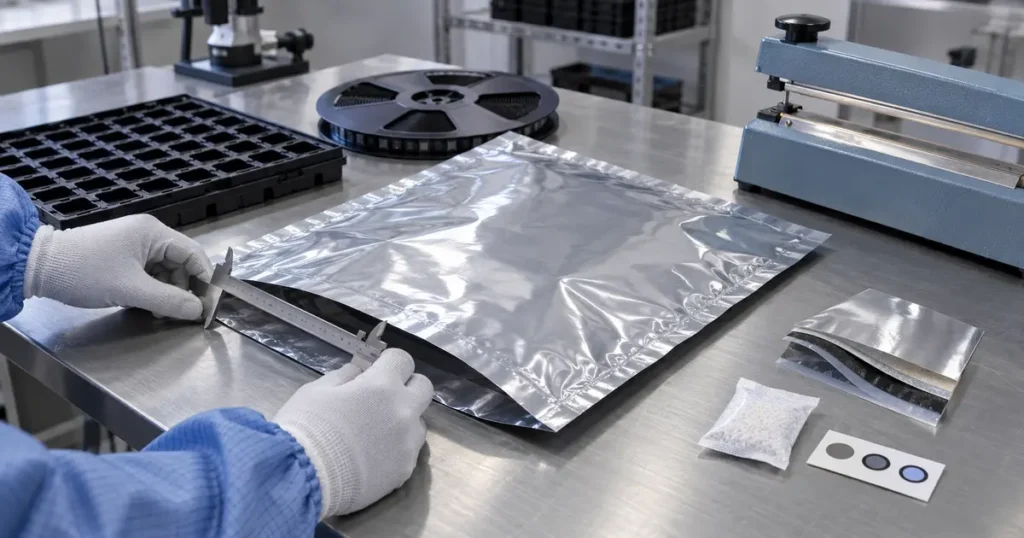
A moisture barrier bag specification should define measurable requirements rather than rely on descriptions such as “silver bag,” “foil pouch,” “anti-static bag” or “heavy-duty packaging.”
Bags with a similar appearance can have different material structures, barrier performance, ESD properties, sealing conditions and mechanical strength. If the purchasing specification is incomplete, quotations from different suppliers may not be directly comparable.
A clear specification also reduces problems during sampling, production, inspection and packing. It helps the buyer and packaging supplier confirm what is required before dimensions, materials, accessories, testing and commercial conditions are finalized.
This guide explains seven essential details buyers should confirm when preparing a moisture barrier bag specification.
Send your product size, moisture and ESD risks, required documents, order quantity and destination for material comparison and sample coordination.
Quick Answer: What Should a Moisture Barrier Bag Specification Include?
A practical moisture barrier bag specification should identify:
- The product or component being packed
- Bag style and usable dimensions
- Complete material structure
- Required moisture-barrier performance
- ESD properties, if applicable
- Mechanical and sealing requirements
- Desiccant and humidity indicator requirements
- Printing and labeling
- Testing and documentation
- Packing quantity and destination
The required level of detail depends on the application. Packaging for moisture-sensitive semiconductors, metal parts, optical products, precision instruments and general industrial equipment may require different materials and performance criteria.
The buyer should provide the product risks and acceptance requirements. The packaging supplier can then support material comparison, sample preparation and specification coordination.
For available structures and bag formats, visit our Moisture Barrier and Aluminum Foil Bags page.
Why Is a Written Specification Important?
A written specification creates a common reference for purchasing, engineering, quality control, the packaging supplier and the packing team.
Without a clear document, different parties may interpret the same request differently.
For example, the term “foil bag” does not explain:
- Whether the laminate contains real aluminum foil or metallized film
- The thickness of each material layer
- The required Water Vapor Transmission Rate
- Whether electrostatic shielding is needed
- Which side of the bag must be heat sealable
- Whether vacuum packing will be used
- How much weight the bag must carry
- Whether a humidity indicator card and desiccant are required
- Which tests and documents must be supplied
An incomplete specification can lead to quotations based on different structures. The lowest quoted price may therefore represent a different level of performance rather than a genuinely lower price for the same packaging.
The specification does not need to be unnecessarily complicated. It should include the information needed to select, produce and inspect the package consistently.
Detail 1: Product, Application and Risk Information
The moisture barrier bag specification should begin with the item being packed and the risks the package must control.
Provide:
- Product or component name
- Part number, where applicable
- Product dimensions
- Quantity per bag
- Individual and total packed weight
- Product or carrier material
- Sharp corners, edges or protrusions
- Moisture sensitivity
- Electrostatic sensitivity
- Oxidation or corrosion risk
- Cleanliness requirements
- Sensitivity to light or oxygen
- Expected storage period
- Transportation method
- Packing and opening environment
- Applicable customer or industry requirements
Photographs, technical drawings or actual samples can help the packaging supplier understand the shape and loading method.
If the product is packed in trays, reels, tubes or other carriers, provide the loaded carrier dimensions rather than only the dimensions of an individual component.
The supplier should also know whether the package will be used for:
- Domestic transportation
- Export shipping
- Long-term warehouse storage
- Dry packing
- Cleanroom transfer
- Production handling
- Service-parts inventory
- Repeated opening and resealing
The same component may require different packaging configurations at different stages of its supply chain.
For electronic components, moisture protection should not automatically be treated as the only requirement. If the component is sensitive to electrostatic discharge, the specification should define the required ESD function separately.
Detail 2: Bag Style, Dimensions and Loading Direction
A bag dimension is incomplete unless the measurement method and bag style are clear.
Possible formats include:
- Flat bags
- Gusseted bags
- Three-side-seal bags
- Center-seal bags
- Open-top bags
- Preformed pouches
- Tubing
- Custom covers or liners
Confirm whether the dimensions are:
- Internal usable dimensions
- External finished dimensions
- Width × length
- Width × gusset × length
- Measured before or after sealing
- Measured with or without the closure area
The specification should also identify:
- Opening direction
- Loading direction
- Required headspace
- Heat-seal position
- Minimum seal width
- Distance between the product and seal
- Tear notch, if required
- Rounded or square corners
- Required number of seal bands
- Required area for labels or printing
An undersized bag can create loading difficulty, tight folds, seal wrinkles and puncture risk. It may also leave insufficient space for desiccant or a humidity indicator card.
An oversized bag increases the amount of material, internal air volume and exposed barrier-film area. It can also allow the product or carrier to move during handling.
If vacuum or controlled air removal is planned, the bag must accommodate the final compressed configuration without placing excessive stress on the laminate.
Samples should be evaluated with the actual product or loaded carrier before final dimensions are approved.
Detail 3: Complete Laminate Structure
The specification should identify the complete material structure instead of using only a general product name.
Possible structures may include:
- Aluminum foil laminates
- Metallized film laminates
- Moisture barrier shielding films
- Nylon-reinforced barrier structures
- Transparent high-barrier laminates
- Other multilayer flexible materials
A laminate may contain:
- An outer protective layer
- A printed layer
- A reinforcing layer
- A barrier layer
- An ESD functional layer or coating
- An inner heat-seal layer
The specification may state the material and thickness of each layer, such as micrometres or another agreed unit.
The sealant layer is particularly important because it affects:
- Sealing temperature
- Seal initiation
- Dwell time
- Seal strength
- Contamination tolerance
- Compatibility with the packing equipment
- Resistance to the product or internal accessories
The buyer should confirm whether the material must be:
- Opaque
- Transparent
- Printed
- Unprinted
- Low charging
- Static dissipative
- Conductive
- Electrostatic shielding
- Puncture resistant
- Suitable for vacuum packing
- Suitable for a controlled environment
Two silver bags should not be assumed to have the same structure. Aluminum foil and metallized film are different barrier materials and may provide different moisture, oxygen, light, flexibility and cost characteristics.
Read Aluminum Foil Bags vs Metallized Bags for a direct comparison.
For a broader explanation of laminate options, see How to Choose Moisture Barrier Bag Materials.
Detail 4: Barrier and ESD Performance Requirements
Material composition alone does not fully define package performance.
A moisture barrier bag specification may include a target Water Vapor Transmission Rate, commonly abbreviated as WVTR.
WVTR indicates how much water vapor passes through a material under specified test conditions. When reviewing a WVTR value, confirm:
- Test method
- Temperature
- Relative humidity
- Reporting units
- Material thickness
- Sample conditioning
- Test direction, if relevant
- Whether the result applies to flat film or a finished package
- Test report date
- Acceptance limit
Values produced under different test conditions should not be compared directly.
ASTM F1249 is one recognized test method for measuring water-vapor transmission through plastic film and sheeting using a modulated infrared sensor. The ASTM International ASTM F1249-25 standard lists F1249 among the standards covering flexible barrier materials.
Depending on the application, the buyer may also specify:
- Oxygen Transmission Rate
- Light barrier
- Odor or vapor barrier
- Resistance to oils or chemicals
- Seal integrity
- Package leak requirements
Where ESD protection is required, identify the necessary function rather than requesting only an “anti-static bag.”
Possible requirements include:
- Low-charging properties
- Static-dissipative properties
- Conductive properties
- Electrostatic discharge shielding
- Combined moisture and ESD protection
ANSI/ESD S541 defines packaging properties for ESD-sensitive items during production, transportation and storage. The applicable test methods, property limits and customer requirements should be confirmed for each project.
For more information, read ESD Packaging Standards: 7 Essential Compliance Checks.
A moisture barrier bag should not be described as ESD protective unless the required electrical performance has been defined and supported.
Detail 5: Mechanical Strength and Seal Requirements
Barrier data from flat film does not describe every risk encountered by a finished bag.
The package may also need to withstand:
- Puncture
- Tearing
- Flexing
- Abrasion
- Product weight
- Vacuum pressure
- Compression
- Vibration
- Handling during loading
- Carton and pallet transportation
Important mechanical requirements may include:
- Total laminate thickness
- Tensile strength
- Tear resistance
- Puncture resistance
- Flex durability
- Lamination bond strength
- Drop or handling performance
- Maximum packed weight
- Required safety margin
The appropriate tests depend on the product and approved specification. Not every project requires every test.
Seal requirements may include:
- Sealing temperature range
- Dwell time
- Pressure
- Seal width
- Seal strength
- Number of seal bands
- Seal appearance
- Leak-test method
- Acceptance criteria
- Cooling time before handling
The packaging supplier should provide starting sealing conditions where available, but the final settings must be verified on the buyer’s actual equipment.
A strong laminate can still fail if:
- The sealing jaws are not aligned
- The seal area contains dust, oil or desiccant material
- The bag has wrinkles or folds
- The selected temperature is too low
- Excessive heat damages the sealant or laminate
- The seal is too narrow
- The product interferes with the sealing area
- The package is handled before the seal has stabilized
Filled-package evaluation is more useful than inspecting an empty bag alone.
Sharp reels, trays, tube ends and metal parts may require corner protection, cushioning, sleeves or a stronger laminate. Mechanical protection should be coordinated with the outer carton and the complete distribution system.
Detail 6: Desiccants, Humidity Indicator Cards and Packing Procedure
If the package is intended for dry storage, the specification should explain how moisture-control accessories will be used.
For desiccants, confirm:
- Desiccant type
- Unit definition
- Quantity per bag
- Packet dimensions
- Packet material
- Dust requirements
- Placement inside the package
- Storage before use
- Exposure-time controls
- Required test reports or declarations
The required quantity depends on the bag size, internal volume, barrier performance, enclosed materials, storage duration, temperature, humidity and applicable packing method.
It should not be selected only by copying the number of packets used for another product.
For humidity indicator cards, confirm:
- Required humidity indication levels
- Cobalt-containing or cobalt-free requirement
- Card dimensions
- Printing and language
- Storage requirements
- Shelf life
- Placement inside the bag
- Inspection method
- Acceptance and rejection criteria
A humidity indicator card indicates humidity exposure at its location. It does not remove moisture and should not be treated as a replacement for desiccant.
The packing procedure may also specify:
- Maximum time allowed between accessory exposure and sealing
- Packing-room temperature and humidity
- Product condition before packing
- Loading sequence
- Accessory position
- Air-removal or vacuum procedure
- Heat-sealing settings
- Seal inspection
- Label application
- Outer packing
- Opening and resealing instructions
The complete system should be tested with the actual bag, product, carrier, desiccant and humidity indicator card.
For further guidance, read Desiccants and Humidity Indicator Cards for Moisture Barrier Packaging.
Detail 7: Printing, Inspection and Documentation
Printing and labels should be included in the specification before the final quotation.
Possible printing requirements include:
- Product or customer name
- Part number
- Bag size
- Lot number
- Packing date
- Quantity
- ESD warning
- Moisture warning
- Opening instructions
- Resealing instructions
- Storage conditions
- Barcode or QR code
- Recycling or disposal information
- Language requirements
- Customer-approved artwork
The buyer should provide approved wording and artwork. The packaging supplier should not create technical classifications, exposure limits or handling statements without approved information.
Confirm:
- Printing method
- Number of colors
- Print position
- Print direction
- Ink color
- Repeat distance
- Surface or reverse printing
- Required print resistance
- Variable-data requirements
- Artwork file format
- Approval method
Inspection requirements may cover:
- Bag dimensions and tolerances
- Material structure
- Total thickness
- Appearance
- Printing position and color
- Seal dimensions
- Seal strength
- Barrier performance
- ESD properties
- Cleanliness
- Quantity
- Packing and carton labeling
Documents that buyers may request include:
- Material specification
- Layer structure and thickness
- WVTR test report
- ESD performance report
- Seal-strength data
- Dimensional inspection report
- Certificate of Analysis
- Restricted-substance declaration
- Lot traceability
- Desiccant specification
- Humidity indicator card specification
- Packing instructions
- Change-notification agreement
Not every document is automatically available for every structure or order. Required reports, standards, test methods, acceptance limits and document language should be confirmed before sample approval and quotation.
How to Compare Moisture Barrier Bag Quotations
To compare quotations fairly, give each supplier the same specification.
Check whether every quotation is based on the same:
- Bag dimensions
- Measurement method
- Material structure
- Layer thicknesses
- Total thickness
- Barrier requirement
- ESD requirement
- Printing
- Seal configuration
- Accessories
- Testing
- Documentation
- Packing quantity
- Delivery term
- Destination
- Order quantity
If one quotation is substantially lower, check whether it excludes a barrier layer, ESD performance, printing, accessories, testing or special packing.
A quotation should also clarify whether prices include:
- Tooling or printing setup
- Printing plates
- Sample charges
- Desiccants and indicator cards
- Individual or bulk packing
- Inspection documents
- Cartons and palletization
- Domestic transportation
- Export delivery terms
Price comparison is meaningful only after the technical and commercial scope has been aligned.
Sample Approval Checklist
Before approving a production sample, evaluate the filled package rather than only the flat bag.
Confirm:
- Correct material appearance
- Bag dimensions
- Usable internal space
- Loading direction
- Product or carrier fit
- Headspace
- Seal position
- Seal width
- Seal appearance
- Required accessory placement
- Humidity indicator visibility
- Vacuum or air-removal behavior
- Puncture risk
- Flexing around corners
- Label position
- Printing accuracy
- Outer-carton fit
- Opening procedure
- Resealing space
- Required test results
The approved sample, final drawing, material specification and artwork should refer to the same revision.
If the material, dimensions, printing or packing procedure changes after approval, the effect on package performance should be reviewed before production.
Common Specification Mistakes
Requesting Only a “Foil Bag”
This does not define the laminate, thickness, barrier performance, ESD properties or sealant layer.
Request the complete structure and measurable requirements.
Providing Product Dimensions Without the Carrier
Trays, reels and tubes may determine the actual bag size and puncture risk.
Provide loaded dimensions and weight.
Comparing WVTR Values Without Test Conditions
WVTR results obtained at different temperatures, relative humidity levels or test methods may not be comparable.
Review the complete report.
Treating Anti-Static and Shielding as the Same
Low charging, static dissipation, conductivity and discharge shielding are different properties.
Specify the required ESD function.
Ignoring the Packing Equipment
A material may require different sealing conditions from the buyer’s existing bag.
Test samples on the intended equipment.
Leaving Accessories Outside the Quotation
Desiccants, humidity indicator cards, labels and special outer packing can affect both cost and package design.
Include them in the request.
Asking the Packaging Supplier to Determine Component Limits
Moisture Sensitivity Level, floor life, baking conditions and other device-handling limits should come from the component manufacturer or the buyer’s approved technical specification.
Approving Appearance Without Testing the Filled Package
An empty bag may look acceptable but develop punctures, tight folds or seal problems after loading and vacuum packing.
Evaluate the complete configuration.
Information to Send With a Quotation Request
A useful quotation request should include:
Product Information
- Product name and application
- Dimensions and weight
- Quantity per bag
- Photographs or drawings
- Moisture, ESD and mechanical risks
- Carrier type and loaded dimensions
Bag Information
- Bag style
- Required dimensions
- Opening direction
- Preferred material structure
- Required barrier and ESD performance
- Total thickness
- Seal requirements
- Printing and labeling
Packing Information
- Desiccant and humidity indicator requirements
- Vacuum or air-removal process
- Packing environment
- Outer packaging
- Storage and transportation conditions
- Opening and resealing procedure
Commercial Information
- Sample quantity
- Estimated order quantity
- Annual usage, if known
- Delivery destination
- Required delivery term
- Required documents
- Target schedule
If some technical details have not yet been established, clearly identify which points require supplier recommendations and which requirements are fixed.
Jinhong Packaging supports moisture barrier bag material comparison, size confirmation, accessory coordination, sampling, documentation follow-up and production coordination through selected production partners.
Final materials, performance requirements, testing, documentation, quantities and commercial terms are confirmed according to the individual project.
For packaging used in extended inventory programs, also read Long-Term Storage Packaging for Electronic Components.
Frequently Asked Questions
What information is required to quote a moisture barrier bag?
Provide the product and carrier dimensions, packed weight, bag style, required size, material or barrier target, ESD requirements, printing, accessories, order quantity and destination. Photographs or drawings are also helpful.
Is the total bag thickness enough to define the material?
No. Two laminates with the same total thickness may use different barrier, reinforcement and sealant layers. The complete material structure and required performance should be confirmed.
Should WVTR be included in the specification?
It should be included when moisture-barrier performance is important and the buyer has an approved target. The test method, temperature, humidity, units and acceptance limit should accompany the value.
Is every moisture barrier bag also ESD protective?
No. Moisture-barrier and electrostatic properties are separate functions. Required low-charging, dissipative, conductive or shielding performance should be specified and verified.
Should desiccant quantity be written into the specification?
Yes, when desiccant is part of the approved packaging system. The type, unit, quantity, packet material, placement and storage procedure should be defined.
Can the supplier choose the final heat-sealing settings?
The supplier may provide recommended starting conditions, but the buyer should verify and approve the settings on the intended equipment using the actual filled package.
Which documents should be requested before ordering?
The answer depends on the project. Common requests include a material specification, layer structure, barrier and ESD data, dimensional inspection, seal information, accessory specifications, traceability and applicable declarations.