
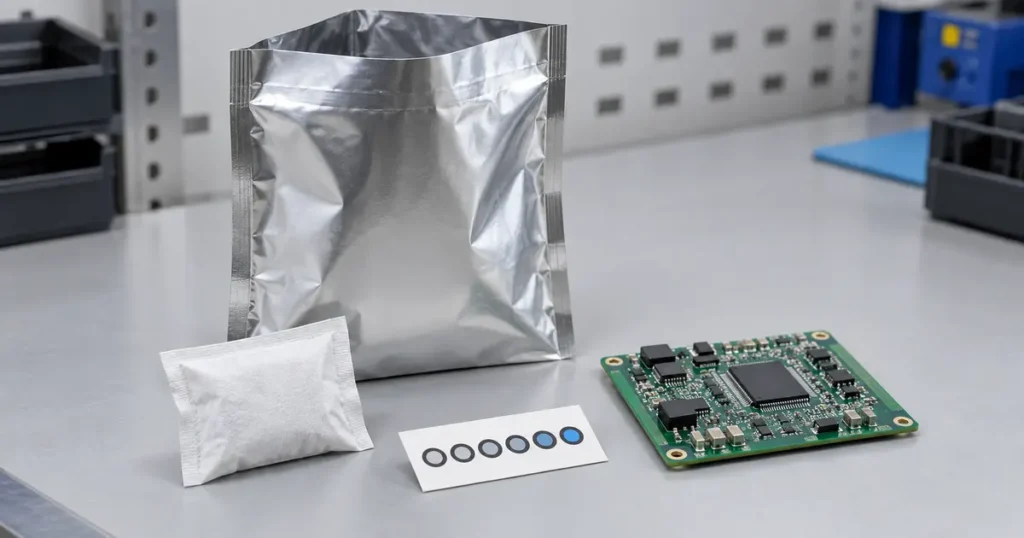
Moisture-sensitive products often require more than a barrier bag alone. A complete dry-pack system may combine a moisture barrier bag, a suitable desiccant, a humidity indicator card and a controlled sealing process.
Each component has a different function. The barrier bag limits moisture entering the package, the desiccant absorbs moisture inside the sealed space, and the humidity indicator card provides a visual indication of the relative humidity conditions inside the package.
However, these components should not be selected separately or treated as interchangeable. Their suitability depends on the product, package size, barrier performance, initial moisture, required storage period and applicable customer or industry requirements.
Quick Answer: How Do Desiccants and Humidity Indicator Cards Work Together?
Desiccants and humidity indicator cards are commonly placed inside sealed moisture barrier packaging to support humidity control and monitoring.
The desiccant helps absorb moisture contained in the enclosed air, packaging materials or product environment. The humidity indicator card changes colour at specified relative humidity levels, allowing the user to check whether the internal environment may have exceeded the indicated conditions.
A humidity indicator card does not remove moisture, and a desiccant does not show the humidity level by itself. They perform different functions and may be used together when the packaging specification requires both moisture control and a visible humidity indication.
The complete packaging system should be reviewed according to the product sensitivity, material barrier properties, sealing method, storage conditions and required documentation.
Why a Moisture Barrier Bag May Not Be Enough
A moisture barrier bag is designed to reduce the rate at which water vapour passes through the packaging material. It does not automatically remove moisture already present inside the package.
Moisture may enter the sealed environment from several sources:
- Humidity in the air trapped during packing
- Moisture contained in internal packaging materials
- Moisture absorbed by the product before packing
- Water vapour entering gradually through the packaging material
- Small seal defects, punctures or damage during handling
- Repeated opening and closing of the package
For moisture-sensitive electronic components, precision parts, optical products, instruments and other technical products, the packaging system may therefore need to control both the initial internal moisture and the moisture that could enter during storage.
The required approach depends on the actual product and its acceptable exposure conditions. A high-barrier package may reduce moisture transmission, but the complete dry-pack design must also consider sealing quality, desiccant selection, packing environment and expected storage duration.
What Is a Packaging Desiccant?
A packaging desiccant is a moisture-absorbing material placed inside a sealed package to help reduce humidity in the enclosed space.
Common desiccant materials may include silica gel, molecular sieve, clay and other moisture-absorbing formulations. They can be supplied in sachets, bags, capsules or other formats depending on the application and packaging requirements.
Different desiccants behave differently under varying temperature and humidity conditions. Selection should not be based only on the external appearance or packet size.
Important points to confirm include:
- Desiccant material
- Absorption characteristics
- Packet construction
- Dust and leakage control
- Product compatibility
- Required quantity or number of units
- Storage and handling before use
- Applicable specifications and test documentation
The desiccant should remain properly stored before packing. If it is exposed to ambient air for too long, it may begin absorbing moisture before it is placed inside the final package.
Common Desiccant Options
Silica Gel
Silica gel is widely used for moisture control in packaging. It is available in different particle sizes, packet formats and indicator or non-indicator versions.
Its suitability depends on the target application, required absorption performance, packing conditions and any restrictions relating to the product or destination market.
The outer sachet material should also be reviewed. It must contain the desiccant securely while allowing moisture vapour to reach the absorbing material.
Molecular Sieve
Molecular sieve may be considered for applications requiring moisture absorption at relatively low humidity levels. Its performance characteristics differ from those of silica gel and clay desiccants.
Whether it is appropriate depends on the product sensitivity, target internal conditions, temperature range and packaging specification.
Clay Desiccant
Clay desiccants are used in various industrial and transport packaging applications. Their suitability can depend on the operating temperature, required absorption capacity and packaging environment.
The selected material and sachet construction should be confirmed for the actual application rather than selected only according to cost.
Other Desiccant Formats
Depending on the product and packing method, desiccants may also be supplied as capsules, canisters, cards or integrated packaging components.
These formats may be useful where loose sachets are unsuitable, space is limited or the product requires a specific presentation. Compatibility, placement and retention inside the package should be reviewed before use.
What Is a Humidity Indicator Card?
A humidity indicator card, often shortened to HIC, is a visual monitoring card containing humidity-sensitive indicator spots.
The indicator spots are designed to change colour when exposed to specified relative humidity conditions. The card allows the package user to make a visual assessment of the humidity condition inside a sealed package.
Humidity indicator cards may be available with different indication levels, colour systems, card formats and compliance requirements. The correct version should be selected according to the applicable packaging specification and customer requirements.
A humidity indicator card is not the same as an electronic humidity data logger. It does not provide a continuous time-based humidity record. It gives a visual indication that must be interpreted according to the card instructions and the relevant packaging procedure.
What a Humidity Indicator Card Can and Cannot Tell You
A humidity indicator card can provide a practical visual warning that the internal package humidity has reached or exceeded one or more indicated levels.
It may help receiving, warehouse or production personnel check the package condition before opening or using the contents.
However, an indicator card does not by itself confirm:
- The exact duration of humidity exposure
- The source of the moisture
- The remaining absorption capacity of the desiccant
- The moisture content of the packaged product
- The electrical or functional condition of an electronic component
- The integrity of every part of the package seal
- Compliance with a complete packaging standard
If an indicator spot shows an unexpected condition, the package, seal, desiccant, storage history and product handling requirements may all need to be reviewed.
How Moisture Barrier Bags, Desiccants and HICs Form a System
A dry-pack system works only when its components are selected and used together.
Moisture Barrier Bag
The moisture barrier bag helps slow water-vapour transmission from the external environment. Material options may include aluminum foil laminates, metallized barrier structures or other multilayer films.
The required material depends on the target barrier performance, storage period, puncture risk, sealing process and product requirements.
Desiccant
The desiccant helps absorb moisture inside the sealed package. Its required amount depends on the complete packaging system and should not be determined only by the physical size of the sachet.
Humidity Indicator Card
The humidity indicator card provides a visible indication of internal relative humidity at selected levels. It helps users check package conditions but does not replace moisture-control materials or handling procedures.
Sealing Process
The package must be sealed using suitable equipment and validated or confirmed process settings. Seal temperature, pressure, dwell time, seal width, bag cleanliness and operator handling can all affect package integrity.
Packing Environment
Ambient humidity and the time that products, bags and desiccants remain exposed before sealing can affect the initial conditions inside the package.
A suitable barrier material cannot compensate for uncontrolled packing practices or a poorly formed seal.
How Is the Required Amount of Desiccant Determined?
There is no single desiccant quantity that is correct for every package.
The required amount may depend on:
- Internal package volume
- Moisture barrier performance of the bag
- Surface area of the packaging
- Expected storage duration
- Temperature and humidity conditions
- Moisture contained in the product and internal materials
- Packing-room conditions
- Seal quality
- Frequency of package opening
- Applicable customer, industry or military specifications
A calculation or specified packing method may be required for regulated, defense, electronics or long-term storage applications.
For this reason, Jinhong Packaging does not recommend choosing desiccant quantity only from a general online table. The product, package structure, storage conditions and applicable specification should first be confirmed with the customer and selected production partner.
Where Should the Desiccant and Humidity Indicator Card Be Placed?
Placement should allow the desiccant to function without damaging, contaminating or interfering with the packaged product.
The humidity indicator card should be positioned where it can be inspected according to the packing and receiving procedure. It should not be hidden behind components or placed where direct contact with other materials could affect visibility or interpretation.
Points to consider include:
- Direct contact restrictions
- Risk of sachet puncture or rupture
- Dust sensitivity
- Product movement during transportation
- Visibility of the humidity indicator card
- Separation from sharp components
- Package orientation
- Accessibility during receiving inspection
For sensitive electronic assemblies or precision products, internal trays, separators or cushioning may also be required to prevent movement and physical damage.
Common Dry-Pack Mistakes
Using a Desiccant Without a Suitable Barrier Package
A desiccant placed inside a highly moisture-permeable package may absorb moisture continuously from the surrounding environment and become ineffective sooner than expected.
Leaving the Desiccant Exposed Before Sealing
Desiccants begin interacting with ambient moisture when removed from their protective storage. Packing procedures should control exposure time and reseal unused desiccants appropriately.
Treating Every Foil-Looking Bag as a Moisture Barrier Bag
Some packaging has a metallic appearance but may not provide the required water-vapour barrier. Material structure and available performance documentation should be confirmed.
Assuming Every Metallized Bag Provides ESD Shielding
Moisture protection and electrostatic protection are different functions. A metallized appearance alone does not prove that a bag provides the required static-dissipative or shielding performance.
Selecting a Humidity Indicator Card by Colour Alone
Indicator cards can use different humidity levels and colour-change systems. The card specification and interpretation instructions should match the customer’s packaging procedure.
Ignoring Seal Quality
Even a suitable bag, desiccant and humidity indicator card cannot compensate for incomplete seals, wrinkles, contamination, punctures or unsuitable sealing settings.
Using Fixed Quantities Without Reviewing the Application
Desiccant quantity should reflect the package, materials, storage period and applicable requirements. Copying a quantity from another project can lead to under-protection or unnecessary cost.
Applications for Desiccants and Humidity Indicator Cards
Dry-pack systems may be considered for products such as:
Electronic Components and PCB Assemblies
Moisture-sensitive components, circuit boards, sensors, modules and assemblies may require protection from humidity during storage and international transportation.
Some projects may also require ESD shielding, cushioning or controlled handling in addition to moisture protection.
Semiconductor-Related Components
Selected semiconductor components, production materials and precision assemblies may require controlled moisture exposure and documented packing procedures.
The applicable handling and packaging requirements should be confirmed according to the product classification and customer specifications.
Optical and Precision Products
Optical components, precision instruments and sensitive surfaces may require protection from humidity, contamination and handling damage.
Industrial Parts and Long-Term Storage
Metal components, spare parts, machinery components and technical equipment may use barrier packaging and desiccants for storage or export transportation.
Where corrosion is the main risk, the customer may also need to evaluate corrosion-protection methods separately.
Medical Device Components
Selected non-sterile medical device components and production materials may require clean handling and moisture protection before further processing or assembly.
Moisture barrier packaging does not automatically create a sterile barrier. Cleanliness, biocompatibility, sterilization and regulatory requirements must be assessed separately where applicable.
Information Needed for a Dry-Pack Packaging Project
Providing clear project information helps compare suitable packaging materials, desiccants, indicator cards and sealing options.
Product Information
Describe the product, component or assembly, including dimensions, weight, sharp edges and sensitivity to moisture, static or contamination.
Required Protection
Confirm whether the project requires moisture protection, ESD control, cushioning, light protection, oxygen barrier or clean handling.
Packaging Format
Provide the preferred bag style, approximate dimensions, closure method and whether vacuum packing or controlled air removal is required.
Storage and Transportation
Explain the expected storage period, transportation method and environmental conditions where known.
Packing Process
Confirm the packing environment, sealing equipment, exposure limits and whether the bag will be opened and resealed.
Standards and Documentation
Identify any customer specifications, industry standards, military requirements, desiccant standards or humidity indicator card requirements that apply to the project.
Required Quantity
Provide the estimated order quantity for bags, desiccants and humidity indicator cards, including whether the requirement is for sampling, trial production or repeat supply.
Standards and Documentation to Confirm
Different industries and customers may apply different packaging specifications.
Certain defense or government packaging projects may refer to specifications covering activated desiccants, barrier materials, humidity indicators and preservation methods. Electronics projects may use customer requirements or recognized moisture-sensitive-device handling standards.
Before quotation or sampling, the buyer should confirm:
- Applicable standard and revision
- Required desiccant type
- Required humidity indicator levels
- Barrier material requirements
- Marking and traceability
- Packing and sealing procedures
- Test reports or certificates required
- Shelf-life and storage requirements
- Acceptance and inspection criteria
Standards should be reviewed in their current official version. A product name or general material description alone does not demonstrate compliance.
Why Work With Jinhong Packaging?
Jinhong Packaging supports international buyers as a packaging supplier and sourcing and project coordination partner.
We work with selected manufacturing partners to compare moisture barrier materials, desiccant formats, humidity indicator cards, bag specifications, sealing options and supporting documentation according to the project requirements.
Our role may include:
- Reviewing the product and protection requirements
- Comparing suitable packaging structures
- Coordinating bag sizes and formats
- Confirming desiccant and indicator card specifications
- Arranging available samples
- Following specification confirmation and production progress
- Coordinating agreed documentation
- Supporting packing and delivery preparation
Final material selection, desiccant quantity, indicator level and packing procedure should be confirmed according to the actual application and applicable customer requirements.
Frequently Asked Questions
Are desiccants and humidity indicator cards the same thing?
No. A desiccant absorbs moisture inside a sealed package. A humidity indicator card provides a visual indication of relative humidity conditions. One controls moisture while the other helps monitor the internal environment.
Does every moisture barrier bag need a desiccant?
Not necessarily. The requirement depends on the product sensitivity, initial moisture, packaging material, storage period and customer specification. Some applications require a complete dry-pack system, while others may use barrier packaging without an internal desiccant.
How many desiccant packets should be placed in a package?
The required amount cannot be determined only by packet count. It may depend on package volume, barrier properties, storage duration, internal materials, environmental conditions and the applicable packing standard.
Can a humidity indicator card prove that the product is undamaged?
No. It provides a visual indication of humidity conditions at specified levels. It does not confirm product functionality, exposure duration, remaining desiccant capacity or complete package integrity.
Is an aluminum foil bag automatically suitable for ESD-sensitive electronics?
No. Moisture barrier performance and ESD protection are different properties. If the product is static-sensitive, the required electrical performance and supporting test documentation should be specified separately.
Can you supply moisture barrier bags together with desiccants and humidity indicator cards?
Jinhong Packaging can help coordinate moisture barrier bags, selected desiccant formats and humidity indicator cards through suitable manufacturing and supply partners. Availability, specifications, quantities and documentation need to be confirmed for each project.
Request a Moisture-Control Packaging Review
Planning a dry-pack system for electronic components, precision parts, instruments or selected medical device components?
Send us the product type, package dimensions, required protection, expected storage period, quantity and any applicable specifications.
Jinhong Packaging can help compare moisture barrier bags, desiccants, humidity indicator cards and related packaging options according to your project requirements.