
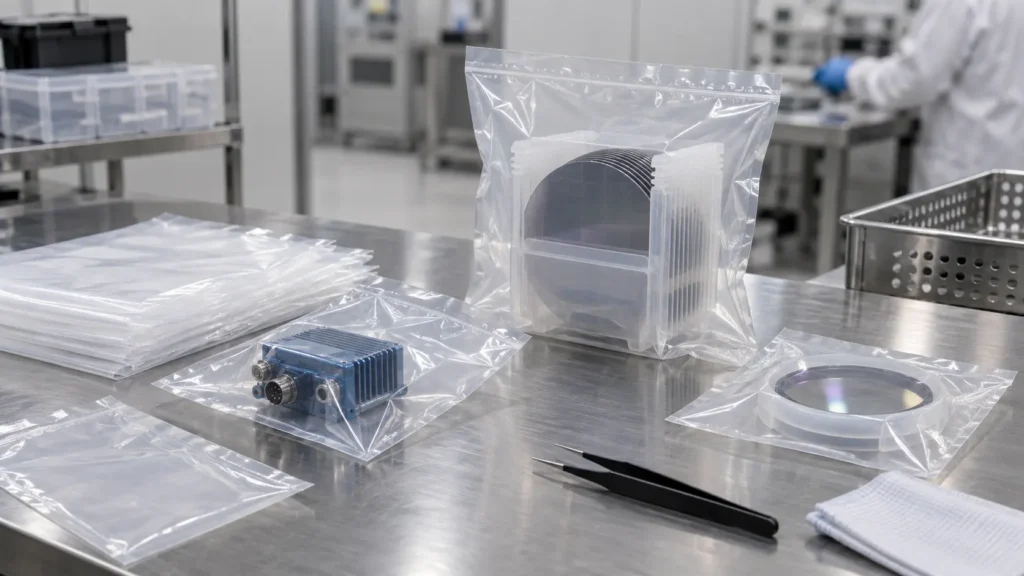
Cleanroom packaging materials should be selected according to the product, required cleanliness level, packaging process, handling environment and risks that must be controlled. A bag made from a familiar polymer is not automatically suitable for cleanroom use, and a package produced in a controlled environment is not automatically sterile.
For buyers, the key is to separate several requirements that are often combined under the general term “clean packaging.” These may include control of particles, fibers, residues, electrostatic charge, moisture, microbial contamination and physical damage. Each requirement should be defined and evaluated separately.
This guide explains the common cleanroom packaging materials, the main cleanliness considerations and the information that should be confirmed before sampling.
Quick Answer: Which Cleanroom Packaging Materials Should You Choose?
Polyethylene bags are widely considered for cleanroom and controlled-environment packaging because they are flexible, heat-sealable and available in different grades and constructions. However, the suitability of a polyethylene bag depends on resin selection, film production, bag conversion, cleaning, packaging and handling conditions.
Nylon-PE laminates may be considered when greater puncture resistance, toughness or vacuum-packaging capability is needed. High-barrier laminates may be appropriate when the product also requires protection against moisture or oxygen.
Static-dissipative or ESD shielding structures may be required for sensitive electronic components, but electrical performance and cleanliness must be confirmed separately.
Double-bagging is commonly used when products must move between areas with different cleanliness controls. The outer bag can be removed at a defined transfer point while the inner bag remains around the product.
There is no universal cleanroom bag that is suitable for every application. Cleanroom packaging materials should be matched to the product, the required packaging environment, the intended handling procedure and the buyer’s acceptance criteria.
For an overview of available bag formats, visit our Cleanroom Packaging Bags page.
What Does Cleanroom Packaging Mean?
Cleanroom packaging generally refers to packaging intended for use with products, processes or environments that require controlled contamination.
The term does not describe one specific material or one universal performance level. Two bags described as cleanroom bags may differ in their polymer grade, particle levels, surface cleanliness, electrical properties, processing environment and supporting documentation.
A cleanroom packaging project may need to control:
- Airborne or surface particles
- Fibers and visible contamination
- Non-volatile residues
- Ionic contamination
- Lubricants, processing aids or additives
- Electrostatic charge
- Moisture transmission
- Oxygen or light exposure
- Puncture and abrasion
- Microbial contamination
- Package integrity during transfer and storage
Not every application requires testing for every item on this list. The buyer should identify the contaminants and risks that are relevant to the product and process.
Cleanroom Classification Does Not Automatically Define Package Cleanliness
ISO 14644-1 classifies the cleanliness of cleanrooms and clean zones according to the concentration of airborne particles. This is important for defining and monitoring the surrounding environment, but an air-classification number alone does not fully describe the cleanliness of a finished bag.
A bag processed in a classified room can still be affected by:
- The condition of the incoming film
- Film extrusion and winding conditions
- Contact with rollers and conversion equipment
- Cutting and sealing operations
- Operator handling
- Static attraction of particles
- Cleaning procedures
- Inspection methods
- Inner and outer packaging
- Storage and transportation after production
For this reason, buyers should ask how the complete manufacturing and packaging process is controlled rather than relying only on a general cleanroom statement.
The required environmental class, operating condition and test method should be agreed for the individual project. A statement such as “made in a cleanroom” is incomplete unless the relevant process scope and supporting information are clear.
Clean Is Not the Same as Sterile
Cleanroom packaging and sterile-barrier packaging serve different purposes.
A clean package may be produced and handled under controlled conditions to reduce particles or other contaminants. It is not necessarily sterile and should not be described as sterile unless it has undergone an appropriate validated sterilization process and meets the applicable product and packaging requirements.
Similarly, a clean non-sterile medical component bag may be used before assembly, sterilization or final packaging without acting as the final sterile barrier.
Important distinctions include:
- Clean does not automatically mean sterile
- Low particle levels do not prove sterility
- A cleanroom classification does not validate a sterilization process
- A heat-sealed bag is not automatically a sterile-barrier system
- Medical use does not automatically make a package sterile
- Sterilization compatibility must be evaluated separately
For medical components that need controlled, non-sterile protection, see our Medical Clean Non-Sterile Packaging page.
Common Cleanroom Packaging Materials
1. Low-Density Polyethylene Bags
Low-density polyethylene, commonly abbreviated as LDPE, is widely used for flexible bags, liners and covers.
Possible advantages include:
- Good flexibility
- Easy loading
- Heat-sealing capability
- Transparent product visibility
- Availability in different thicknesses
- Suitability for many custom bag sizes
- Relatively economical material options
Points to confirm include:
- Resin grade
- Additives and processing aids
- Film thickness
- Surface cleanliness
- Particle and residue requirements
- Seal strength
- Bag dimensions and tolerances
- Processing and final-packaging environment
Standard commercial LDPE should not automatically be considered equivalent to a specified cleanroom-grade bag. The film formulation, converting controls and required supporting data may be different.
2. Linear Low-Density Polyethylene Bags
Linear low-density polyethylene, or LLDPE, may be used alone or blended with other polyethylene grades to improve toughness, flexibility or puncture resistance.
Possible advantages include:
- Good impact resistance
- Flexible handling
- Improved toughness in suitable constructions
- Heat-sealing capability
- Suitability for liners, covers and component bags
The exact performance depends on the resin blend, thickness and film-production process. Buyers should confirm whether the structure meets the project’s cleanliness and mechanical requirements.
3. High-Density Polyethylene Bags
High-density polyethylene, or HDPE, provides a stiffer feel than LDPE and may be used for certain liners, covers or clean handling applications.
Possible advantages include:
- Good strength at a relatively low thickness
- Stiffer handling characteristics
- Resistance to some chemicals
- Availability in large liner formats
Important considerations include:
- Flexibility requirements
- Noise or handling behavior
- Puncture resistance
- Seal performance
- Surface particles
- Suitability for direct product contact
HDPE is not automatically cleaner than LDPE. Material cleanliness depends on the complete production and handling process.
4. Nylon-PE Laminates
Nylon-PE structures combine the mechanical strength and puncture resistance of nylon with the heat-sealing properties of polyethylene.
These laminates may be considered for heavy components, products with irregular shapes or applications that require vacuum packaging.
Possible advantages include:
- Good puncture resistance
- Strong mechanical performance
- Flexible handling
- Heat-sealing capability
- Suitability for some vacuum-packaging applications
Points to confirm include:
- Complete laminate structure
- Film and total thickness
- Adhesive or lamination system
- Cleanliness requirements
- Outgassing or residue concerns
- Seal strength
- Vacuum performance
- Compatibility with the packed product
The additional strength of a laminate does not automatically establish its cleanroom suitability. Every layer, adhesive and converting step should be considered.
5. High-Barrier Laminates
Cleanroom products may also be sensitive to moisture, oxygen or light. In these cases, a high-barrier laminate may be required in addition to cleanliness control.
Possible structures include:
- Aluminum foil laminates
- Metallized film laminates
- Transparent high-barrier films
- Nylon-based barrier laminates
- Multilayer moisture barrier structures
Cleanliness and barrier performance are separate characteristics. A film with a low water vapor transmission rate is not automatically suitable for cleanroom use, while a clean polyethylene bag may not provide the moisture protection required for long-term storage.
For more information about barrier selection, read How to Choose Moisture Barrier Bag Materials.
6. Static-Dissipative and ESD Shielding Materials
Electronic components used in cleanrooms may require both contamination control and ESD protection.
Possible packaging options include:
- Static-dissipative polyethylene bags
- Static shielding bags
- ESD moisture barrier bags
- Static-dissipative liners
- ESD-compatible bubble bags or cushioning
- Conductive packaging for defined applications
A low-particle bag is not automatically ESD protective, and an ESD bag is not automatically suitable for cleanroom use. Buyers should define and verify both sets of requirements.
For a detailed comparison of ESD bag types, read ESD Bags: Types, Materials and Applications.
Additives and Material Formulation
Polymer films may contain additives that support processing or modify performance.
Examples can include:
- Slip agents
- Anti-block additives
- Antistatic additives
- Processing aids
- Colorants
- Stabilizers
- Fillers
These additives are not automatically unacceptable, but their suitability depends on the product and application.
A formulation used for general industrial packaging may not be appropriate where the buyer has strict requirements for residues, extractables, outgassing, ionic contamination or product compatibility.
When evaluating cleanroom packaging materials, ask whether:
- The resin formulation is controlled
- Recycled content is permitted
- Additives are declared where required
- The formulation may change without notification
- Product-contact requirements apply
- Extractables or outgassing data are needed
- Customer-restricted substances have been reviewed
Requirements should be confirmed before sampling because a change of resin or additive package can affect both cleanliness and performance.
Particles, Fibers and Visible Contamination
Particles can be introduced at many stages of film and bag production.
Possible sources include:
- Dust in the production environment
- Film cutting and trimming
- Abrasion against equipment
- Operators and garments
- Packaging materials
- Cardboard fibers
- Static attraction
- Damaged pallets or transport packaging
- Opening and repacking procedures
Visible inspection is useful for identifying obvious contamination, but it may not detect smaller particles or residues.
If particle cleanliness is important, the buyer should define:
- Relevant particle sizes
- Acceptable particle limits
- Whether particles are measured on the surface or in an extraction liquid
- Sampling quantity
- Extraction or test method
- Reporting units
- Acceptance criteria
- Frequency of testing
Without an agreed method, particle data from two suppliers may not be directly comparable.
Non-Volatile Residue and Ionic Contamination
Some precision, optical, semiconductor and electronic applications may require control of contamination that cannot be evaluated through particle counting alone.
Non-volatile residue may remain after a solvent or extraction liquid has evaporated. Ionic contamination can involve soluble ions that may affect sensitive surfaces, electronic performance or downstream processing.
Potential sources include:
- Processing aids
- Cleaning agents
- Operator handling
- Water quality
- Equipment contact
- Printing inks
- Adhesives
- Antistatic treatments
- Outer packaging materials
Not every project requires non-volatile-residue or ionic testing. When it is required, the buyer and supplier should agree on the test method, extraction conditions, reporting units and acceptance limits.
A general statement that a material is “clean” is not enough to confirm these properties.
Outgassing and Odor Considerations
Cleanroom packaging materials used around optics, sensors, semiconductors, vacuum systems or sensitive surfaces may be subject to requirements for outgassing, odor or volatile substances.
Possible concerns include:
- Volatile components released from polymers
- Adhesive or ink residues
- Odor from additives
- Surface deposition on sensitive parts
- Interaction with vacuum processes
- Long-term enclosed storage
If outgassing is critical, the buyer should provide the applicable specification and test method. A material’s suitability cannot be confirmed from polymer type alone.
Unprinted bags may be preferred for some sensitive applications, while other projects may permit controlled printing or external labels.
Cleanroom Bag Conversion and Processing
The way a bag is converted can be as important as the film itself.
Relevant processing steps include:
- Film unwinding
- Cutting
- Folding
- Heat sealing
- Hole punching
- Zipper installation
- Printing
- Cleaning
- Inspection
- Inner packing
- Outer packing
Each step creates potential sources of particles, residues or physical damage.
Questions to ask include:
- Where is the bag converted?
- Which operations occur inside the controlled environment?
- Is the film cleaned before conversion or packing?
- How are work surfaces and equipment controlled?
- What garments and handling procedures are used?
- How are finished bags inspected?
- How soon are bags sealed into their inner packaging?
- Is cardboard excluded from designated clean areas?
- How are lots identified?
The answers should be evaluated against the actual project requirements rather than a general expectation that every cleanroom bag follows the same process.
Double-Bagging for Controlled Transfer
Double-bagging can support the transfer of products between areas with different cleanliness controls.
A typical process may involve:
- Packaging the product in an inner clean bag
- Sealing the inner bag
- Placing it inside a second clean bag
- Sealing the outer bag
- Removing the outer bag at a defined transfer point
- Moving the protected inner bag into the cleaner area
The correct procedure depends on the facility, product and contamination-control plan.
Points to confirm include:
- Inner and outer bag materials
- Bag dimensions
- Seal locations
- Opening direction
- Label placement
- Removal sequence
- Number of packaging layers
- Operator handling
- Disposal or reuse requirements
The two bags may require different sizes so that the inner package can be removed without excessive contact or handling.
Heat Sealing and Closure Selection
The closure must support both package integrity and the intended transfer process.
Possible closure formats include:
- Open-top heat-seal bags
- Zipper bags
- Zipper bags with an additional heat seal
- Peelable closures
- Tie closures for selected covers or liners
- Vacuum-sealed bags
A zipper may provide convenient access, but it does not automatically provide the same package integrity as a complete heat seal.
Important sealing parameters include:
- Sealant-layer material
- Sealing temperature
- Dwell time
- Pressure
- Seal width
- Bag opening design
- Product contamination in the seal area
- Equipment compatibility
- Seal-inspection method
Samples should be tested with the customer’s intended equipment whenever possible.
Cleanroom Packaging for Different Applications
Semiconductor and Microelectronic Components
Semiconductor components may require control of particles, ionic contamination, electrostatic charge and moisture.
The packaging system may include:
- A clean inner bag
- An ESD shielding layer
- Moisture barrier protection
- Desiccant
- A humidity indicator card
- Trays, tubes or reels
- Double-bagging
- Lot identification
The required combination depends on device sensitivity, storage conditions and downstream processing.
Optics and Precision Surfaces
Optical products, coated surfaces and precision components may be sensitive to particles, abrasion, residue and outgassing.
Important considerations include:
- Non-abrasive contact surfaces
- Low-residue materials
- Protective interleaving
- Product immobilization
- Visibility for inspection
- Controlled opening
- Suitable outer cushioning
The bag should not be expected to provide all physical protection by itself.
Aerospace and Precision Industrial Parts
Precision metal, aerospace and machined components may need control of particles, corrosion, moisture and physical damage.
Material selection may depend on:
- Product weight
- Sharp edges
- Surface finish
- Corrosion sensitivity
- Storage duration
- Export conditions
- Cleanliness requirements
- Use of desiccants or corrosion-control materials
For heavy or irregular products, puncture resistance and seal strength can be as important as cleanliness.
Medical Devices and Components
Medical components may require clean, non-sterile protection before assembly, sterilization or final packaging.
The buyer should separately define:
- Cleanliness requirements
- Product-contact requirements
- Biocompatibility requirements, where applicable
- Sterilization compatibility
- Packaging environment
- Traceability
- Material documentation
- Final sterile-barrier requirements
A cleanroom bag used during component handling should not automatically be described as the final medical sterile barrier.
Printing and Labeling
Cleanroom bags may require product identification, lot numbers, opening instructions, barcodes or ESD symbols.
However, printing introduces additional materials and processing steps.
Confirm:
- Whether direct printing is permitted
- Ink location
- Print method
- Required curing
- Abrasion resistance
- Label material
- Label adhesive
- Barcode readability
- Lot traceability
- Cleanliness or outgassing restrictions
- Language requirements
For highly sensitive applications, an external label or an unprinted bag may be preferred. The final choice should follow the customer’s specification.
How Should Cleanroom Bags Be Packed for Delivery?
Clean bags can be contaminated after production if the secondary and transport packaging are not properly planned.
A delivery configuration may include:
- A defined quantity per inner bag
- Heat-sealed inner packaging
- Double or triple protective layers
- Clean polyethylene outer liners
- Lot identification
- Controlled carton packing
- Pallet protection
- Instructions for staged unpacking
Cardboard may generate fibers and particles. Some facilities therefore require outer cartons to remain outside cleaner areas, with inner protective layers removed in sequence.
The delivery format should be coordinated with the customer’s receiving and transfer procedure.
Documentation Buyers May Request
Documentation requirements vary by project.
Possible documents include:
- Material specification
- Complete material structure
- Resin or material declaration
- Certificate of analysis
- Lot inspection record
- Dimensional inspection
- Cleanliness test report
- Particle test report
- Non-volatile-residue data
- Ionic contamination data
- ESD performance data
- WVTR or oxygen-barrier data
- Declaration of restricted substances
- Process or environment statement
- Change-notification requirements
Buyers should identify required documents before approving samples. Some tests or documents may not be available for every material or order quantity and must be confirmed according to the selected supply arrangement.
Common Cleanroom Packaging Selection Mistakes
Choosing Only by Polymer Name
Two polyethylene bags can have different formulations, production conditions, particle levels and supporting documents.
Compare the complete specification, not just the polymer name.
Treating a Cleanroom Class as a Product Specification
A controlled production environment is relevant, but it does not define all properties of the finished bag.
Specify the cleanliness and performance requirements of the package itself.
Assuming Clean Means Sterile
Cleanliness and sterility are different requirements.
Do not make a sterile claim without an appropriate validated process and supporting evidence.
Ignoring Additives
Slip, anti-block and antistatic additives may affect sensitive applications.
Confirm material formulation and restricted-substance requirements where necessary.
Ignoring ESD or Moisture Requirements
Particle control does not automatically provide electrostatic or moisture protection.
Define each required function separately.
Selecting by Thickness Alone
A thicker bag may provide more strength, but thickness does not determine particle cleanliness, barrier performance or ESD protection.
Compare material structure and verified data.
Ignoring Secondary Packaging
A clean bag can be contaminated by unsuitable inner packs, cartons, pallets or receiving procedures.
Review the complete delivery and unpacking configuration.
Questions to Answer Before Requesting a Quotation
Before requesting cleanroom packaging materials, provide the following information.
- What product will be packed?
Include its dimensions, weight, shape, surface condition and any sharp edges.
- Where will the bag be used?
Identify the production, packing, transfer, storage and opening environments.
- What cleanliness requirements apply?
Specify relevant particles, fibers, residues, ionic contamination, microbial control or visible-cleanliness criteria.
- Is the package required to be sterile?
Clarify whether the bag is clean non-sterile, will undergo sterilization or must act as a final sterile barrier.
- Is ESD protection required?
Confirm low-charging, dissipative, conductive or discharge-shielding requirements.
- Is moisture or oxygen protection required?
Provide any target WVTR, storage-period or barrier requirement.
- What physical protection is needed?
Identify puncture, abrasion, vacuum, cushioning or heavy-load requirements.
- Is double-bagging required?
Confirm the number of layers, dimensions and opening sequence.
- How will the bag be closed?
Specify heat sealing, zipper, vacuum sealing or another closure.
- What testing and documentation are required?
Define these requirements before sampling.
- What quantity and destination are expected?
This information supports material availability, packing and delivery planning.
Sampling and Evaluation
Samples should be evaluated with the actual product and intended packaging process whenever possible.
Check:
- Product fit
- Loading procedure
- Seal quality
- Puncture risk
- Surface contact
- Visible contamination
- Bag opening and transfer
- Double-bagging sequence
- Label placement
- Compatibility with packing equipment
- Inner and outer packaging
- Expected storage and transportation conditions
Laboratory testing may also be required according to the buyer’s specification and risk assessment.
Jinhong Packaging supports material comparison, bag specifications, custom sizing, sampling and project coordination through selected manufacturing partners. Material availability, processing conditions, test data and documentation are confirmed according to the selected structure and project requirements.
For a broader view of cleanroom, ESD, moisture barrier and medical clean packaging, explore our Protective and Clean Packaging Solutions.
Frequently Asked Questions
What material is commonly used for cleanroom bags?
Polyethylene is widely used, but material suitability depends on resin formulation, film processing, bag conversion, cleanliness controls and the application’s acceptance criteria. Nylon-PE, high-barrier and ESD structures may be required for additional protection.
Is a polyethylene bag automatically cleanroom compatible?
No. A standard commercial polyethylene bag should not automatically be considered suitable for a cleanroom application. The complete production process, cleanliness requirements and supporting data must be reviewed.
Are cleanroom bags sterile?
Not necessarily. Cleanroom bags may be clean non-sterile. Sterility requires an appropriate validated sterilization process and should be treated as a separate requirement.
What is double-bagging?
Double-bagging places a sealed inner bag inside a second protective bag. The outer bag can be removed at a defined transfer point while the inner package remains protected for entry into a cleaner area.
Can cleanroom packaging also provide ESD protection?
Yes, some structures combine clean processing with static-dissipative or shielding properties. Cleanliness and ESD performance must be specified and verified separately.
Can cleanroom bags provide a moisture barrier?
Some high-barrier structures can provide both cleanliness control and moisture protection. Standard polyethylene bags should not automatically be treated as high moisture barriers.
What test data should be requested for cleanroom packaging materials?
The required data may include material structure, particle cleanliness, non-volatile residue, ionic contamination, ESD performance, barrier data, seal strength and dimensional inspection. The exact requirements depend on the product and application.
How should cleanroom bags be supplied?
They may be supplied in sealed inner packaging with one or more protective outer layers, lot identification and a defined quantity per pack. The configuration should match the customer’s receiving and controlled-transfer process.
Start Your Cleanroom Packaging Project
Selecting cleanroom packaging materials requires balancing cleanliness, material compatibility, physical protection, sealing, handling, documentation and cost.
Tell us what product you need to pack, its dimensions and weight, the required cleanliness controls, packing environment, ESD or barrier requirements, double-bagging procedure, estimated quantity and delivery destination.
We can help compare suitable material options, coordinate specifications and samples, and follow the project through the selected supply arrangement.