
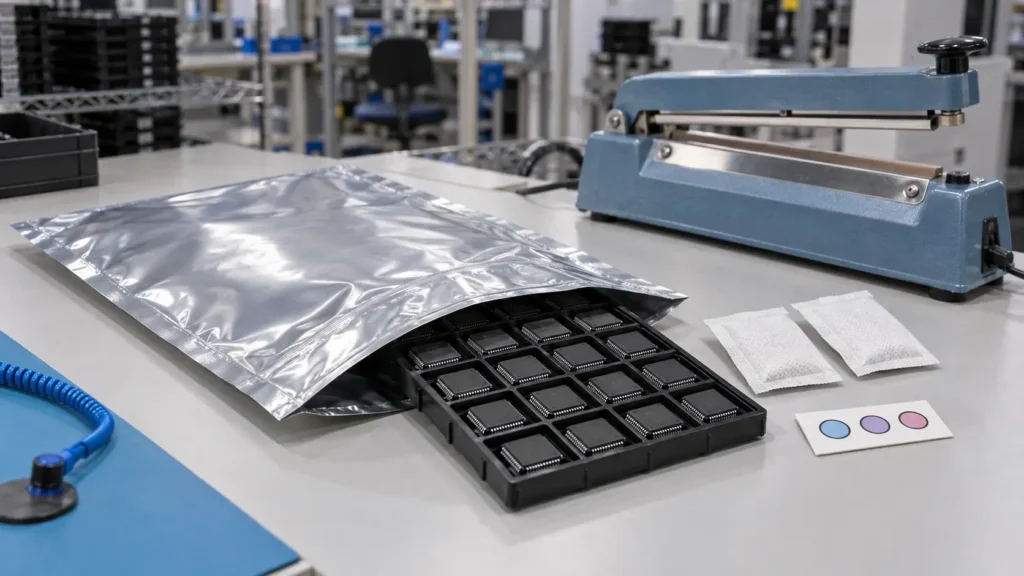
Moisture-sensitive electronic components require more than a general-purpose plastic bag. Their packaging may need to control humidity, electrostatic discharge, physical damage and contamination throughout storage, transportation and production handling.
For many projects, the packaging system includes a moisture barrier bag, desiccant, humidity indicator card, ESD protection, suitable component carriers and a controlled heat-sealing process.
The correct combination depends on the component’s moisture sensitivity, electrostatic sensitivity, storage period, handling procedure, destination and applicable customer requirements.
This guide explains how to choose packaging for moisture-sensitive electronic components and which information should be confirmed before sampling or ordering.
Quick Answer: What Packaging Should Be Used?
Moisture-sensitive electronic components are commonly packed in a heat-sealed moisture barrier bag with an appropriate quantity of desiccant and a humidity indicator card.
If the components are also sensitive to electrostatic discharge, the selected bag should provide the required ESD performance in addition to moisture protection.
Trays, reels, tubes or other carriers may be placed inside the barrier bag to protect and organize the components. Sharp edges and movement should be controlled so that the carrier does not puncture or damage the bag.
The exact material, barrier level, accessory quantities and packing procedure must be selected according to the device, storage conditions and applicable specification.
For available moisture-control formats, visit our Moisture Barrier and Aluminum Foil Bags page.
Why Can Moisture Damage Electronic Components?
Many semiconductor and electronic components contain polymeric materials that can absorb moisture from the surrounding environment.
During high-temperature assembly or reflow processes, absorbed moisture may rapidly expand. This can contribute to internal stress, delamination, cracking or other forms of damage in susceptible devices.
Moisture can also affect electronic products through:
- Corrosion
- Oxidation
- Changes to sensitive surfaces
- Reduced insulation performance
- Contamination
- Package swelling
- Degradation during long-term storage
- Condensation caused by temperature changes
Not every electronic component has the same moisture risk. The buyer should identify the applicable moisture-sensitivity classification, handling requirements and exposure limits for the specific device.
Packaging can reduce additional moisture exposure during storage and transportation, but it does not reverse moisture already absorbed by the component.
Understand Moisture Sensitivity Level
Moisture Sensitivity Level, commonly abbreviated as MSL, is used to classify the susceptibility of certain surface-mount devices to moisture-related damage during reflow processing.
The component supplier’s label, technical data and applicable handling standard should be reviewed before selecting the packaging system.
Important information may include:
- MSL classification
- Floor-life requirements
- Exposure history
- Packing date
- Required dry-packing method
- Baking conditions, if applicable
- Reflow conditions
- Storage requirements
- Resealing procedure
- Humidity indicator requirements
Packaging suppliers should not independently assign an MSL classification to a component. This information should come from the component manufacturer or the buyer’s approved technical specification.
The applicable edition of standards such as J-STD-033 should be confirmed by the customer. Requirements may vary according to the device classification, packing stage and internal quality procedure.
Moisture Protection and ESD Protection Are Different
A moisture barrier bag is designed to reduce water-vapor transmission.
An ESD bag is designed to provide defined electrostatic properties, which may include low charging, static dissipation, conductivity or discharge shielding.
These functions are related in many electronic-component projects, but they are not interchangeable.
A bag with strong moisture resistance is not automatically ESD protective. Similarly, an anti-static polyethylene bag is not automatically a moisture barrier bag.
When both risks are present, the packaging system should address both requirements.
For an overview of electrical-protection formats, visit our ESD Packaging and Anti-Static Bags page.
What Is a Moisture Barrier Bag?
A moisture barrier bag is a flexible package designed to slow the movement of water vapor into the sealed package.
Possible structures include:
- Aluminum foil laminates
- Metallized film laminates
- Moisture barrier shielding structures
- Transparent high-barrier laminates
- Nylon-reinforced barrier structures
- Other multilayer films selected for the required performance
A typical bag may combine:
- An outer protective layer
- A barrier layer
- One or more reinforcing layers
- An ESD functional layer or coating where required
- An inner heat-seal layer
The complete laminate should be identified. Terms such as “foil bag,” “silver bag,” “Mylar bag” or “anti-static moisture bag” are not complete material specifications.
Aluminum Foil or Metallized Film?
Aluminum foil laminates generally provide a stronger moisture, oxygen and light barrier when the foil remains intact and the bag is properly sealed.
Metallized films may offer a lighter, more flexible and more economical solution when their verified barrier performance is sufficient for the application.
The selection should consider:
- Required WVTR
- Storage period
- Temperature and humidity
- Flex-crack risk
- Puncture resistance
- Vacuum packing
- Bag dimensions
- Seal strength
- ESD requirements
- Cost
For a direct comparison, read Aluminum Foil Bags vs Metallized Bags.
The silver appearance of a bag does not confirm whether it contains aluminum foil or metallized film. Always request the complete laminate structure.
Understand WVTR
Water Vapor Transmission Rate, abbreviated as WVTR, indicates how much water vapor passes through a packaging material under specified test conditions.
A lower WVTR generally indicates stronger resistance to moisture transmission. However, a value is meaningful only when the test conditions are known.
When reviewing WVTR information, confirm:
- Test method
- Temperature
- Relative humidity
- Film thickness
- Complete material structure
- Sample condition
- Reporting units
- Test date
- Whether the result applies to flat film or a finished package
ASTM F1249 is one recognized test method for determining water vapor transmission through flexible barrier materials.
Results obtained using different methods or conditions should not be compared directly.
WVTR is important, but it does not describe every aspect of package performance. Pinholes, flex cracks, weak seals or punctures can reduce the effectiveness of an otherwise strong barrier material.
For more information, read How to Choose Moisture Barrier Bag Materials.
Selecting the Required ESD Performance
Electronic components may require different types of electrostatic protection.
Possible packaging functions include:
- Low-charging or anti-static surfaces
- Static-dissipative performance
- Conductive performance
- Electrostatic discharge shielding
- Combined moisture and ESD protection
The required function should be defined by the customer’s component-handling procedure.
A pink anti-static bag may reduce charge generation in some handling situations, but it should not automatically be treated as a shielding bag or a moisture barrier bag.
A static shielding bag may provide electrical protection but may not have the moisture resistance required for extended dry storage.
A moisture barrier shielding bag can combine these functions, but both the barrier and electrical performance should be verified.
For a detailed comparison, read ESD Bags: Types, Materials and Applications.
Why Is Desiccant Used?
Desiccant is placed inside a sealed barrier package to adsorb moisture from the enclosed air, packaging materials and other approved internal sources.
The required quantity depends on factors such as:
- Bag size
- Internal air volume
- Barrier performance
- Initial moisture condition
- Packaging materials inside the bag
- Storage period
- Temperature and humidity
- Applicable packing method
- Required safety margin
The quantity should not be selected only by copying another package.
Too little desiccant may provide insufficient moisture control. Excessive or poorly positioned desiccant may increase cost, take up space or create handling problems.
Desiccant must also be kept dry before use. Open storage or uncontrolled exposure can reduce its remaining capacity before it is placed inside the package.
The desiccant type, unit definition, package material, placement and required documentation should be confirmed for the project.
What Does a Humidity Indicator Card Do?
A humidity indicator card, commonly abbreviated as HIC, provides a visual indication of humidity exposure inside the sealed package.
It does not actively remove moisture and should not replace desiccant.
The card normally contains indicator spots that respond to defined relative-humidity levels. The appropriate card configuration depends on the applicable packing specification and customer requirements.
Confirm:
- Required indication levels
- Cobalt-containing or cobalt-free requirement
- Applicable standard
- Card size
- Printing and language
- Storage conditions
- Shelf life
- Packaging before use
- Placement inside the barrier bag
- Acceptance and rejection criteria
The card should remain visible when the bag is opened or inspected according to the intended procedure.
A humidity indicator card shows humidity exposure at the card’s location. It does not independently prove that every component is dry or undamaged.
Desiccant and HIC Placement
Accessory placement should be considered during sample evaluation.
Desiccant packets should not:
- Damage component leads
- Obstruct sealing
- Cover required labels
- Create excessive pressure points
- Interfere with trays or reels
- Contact surfaces where direct contact is restricted
The humidity indicator card should be positioned so that it can be inspected without unnecessary handling.
If the bag will be vacuum sealed, the placement of desiccant and cards should be tested to prevent sharp pressure points or damage.
Accessory quantities and placement should be documented in the packing instruction.
Is Vacuum Sealing Required?
Vacuum sealing may reduce the amount of air inside a package and help immobilize the contents, but it is not always required.
Vacuum alone does not replace:
- A suitable moisture barrier
- Desiccant
- A humidity indicator card
- ESD protection
- Correct heat sealing
- Approved component handling
Excessive vacuum may place stress on components, trays, reels and laminate folds. Sharp carrier edges may press against and puncture the bag.
Possible alternatives include controlled air removal or sealing without a high vacuum, depending on the approved packing procedure.
The vacuum level and equipment should be evaluated with the actual components and packaging configuration.
Heat Sealing and Seal Integrity
The sealed opening is a critical part of the moisture-control system.
Important heat-sealing parameters include:
- Sealant-layer material
- Sealing temperature
- Dwell time
- Pressure
- Seal width
- Number of seal bands
- Bag opening condition
- Equipment compatibility
- Wrinkles and folds
- Contamination in the seal area
- Inspection method
A bag with excellent film-barrier data can still fail if the seal is incomplete or damaged.
The seal area should be clean and flat. Component carriers, desiccants, labels and internal air should not interfere with the sealing operation.
Samples should be sealed using the intended production equipment and evaluated before the final specification is approved.
Bag Size and Headspace
The bag should be large enough to contain the product carrier, desiccant, humidity indicator card and required seal area without excessive stress.
An undersized bag may cause:
- Difficult loading
- Tight folds
- Pressure against component edges
- Wrinkles in the seal
- Insufficient sealing space
- Puncture risk
An unnecessarily large bag increases internal air volume and exposed film area. It may also require more packaging material and potentially affect the dry-packing calculation.
Confirm:
- Product or carrier length, width and height
- Loading direction
- Required clearance
- Seal position
- Seal width
- Accessory placement
- Headspace
- Outer-packaging dimensions
Internal usable dimensions should be distinguished from the bag’s external dimensions.
Trays, Reels and Tubes
Moisture-sensitive electronic components are often supplied in trays, reels, tubes or other carriers.
The carrier protects component orientation and supports automated or controlled handling, but it can create additional packaging considerations.
Check:
- Carrier dimensions
- Maximum loaded weight
- Sharp corners
- Protruding hubs or edges
- Movement inside the bag
- Heat resistance where applicable
- Cleanliness requirements
- Compatibility with desiccant and HIC placement
- Need for cushioning
- Stacking method
Protective caps, corner guards, wrapping or cushioning may be needed to prevent the carrier from damaging the barrier bag.
The bag should not be expected to provide all mechanical protection by itself.
Cleanliness and Contamination Control
Some semiconductor, optical and precision electronic components require both moisture control and clean handling.
Barrier performance does not automatically confirm cleanliness.
If contamination control is important, define requirements for:
- Particles
- Fibers
- Visible contamination
- Non-volatile residues
- Ionic contamination
- Additives
- Outgassing
- Packaging environment
- Inner and outer packaging
- Handling procedures
A barrier bag converted or packed under general industrial conditions should not automatically be described as cleanroom compatible.
For projects with controlled-environment requirements, read Cleanroom Packaging Materials and Cleanliness Considerations.
Labels and Identification
The dry-packed package may require labels that communicate component and handling information.
Possible label content includes:
- Product name
- Part number
- Lot number
- Quantity
- MSL classification
- Packing date
- Shelf-life information
- Humidity warning
- Opening instructions
- Resealing instructions
- ESD symbol
- Barcode
- Supplier or customer reference
- Country or language information
The buyer should provide the approved label content and format.
Packaging suppliers should not create technical classifications or exposure limits without approved customer information.
Labels should be positioned so that they remain readable and do not interfere with sealing or opening.
Inner and Outer Packaging
The moisture barrier bag is one part of the complete shipping system.
Outer packaging may need to protect against:
- Puncture
- Compression
- Vibration
- Impact
- Abrasion
- Water exposure
- Temperature changes
- Uncontrolled handling
- Static-generating cushioning
- Damage from cartons or pallets
The barrier bag should be immobilized where necessary and protected from sharp objects.
If several barrier bags are packed in one carton, separators or cushioning may be needed to prevent rubbing and edge damage.
For controlled environments, outer cartons may need to remain outside designated clean areas while inner protective layers are removed in sequence.
Storage Before Use
Unused barrier bags, desiccants and humidity indicator cards should be stored according to their specified conditions.
Important controls may include:
- Original sealed packaging
- Temperature and humidity
- Protection from direct sunlight
- Lot identification
- Shelf-life control
- First-in, first-out use
- Protection from dust and damage
- Resealing after opening
- Exposure-time records
Desiccants and humidity cards can be affected by uncontrolled exposure before packing.
The packaging process should therefore include clear instructions for opening, use, resealing and storage of remaining materials.
Repacking and Resealing
Components may need to be repacked after inspection, partial use or production handling.
Before resealing, confirm:
- Exposure time
- Humidity conditions
- Component status
- Whether baking or drying is required
- Condition of the original bag
- Desiccant replacement
- Humidity-card replacement
- Seal location
- Remaining usable bag length
- Label updates
- Applicable customer procedure
A previously opened bag should not automatically be resealed with the original accessories without evaluating their condition.
Any baking or drying decision should follow the component supplier’s approved instructions. Packaging advice should not replace the device’s technical handling requirements.
Documents Buyers May Request
Documentation requirements vary by project.
Possible documents include:
- Complete laminate specification
- Material-layer thicknesses
- WVTR report
- ESD performance data
- Seal-strength data
- Dimensional inspection
- Certificate of analysis
- Desiccant specification
- Humidity indicator card specification
- Restricted-substance declaration
- Lot traceability
- Packing instructions
- Label artwork
- Change-notification requirements
Required tests, standards and acceptance criteria should be identified before sample approval.
Not every document is automatically available for every material, accessory or order quantity. Availability should be confirmed according to the selected supply arrangement.
Questions to Answer Before Requesting a Quotation
Before requesting packaging for moisture-sensitive electronic components, provide the following information.
What component will be packed?
Include the part number, component type, dimensions, quantity per bag and carrier format.
What is the component’s MSL classification?
Provide the approved classification and applicable handling requirements.
Is ESD protection required?
Specify the required low-charging, dissipative, conductive or shielding performance.
What barrier performance is required?
Provide the target WVTR, material specification or approved packaging standard.
How long will the component be stored?
Include the expected storage, transportation and production-handling periods.
What are the environmental conditions?
Provide expected temperature, relative humidity and transportation conditions.
Will desiccant and an HIC be used?
Specify the required types, quantities, indication levels and placement.
How will the package be sealed?
Identify the sealing equipment, available seal width and whether vacuum or controlled air removal is required.
Does the carrier have sharp edges?
Provide photographs or samples of trays, reels or tubes where possible.
Are cleanliness controls required?
Define particles, residues, ionic contamination or processing-environment requirements.
What labels and documentation are needed?
Provide approved artwork, technical requirements and requested test reports.
What quantity and destination are expected?
This supports material availability, packing and delivery planning.
Common Packaging Mistakes
Using Only an Anti-Static Bag
A general anti-static bag may not provide the moisture barrier required for dry packing.
Confirm both ESD and moisture performance.
Selecting by Bag Color
Silver, pink, black or transparent appearance does not define the full packaging function.
Request the complete material and performance specification.
Ignoring Test Conditions
WVTR values obtained under different temperatures, humidity levels or test methods may not be comparable.
Review the complete test report.
Reusing Exposed Desiccant
Desiccant may lose capacity after uncontrolled exposure.
Follow the approved storage and packing procedure.
Treating the HIC as a Desiccant
A humidity indicator card indicates humidity exposure; it does not remove moisture.
Assuming Vacuum Replaces Moisture Control
Vacuum does not replace a verified barrier material, desiccant or correct sealing.
Ignoring Carrier Edges
Trays, reels and tubes can puncture the bag or damage the barrier layer.
Evaluate the filled package.
Using an Oversized or Undersized Bag
Incorrect sizing can affect loading, sealing, accessory quantities and package integrity.
Confirm usable internal dimensions.
Making Unsupported Shelf-Life Claims
Shelf life depends on the component, barrier material, bag size, desiccant, sealing, storage conditions and applicable procedure.
Do not calculate it from material name alone.
Sampling and Evaluation
Samples should be tested with the actual component carrier, desiccant, HIC and sealing equipment whenever possible.
Evaluate:
- Bag dimensions
- Loading procedure
- Carrier fit
- Puncture risk
- Film flexibility
- Seal quality
- Vacuum or air-removal process
- Desiccant placement
- HIC visibility
- Label position
- ESD performance
- Package integrity
- Inner and outer packaging
- Storage and transportation simulation where required
Laboratory testing may also be required according to the customer’s specification and risk assessment.
Jinhong Packaging supports material comparison, bag specifications, accessory coordination, sampling and project follow-up through selected manufacturing partners. Final materials, performance requirements, documents and order conditions are confirmed according to the selected project.
For a broader overview of moisture, ESD and clean packaging, explore our Protective and Clean Packaging Solutions.
Frequently Asked Questions
What type of bag is used for moisture-sensitive electronic components?
A heat-sealed moisture barrier bag is commonly used, often together with desiccant and a humidity indicator card. If the component is ESD sensitive, the bag should also provide the required electrical protection.
Is an anti-static bag enough for moisture-sensitive components?
Not necessarily. An anti-static bag may reduce charge generation but may not provide adequate moisture resistance or discharge shielding. Each required function should be confirmed separately.
Do moisture barrier bags need desiccant?
Many dry-packing processes use desiccant inside the sealed barrier bag. The required type and quantity depend on the packaging specification, bag size, barrier performance and storage conditions.
What is the purpose of a humidity indicator card?
A humidity indicator card provides a visual indication of humidity exposure inside the package. It does not remove moisture and should not replace desiccant.
Is an aluminum foil bag always required?
No. Foil laminates may be selected when a very strong barrier is required, while suitable metallized or other high-barrier structures may meet less demanding requirements. Selection should be based on verified performance.
Can a moisture barrier bag also provide ESD shielding?
Yes. Some multilayer moisture barrier bags include shielding or other defined ESD properties. Both moisture and electrical performance should be verified.
Should moisture barrier bags be vacuum sealed?
Not always. Vacuum requirements depend on the component, carrier and approved packing procedure. Excessive vacuum can create pressure points or puncture risk.
Can an opened moisture barrier bag be reused?
Reuse depends on the condition of the bag, remaining seal area, exposure history and approved procedure. Desiccant and humidity cards may also need replacement.
How should the correct bag size be calculated?
Use the carrier’s full dimensions, loading clearance, accessory placement, headspace and required seal width. Confirm internal usable dimensions rather than relying only on external bag size.
Start Your Electronic Component Packaging Project
Selecting packaging for moisture-sensitive electronic components requires coordination between moisture control, ESD protection, physical protection, sealing and handling procedures.
Tell us the component type, carrier dimensions, MSL classification, required barrier and ESD performance, storage period, desiccant and humidity-card requirements, sealing method, estimated quantity and delivery destination.
We can help compare suitable packaging structures, coordinate specifications and samples, and follow the project through the selected supply arrangement.