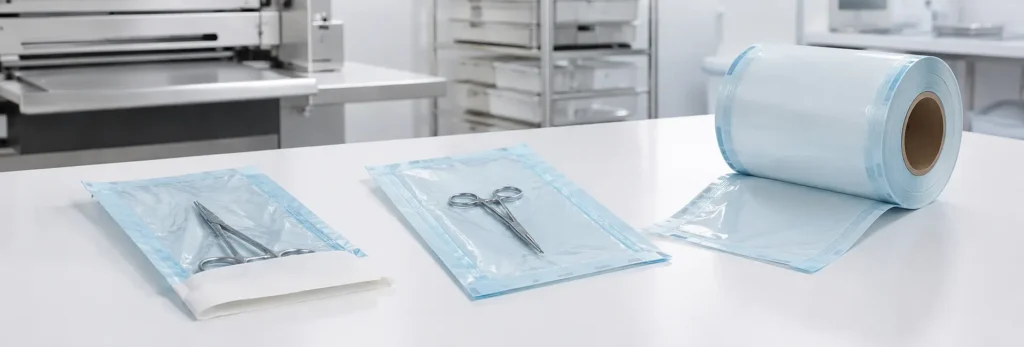
Self-seal vs heat-seal sterilization pouches are commonly compared when selecting packaging for medical instruments, dental products and other healthcare applications. Sterilization rolls provide another option when several package lengths are required.
Although these formats may use similar combinations of medical-grade paper and transparent film, their closure methods, packing processes and common applications are different. They should not be selected only by appearance, price or convenience.
The final choice should consider the medical device, intended sterilization method, sealing process, opening requirements, package validation plan and conditions of storage and distribution.
What Are Self-Seal Sterilization Pouches?
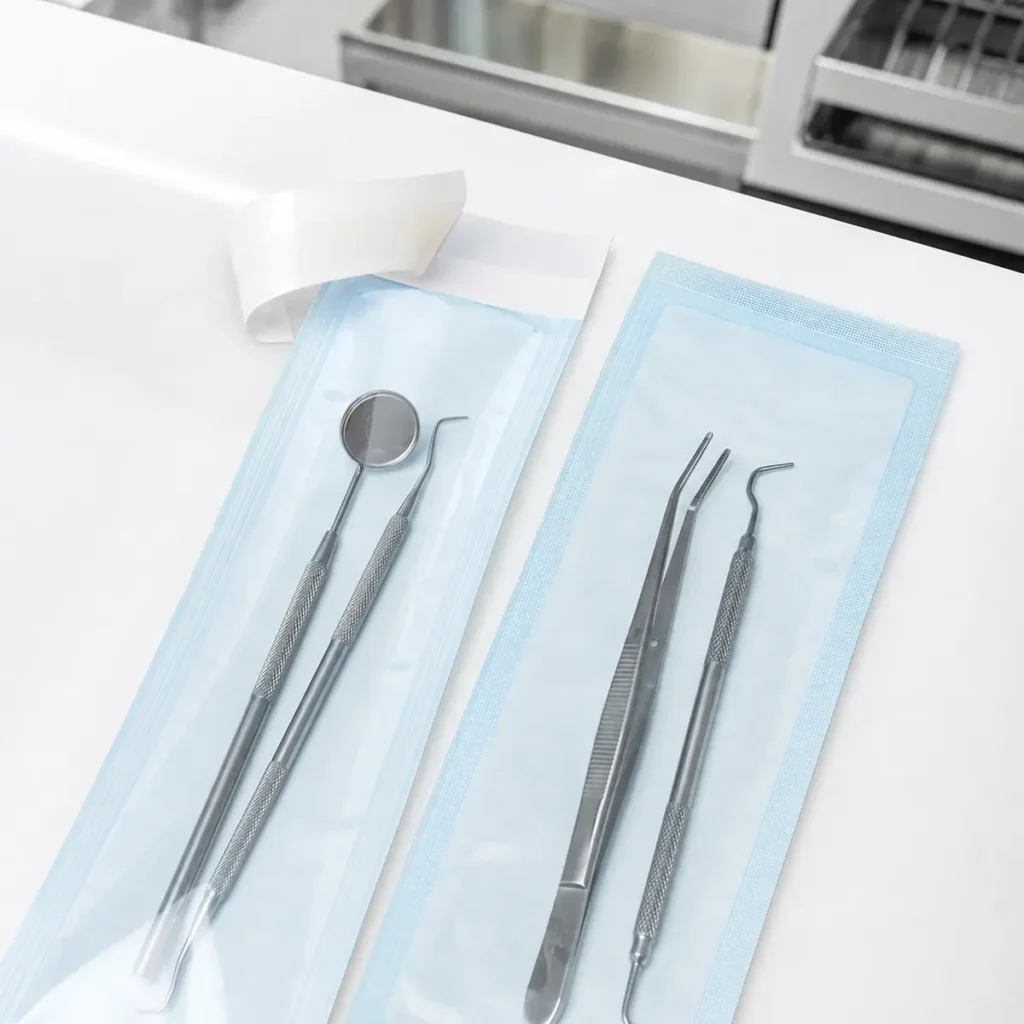
Self-seal sterilization pouches are preformed pouches with an adhesive closure. After the instrument or product is placed inside, the release liner is removed and the flap is folded along the indicated line to close the pouch.
Because the closure does not normally require a separate heat-sealing machine, self-seal pouches are frequently used in dental practices, clinics, hospitals and other healthcare environments that prepare instruments for sterilization.
Common features may include:
- Medical-grade paper combined with transparent multilayer film
- A pre-applied adhesive strip
- A marked folding line
- Process indicators where applicable
- A peelable opening design
- A range of standard dimensions
Self-seal pouches can simplify routine preparation, particularly when facilities handle standard-sized instruments in relatively small or variable quantities.
However, the adhesive closure must be applied correctly. Incorrect folding, wrinkles, contamination in the closure area, overloading or unsuitable storage can affect package performance.
The pouch specification, closure instructions and sterilization compatibility should always be confirmed for the intended application.
What Are Heat-Seal Sterilization Pouches?
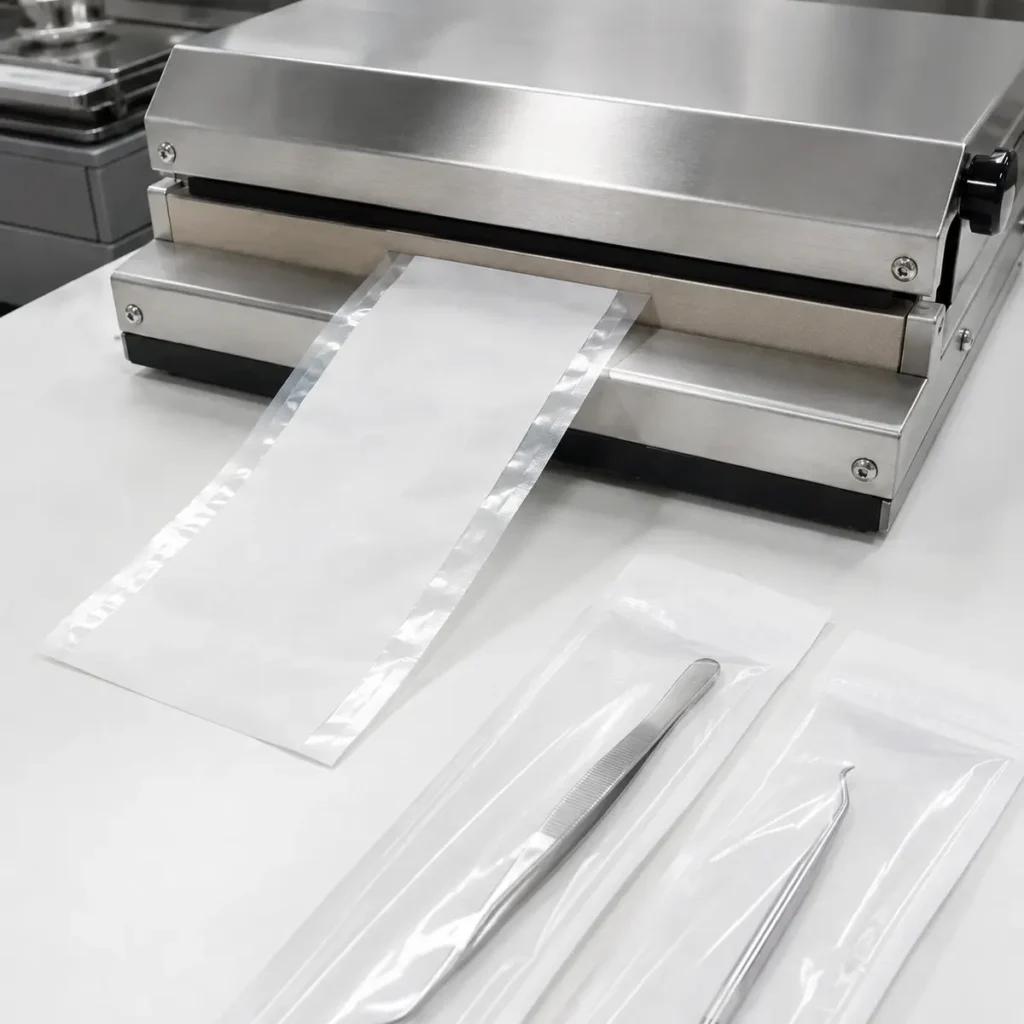
Heat-seal sterilization pouches are normally supplied as preformed pouches with an open end. The device or instrument is inserted into the pouch, and the open end is closed using controlled heat-sealing equipment.
The sealing process may involve parameters such as:
- Sealing temperature
- Sealing pressure
- Dwell time
- Seal width
- Equipment condition
- Material orientation
- Cleanliness of the seal area
Heat-seal pouches are commonly considered when the packing operation needs a controlled and repeatable closure process. They can be used in healthcare facilities as well as industrial medical device packaging operations, depending on the pouch specification and application.
The presence of a heat seal does not automatically make the finished package suitable. The selected material, sealing equipment and process parameters must work together to create a consistent seal.
For medical devices that are terminally sterilized, forming, sealing and assembly processes may need to be developed and validated according to the applicable quality and regulatory requirements.
What Are Medical Sterilization Rolls?
Medical sterilization rolls, also known as sterilization reels, are supplied in continuous lengths. They commonly combine a porous material such as medical-grade paper with transparent plastic film.
The roll can be cut to the required length, allowing the user to prepare packages for instruments or devices of different sizes. After cutting, the open ends are closed using compatible heat-sealing equipment.
Sterilization rolls may be useful when:
- Several device lengths must be packaged
- Standard preformed pouch sizes do not provide a suitable fit
- The packing operation needs more dimensional flexibility
- A facility processes different instruments in smaller quantities
- Reducing the number of pouch sizes held in stock is desirable
This flexibility must be balanced against additional process steps. Operators must cut the material to an appropriate length, leave sufficient space around the device and create consistent seals at the open ends.
Excessive package length can allow unnecessary movement, while insufficient space may place stress on the seals or make aseptic opening more difficult.
Learn more about available formats on our Sterilization Pouches & Rolls page.
Self-Seal vs Heat-Seal Sterilization Pouches: Main Differences
The following comparison provides a general starting point. Actual suitability depends on the specific pouch construction, device, sterilization cycle and packaging process.
| Comparison point | Self-seal pouch | Heat-seal pouch | Sterilization roll |
|---|---|---|---|
| Closure method | Pre-applied adhesive closure and folding flap | Open end closed using heat-sealing equipment | Cut to length and sealed at the open ends |
| Equipment | Usually does not require a separate heat sealer | Requires compatible sealing equipment | Requires cutting and heat-sealing equipment |
| Size options | Standard preformed sizes | Standard or customized preformed sizes | Width is fixed, while package length can be adjusted |
| Common use | Dental practices, clinics and healthcare instrument preparation | Healthcare and industrial medical device packaging operations | Facilities or operations handling several device lengths |
| Process control | Correct folding and adhesive closure are important | Temperature, pressure and dwell time require control | Cutting, package length and sealing parameters require control |
| Production efficiency | Convenient for smaller or variable quantities | Suitable for controlled repeat packing processes | Flexible, but requires additional cutting and sealing steps |
| Validation considerations | Closure performance and finished package must be evaluated | Sealing process and finished package may require validation | Cutting, sealing and finished package configuration must be evaluated |
This table should not be treated as evidence that one format is universally better. The packaging system must be evaluated in relation to the intended medical device and use conditions.
Closure Method and Process Control
The most visible difference between self-seal vs heat-seal sterilization pouches is the method used to close the package.
Self-Seal Closure
A self-seal pouch depends on the correct use of its adhesive strip and flap. The operator should follow the pouch supplier’s instructions concerning filling, release-liner removal, folding and pressure applied across the closure.
Possible problems can include:
- Folding outside the marked area
- Creases across the adhesive closure
- Instruments extending into the closure area
- Dust, moisture or contamination on the adhesive surface
- Uneven pressure across the flap
- Overfilled pouches
- Damage during handling or storage
A convenient closure still requires consistent procedures and trained operators.
Heat-Seal Closure
Heat sealing creates a bond between compatible sealing surfaces. The resulting seal can be influenced by the packaging material, sealer design, temperature, pressure, dwell time and equipment maintenance.
A setting that works for one pouch structure may not be appropriate for another. The recommended sealing conditions should therefore be obtained from the relevant material or pouch supplier and assessed using the actual equipment.
Routine checks may include visual inspection, seal-strength evaluation or other package tests selected by the responsible organization.
ISO 11607-2 addresses the development and validation of forming, sealing and assembly processes for packaging used with terminally sterilized medical devices.
How Device Size and Shape Affect the Choice
Package dimensions should allow the device to fit without placing excessive stress on the materials or seals.
Important factors include:
- Device length, width and thickness
- Overall weight
- Sharp edges or protruding components
- Rigid or flexible construction
- Position inside the pouch
- Required seal area
- Opening and aseptic presentation
- Expected movement during transportation
A small self-seal pouch may be convenient for a lightweight dental instrument, but it may be unsuitable for a heavy or irregular device. A heat-seal pouch can provide a controlled closure, but it still requires an appropriate film structure and adequate package dimensions.
Sterilization rolls can accommodate different lengths, but they should not be cut too closely around the device. Sufficient material is needed for sealing, sterilant circulation where applicable and controlled opening.
Devices with sharp points may require protective caps, inserts, stronger materials or a different packaging format. In some cases, a Tyvek medical packaging structure or a medical blister tray and lidding system may be more appropriate than a conventional paper–plastic pouch.
Sterilization Compatibility Must Be Confirmed
Self-seal, heat-seal and roll formats do not determine sterilization compatibility by themselves. Compatibility depends on the complete material structure and the intended sterilization process.
Common medical device sterilization methods include:
- Ethylene oxide
- Steam
- Gamma irradiation
- Electron-beam irradiation
- Vaporized hydrogen peroxide and other low-temperature processes
Porous packaging materials may permit compatible sterilizing agents to enter and leave the package. However, the paper grade, film, adhesive, seal coating, ink and process indicator can all affect performance.
Heat, moisture, radiation and sterilizing gases can influence materials in different ways. The device load, cycle parameters and number of sterilization exposures may also matter.
Do not assume that every paper–plastic pouch is suitable for both EO and steam, or that every Tyvek structure is compatible with every low-temperature process.
For a direct material comparison, see our guide to Tyvek vs medical-grade paper for sterile barrier packaging.
See our guide to medical packaging for sterilization methods for a broader comparison of EO, steam, gamma and e-beam considerations.
The FDA also notes that medical devices may be sterilized using several different technologies, including moist heat, dry heat, radiation, ethylene oxide and vaporized hydrogen peroxide. The selected packaging system must be considered together with the intended process. See the FDA overview of medical device sterilization.
Seal Integrity, Opening and Aseptic Presentation
A package must remain closed and protect the device during sterilization, handling, transportation and storage. At the same time, it should support controlled opening at the point of use.
A seal that is too weak may open prematurely. A seal that is excessively strong or inconsistent may cause tearing, fibre disruption, sudden opening or difficulty presenting the device aseptically.
Evaluation may consider:
- Seal continuity
- Seal strength
- Visible channels or wrinkles
- Peel behaviour
- Fibre tear or film delamination
- Package integrity
- Opening direction
- Particulate generation
- User handling
- Performance after sterilization and aging
The acceptance criteria depend on the package specification, device risk and applicable validation plan.
ISO 11607-1 specifies requirements and test methods for materials, preformed sterile barrier systems, sterile barrier systems and packaging systems intended to maintain the sterility of terminally sterilized medical devices until the point of use.
Passing one isolated test does not automatically validate the complete packaging system. The responsible medical device manufacturer must define the requirements and confirm that the finished system remains suitable throughout its intended life cycle.
Self-Seal Pouches for Dental and Clinical Applications
Self-seal pouches are often associated with dental and clinical instrument processing because they are easy to prepare without a separate heat sealer.
They may be considered for:
- Dental instruments
- Small clinical instruments
- Lightweight reusable items
- Routine healthcare sterilization
- Facilities processing several small batches
The CDC sterilization guidance identifies peel-open pouches, including self-sealed and heat-sealed paper–plastic pouches, as well as roll stock, among the packaging options used to maintain the sterility of surgical instruments.
This does not mean that every self-seal pouch is appropriate for every dental or clinical application. Users must follow the instructions provided for the pouch, sterilizer and device.
Sterilization monitoring, instrument preparation, loading practices, drying, storage and event-related handling remain separate parts of the facility’s infection-control process.
Heat-Seal Pouches for Controlled Packing Operations
Heat-seal pouches may be preferred when an organization needs a repeatable sealing process and can control the relevant equipment parameters.
Potential applications include:
- Industrially packed disposable medical devices
- Standardized instrument sets
- Medical components supplied in preformed pouches
- Products requiring controlled seal dimensions
- Pilot and commercial production quantities
- Projects requiring documented sealing procedures
For industrial medical device packaging, the process may include equipment qualification, operating-parameter development, performance qualification, routine monitoring and change control.
The exact requirements depend on the device, target market, quality system and applicable standards. A packaging supplier’s recommended sealing range can support process development, but it does not replace the medical device manufacturer’s own validation responsibilities.
When Sterilization Rolls May Be More Practical
Sterilization rolls may be practical when device lengths vary and purchasing a separate preformed pouch for every dimension would create unnecessary inventory.
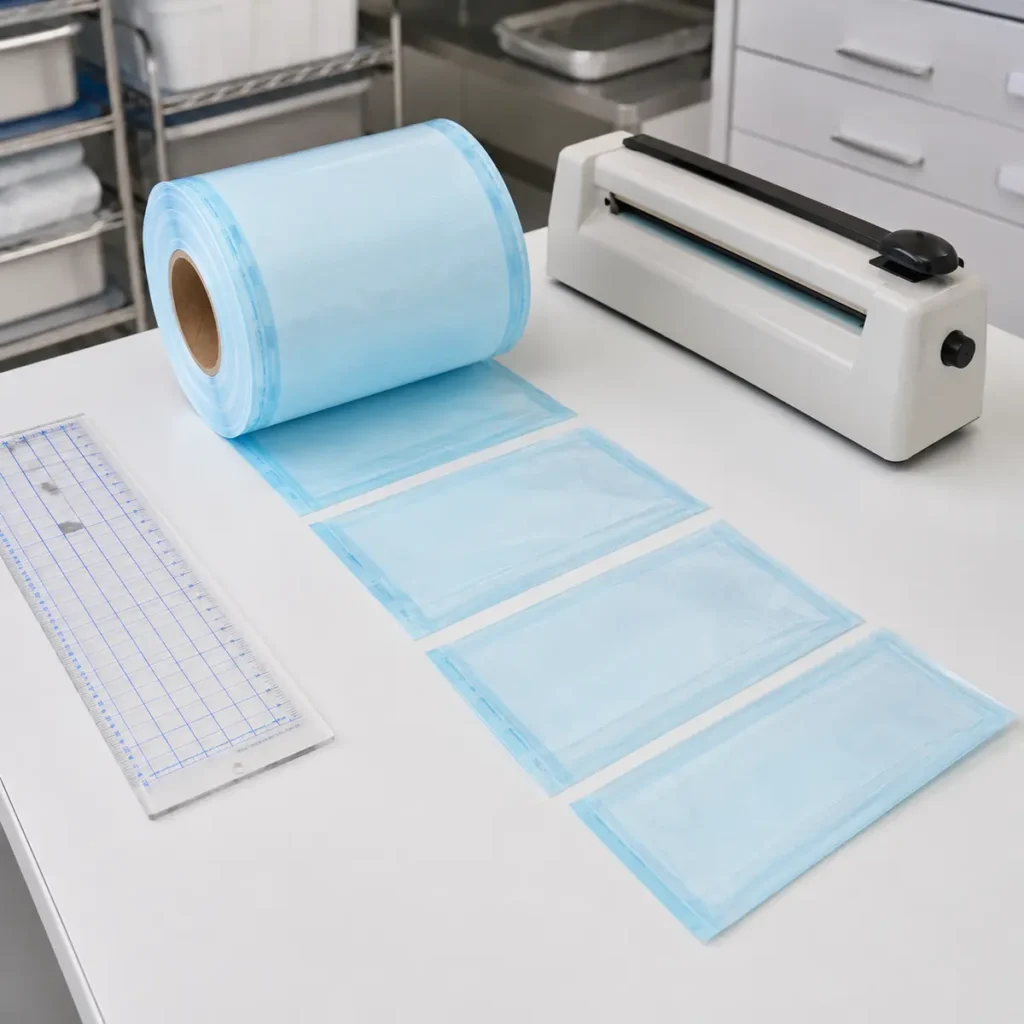
Before selecting a roll, confirm:
- Available roll widths
- Roll length
- Paper specification
- Film structure
- Seal-coating information
- Recommended sealing parameters
- Intended sterilization compatibility
- Process indicator requirements
- Printing and traceability options
- Storage requirements
- MOQ and packaging configuration
Rolls can reduce dependence on multiple pouch lengths, but they also require cutting and sealing controls. The total operational cost should therefore consider equipment, labour, inspection and material waste—not only the price per roll.
How to Choose the Appropriate Format
When comparing self-seal vs heat-seal sterilization pouches and rolls, begin with the actual packing process rather than choosing a format from a catalogue.
Confirm the following information:
1. Medical Device Details
Provide the device name, intended use, dimensions, weight, photographs and technical drawings. Identify sharp points, fragile parts and areas requiring protection.
2. Packing Environment
Clarify whether the package will be prepared in a dental practice, hospital, contract-packing operation or medical device production facility.
3. Sterilization Method
State the intended sterilization process and available cycle information. Do not rely only on a general material description.
4. Preferred Closure Process
Confirm whether the operation requires an adhesive self-seal closure, controlled heat sealing or adjustable roll length.
5. Package Dimensions
Distinguish between internal usable dimensions and external dimensions. Leave sufficient space for the device, seals and opening process.
6. Opening Requirements
Confirm the required peel direction, aseptic presentation method and any limitations on fibre tear, film splitting or particulate generation.
7. Testing and Validation Stage
State whether the project requires initial samples, engineering evaluation, validation quantities, pilot production or routine commercial supply.
8. Documentation
Discuss applicable specifications, quality certificates, material information, test reports, batch documents and change-control requirements.
Our medical packaging testing and validation support page explains the distinction between supplier documentation, package testing and the customer’s finished-system validation responsibilities.
Common Selection Mistakes
Choosing Only by Convenience
Self-seal pouches are convenient, but convenience alone does not confirm package suitability.
Assuming Heat Sealing Guarantees a Better Package
Heat sealing provides a controllable process, but unsuitable parameters or materials can still produce weak, incomplete or inconsistent seals.
Cutting Rolls Too Short
Insufficient package length can create stress around the device and leave inadequate space for sealing and opening.
Ignoring Device Shape
Sharp, heavy or irregular devices can puncture films or damage seals even when the package dimensions appear adequate.
Treating All Paper–Plastic Structures as Equivalent
Paper grade, film structure, seal coating and adhesive system can differ between suppliers and products.
Using Supplier Certificates as Finished-System Validation
Supplier documentation supports material and supplier evaluation. It does not automatically validate the customer’s finished medical device packaging system.
How Jinhong Packaging Supports Sterilization Pouch Projects
Jinhong Packaging supports packaging sourcing and project coordination for medical device and healthcare packaging projects.
Based on the information supplied by the customer, we can help coordinate options for:
- Self-seal sterilization pouches
- Heat-seal sterilization pouches
- Medical sterilization rolls
- Dental sterilization pouches
- Medical-grade paper and film structures
- Tyvek pouches and related packaging formats
- Printed and unprinted packaging options
Our role may include communicating specifications with selected manufacturing partners, coordinating samples, confirming available dimensions, collecting applicable supplier documentation and following production details.
Material and format recommendations remain subject to the device, sterilization process, sealing equipment, target market and validation requirements.
Jinhong Packaging does not perform the customer’s regulatory assessment or replace the medical device manufacturer’s packaging and process validation responsibilities.
Frequently Asked Questions
What is the main difference between self-seal and heat-seal sterilization pouches?
A self-seal pouch normally uses a pre-applied adhesive strip and folding flap. A heat-seal pouch is closed using compatible sealing equipment under controlled process parameters. Both formats must be evaluated for the intended device, sterilization process and use conditions.
Do self-seal sterilization pouches require a heat sealer?
Self-seal pouches normally do not require a separate heat sealer for the final closure. The release liner is removed and the flap is folded according to the pouch instructions. Correct folding and closure remain important.
Are heat-seal sterilization pouches better than self-seal pouches?
Not automatically. Heat-seal pouches may provide more control over the sealing process, while self-seal pouches can be convenient for certain healthcare applications. Suitability depends on the device, packing process, sterilization method and validation requirements.
What is the advantage of sterilization rolls?
Sterilization rolls allow the package length to be adjusted for different devices. This can reduce the number of preformed pouch lengths held in stock, but the user must cut and seal the material consistently.
Can the same pouch be used for EO and steam sterilization?
Not necessarily. Compatibility depends on the complete pouch structure, including the paper, film, adhesive, seal coating, printing and indicator system. The specific product and sterilization cycle must be confirmed and evaluated.
Who is responsible for validating the finished medical packaging system?
The medical device manufacturer or other responsible organization must determine the applicable requirements and complete the necessary evaluation and validation. Supplier documentation can support this work but does not replace finished-system validation.
Discuss Your Sterilization Packaging Requirements
The selection of self-seal vs heat-seal sterilization pouches should consider more than closure convenience. Device dimensions, sterilization method, material structure, sealing process, opening requirements and validation plans all influence the final choice.
Jinhong Packaging can help coordinate pouch and roll options through selected manufacturing partners based on the information provided for the project.
Please send the device dimensions, preferred packaging format, sterilization method, expected quantity and documentation requirements for an initial review.