
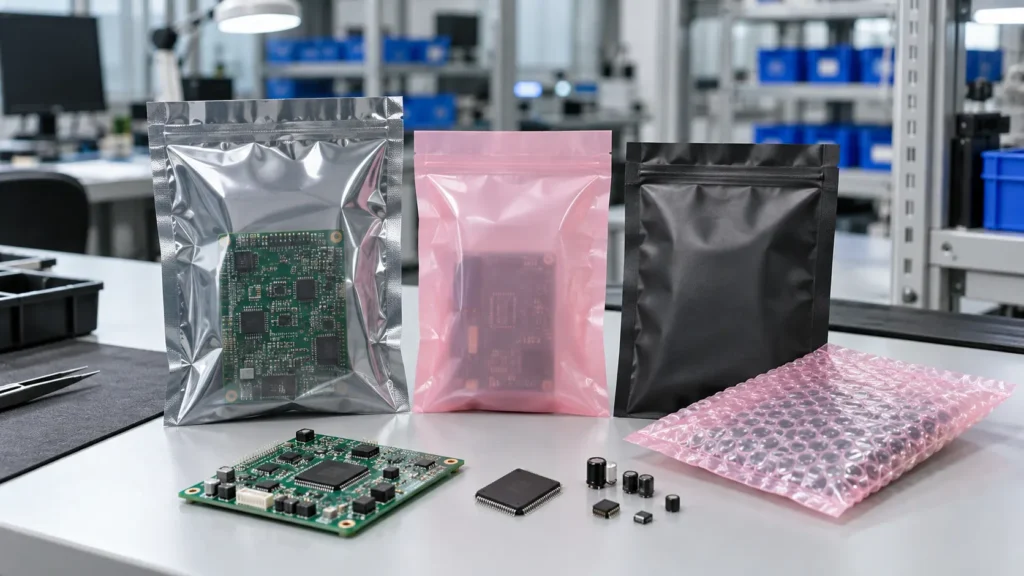
ESD bags help protect electronic components from risks associated with electrostatic discharge during handling, storage and transportation. However, the terms anti-static, static dissipative, conductive and shielding describe different properties. A bag that limits charge generation does not necessarily protect its contents from an external electrostatic discharge.
Selecting the right ESD packaging therefore requires more than choosing a familiar color or a general product name. Buyers need to consider the sensitivity of the component, whether it will remain inside an ESD Protected Area, the required electrical properties, moisture sensitivity, physical protection and sealing method.
This guide explains the main types of ESD bags, their typical applications and the information that should be confirmed before requesting samples.
Quick Answer: Which Type of ESD Bag Should You Choose?
Static shielding bags are commonly considered for ESD-sensitive components that may be handled or transported outside a controlled ESD Protected Area. Their multilayer structure is designed to provide low-charging and dissipative properties while reducing the energy that reaches the packaged item from an external discharge.
Static-dissipative polyethylene bags may be suitable for less sensitive items or controlled handling inside an ESD Protected Area, but they should not automatically be treated as shielding bags.
Conductive bags can move charge rapidly and may be appropriate for certain controlled applications. However, their direct-contact suitability and grounding requirements should be evaluated carefully.
ESD bubble bags combine electrostatic-control properties with cushioning, while ESD moisture barrier bags are intended for components that require both static protection and resistance to moisture transmission.
There is no single ESD bag that is suitable for every electronic product. The correct choice depends on the component, handling environment, required protection functions and applicable customer specification.
For an overview of available formats, visit our ESD Packaging and Anti-Static Bags page.
What Do ESD Bags Protect Against?
Electrostatic charge can build up when materials contact and separate, slide against one another or move through a dry handling environment. People, work surfaces, plastic packaging and transport equipment can all become sources of charge.
Sensitive electronic components may be damaged when electrostatic energy passes through them. Some failures are immediate and easy to identify. Others may be latent, meaning that the component initially functions but has suffered damage that may reduce its reliability.
An ESD packaging system may need to perform several different functions:
- Limit charge generation caused by contact and separation
- Dissipate charge in a controlled manner
- Shield the packaged item from an external discharge
- Reduce exposure to electrostatic fields
- Provide physical protection from puncture, impact or abrasion
- Provide moisture protection when the component is moisture-sensitive
- Maintain protection throughout storage and transportation
Not every ESD bag performs all these functions. Its protective properties depend on the material structure, construction, closure and condition of the finished package.
Anti-Static, Dissipative, Conductive and Shielding Are Not the Same
These terms are often used interchangeably in purchasing requests, but they describe different functions.
Anti-Static or Low-Charging
An anti-static or low-charging material is designed to reduce the amount of charge generated when it contacts or separates from another material.
This property is useful because the packaging itself should not become a major source of electrostatic charge. However, low charge generation alone does not confirm that a bag can shield a sensitive component from an external discharge.
Static Dissipative
A static-dissipative material allows charge to move across or through the material at a controlled rate.
Dissipative materials are often used where rapid discharge could create an additional risk to the packaged component. The exact resistance range and test method should be confirmed from the supplier’s technical data rather than inferred from the color of the bag.
Conductive
Conductive materials allow charge to move more readily than dissipative materials.
Conductive packaging may be useful in specific systems where grounding, containment or rapid charge movement is required. Because charge can move quickly, the product design, direct-contact conditions and handling procedure must be considered before selecting a conductive bag.
Discharge Shielding
A shielding package is designed to reduce the energy reaching its contents when an electrostatic discharge occurs outside the package.
Shielding performance depends on the complete bag structure and the integrity of the enclosure. An open, torn or punctured shielding bag may not provide the intended level of protection.
ANSI/ESD S541 addresses packaging materials used to protect electrostatic-discharge-susceptible items and distinguishes protective functions according to the packaging application.
Main Types of ESD Bags
1. Static-Dissipative Polyethylene Bags
Static-dissipative polyethylene bags are often recognized by a pink or tinted appearance, although color alone does not prove electrical performance.
These bags are designed primarily to reduce charge generation and dissipate charge from their surface. They may be suitable for items used within a controlled ESD Protected Area or for products that are not highly susceptible to external discharge.
Possible advantages include:
- Lightweight and flexible construction
- Good visibility of the packaged item
- Basic protection against dust and handling
- Heat-seal or zipper options
- Economical use in appropriate controlled applications
Points to confirm include:
- Surface or volume resistance data
- Test method and test conditions
- Whether the anti-static property is permanent or additive-based
- Expected service life
- Compatibility with the packaged product
- Whether discharge shielding is required
A pink polyethylene bag should not automatically be selected for shipping an exposed ESD-sensitive device outside an ESD Protected Area. If shielding is required, a verified shielding structure should be evaluated.
2. Metal-In Static Shielding Bags
Metal-in shielding bags normally use a multilayer construction in which a thin metallic layer is positioned between polymer layers.
The outer and inner layers may provide durability, low-charging behavior and heat-sealing capability, while the metallic layer contributes to discharge shielding.
Possible advantages include:
- Discharge shielding for sensitive electronic items
- Low-charging and dissipative surfaces when correctly specified
- Partial visibility of the packaged product
- Compatibility with common heat-sealing processes
- Protection during storage and transportation
Points to confirm include:
- Complete laminate construction
- Surface resistance data
- Shielding test data and test method
- Bag thickness
- Seal strength
- Transparency requirements
- Puncture and flex resistance
- Printed ESD symbols or traceability information
Metal-in bags are widely used for circuit boards, integrated circuits, electronic modules and other sensitive components. However, the exact performance should be verified from the selected structure and supporting test data.
3. Metal-Out Static Shielding Bags
Metal-out shielding bags position the metallic layer closer to the outside surface.
This construction may provide different electrical and mechanical characteristics from a metal-in structure. It can be considered for applications that require stronger conductivity at the outer surface or specific shielding behavior.
Possible advantages include:
- Strong shielding potential in a suitable construction
- Rapid charge movement across the outer layer
- Suitability for certain specialized packaging systems
Important considerations include:
- Greater exposure of the metallic layer to abrasion
- Surface conductivity and grounding requirements
- Risk of contact with adjacent conductive objects
- Corrosion or chemical compatibility
- Flexing and handling conditions
- Customer-specific electrical requirements
Metal-out and metal-in bags should not be treated as interchangeable solely because both have a silver appearance. The complete construction and test results should be compared.
4. Conductive Polyethylene Bags
Conductive polyethylene bags usually incorporate conductive material into a polymer structure. They are commonly black, but appearance should not be used as proof of performance.
They may be used for components, devices or assemblies that require a conductive enclosure within a defined ESD-control process.
Possible advantages include:
- Conductive electrical properties
- Flexible bag construction
- Opaque appearance
- Suitability for some reusable or controlled-handling applications
Points to confirm include:
- Resistance data and test method
- Whether the bag will contact the component directly
- Grounding requirements
- Potential interaction with batteries or exposed contacts
- Cleanliness and particle requirements
- Product identification needs
Conductive packaging should be selected as part of the overall ESD-control system. It is not automatically the best choice simply because its resistance is lower.
5. ESD Bubble Bags
ESD bubble bags combine cushioning with anti-static, dissipative or shielding properties, depending on the construction.
They may be useful for circuit boards, modules, sensors, small instruments and components that need protection from both electrostatic and mechanical hazards.
Possible formats include:
- Static-dissipative bubble bags
- Shielding bubble bags
- Bubble-lined ESD pouches
- Open-top bags
- Zipper bags
- Custom-sized protective sleeves
When comparing ESD bubble bags, confirm both the electrical performance and the physical construction. Bubble height, film thickness, closure design and puncture resistance can affect packaging performance.
A cushioning layer should not be assumed to provide discharge shielding unless the complete structure has been designed and tested for that function.
6. ESD Moisture Barrier Bags
Some electronic components require protection from both electrostatic discharge and moisture.
ESD moisture barrier bags may use a multilayer structure that combines static-control properties with a high-barrier layer. These bags are often considered for moisture-sensitive devices, semiconductors, integrated circuits and components that require controlled dry packaging.
The complete system may include:
- An ESD moisture barrier bag
- A compatible heat seal
- Desiccant
- A humidity indicator card
- Defined internal air volume
- Lot and date identification
- Controlled handling and packing procedures
Moisture barrier performance and ESD shielding are separate properties. Both should be confirmed through appropriate data.
For more information about barrier structures and WVTR, read How to Choose Moisture Barrier Bag Materials.
You can also compare available high-barrier formats on our Moisture Barrier and Aluminum Foil Bags page.
How to Match ESD Bags to the Application
Components Used Inside an ESD Protected Area
Inside an established ESD Protected Area, personnel, work surfaces, equipment and grounding systems are controlled according to the site’s ESD program.
The packaging requirement may therefore differ from a shipment moving through an uncontrolled environment. A static-dissipative bag may be acceptable for some items inside the protected area, but this should be confirmed against the device sensitivity and the customer’s procedure.
Important questions include:
- Will the item remain inside the protected area?
- Will the bag be opened only at a controlled workstation?
- Does the item require discharge shielding?
- Is direct contact with conductive material permitted?
- Will the bag be reused?
- Is sealing required between operations?
Storage or Transportation Outside an ESD Protected Area
Packages moving outside a protected area may be exposed to uncontrolled personnel, plastic containers, conveyor systems, dry conditions and ordinary transport handling.
For sensitive devices, a closed static shielding bag is commonly considered. The bag should remain properly closed throughout the uncontrolled portion of the journey.
The outer carton, cushioning, labels and handling instructions should also support the protection system. An ESD bag does not replace the need for suitable physical packaging.
Printed Circuit Boards and Electronic Modules
Printed circuit boards and assembled modules may have sharp solder points, connectors or irregular edges that can damage a thin bag.
In addition to electrical performance, evaluate:
- Bag dimensions and loading clearance
- Puncture resistance
- Board-edge protection
- Cushioning requirements
- Seal position
- Component height
- Movement inside the package
- Outer-carton support
A shielding bag with insufficient puncture resistance may lose its protective integrity during transportation. Edge protectors, ESD-safe cushioning or a heavier structure may be required.
Integrated Circuits and Semiconductor Components
Integrated circuits and semiconductor devices can vary considerably in their sensitivity to electrostatic discharge and moisture.
Packaging selection may need to consider:
- Device classification
- Tray, tube or reel configuration
- Moisture sensitivity
- Required dry-packing procedure
- Desiccant and humidity indicator use
- Vacuum or controlled air removal
- Lot traceability
- Opening conditions at the destination
Do not select ESD bags only from the component dimensions. The complete handling and storage procedure should be reviewed.
Sensors, Connectors and Precision Electronic Parts
Sensors, connectors, small assemblies and precision parts may require customized bag dimensions, compartment arrangements, labels or cushioning.
If the product has exposed pins or sharp edges, ask whether an additional protective insert or thicker puncture-resistant layer is necessary.
For products that also have cleanliness requirements, electrical performance and cleanliness should be reviewed separately.
Cleanroom and Controlled-Environment Applications
An ESD bag is not automatically suitable for cleanroom use.
Cleanroom projects may require additional control of particles, surface cleanliness, packaging configuration, double-bagging procedures and the production environment. Antistatic additives, printing systems and bag-processing conditions may also need evaluation.
For applications involving controlled environments, see our Cleanroom Packaging Bags.
Zipper Bags or Heat-Seal Bags?
The closure affects both ESD protection and environmental protection.
A zipper provides convenient access and may be suitable for repeated handling inside a controlled process. However, a zipper does not automatically provide the same enclosure integrity as a complete heat seal.
For sensitive components transported outside an ESD Protected Area, confirm whether the bag must be:
- Fully heat-sealed
- Closed with a zipper
- Heat-sealed above the zipper
- Vacuum-sealed
- Tamper-evident
- Reusable after inspection
For ESD moisture barrier bags, heat-sealing conditions are especially important. The sealing temperature, pressure, dwell time, seal width and equipment compatibility should be evaluated during sampling.
Size and Construction Considerations
An ESD bag should be large enough for easy loading without forcing the product against the seals. Excessively large bags, however, may allow unnecessary movement or increase material use.
When specifying dimensions, provide:
- Product length, width and height
- Component weight
- Tray, reel or tube dimensions
- Required loading clearance
- Seal allowance
- Zipper position, if applicable
- Required flap length
- Gusset requirements
- Sharp edges or protruding parts
The finished-bag tolerance should also be agreed before ordering.
For heavy assemblies, the bag’s bottom and side seals may require particular attention. For sharp products, samples should be tested with the actual component rather than with dimensions alone.
Printing, Labels and Traceability
ESD bags may require printed warning symbols, handling instructions, lot information, barcodes or customer branding.
Confirm:
- Required ESD warning symbol
- Print color and print area
- Product or part number
- Lot or batch information
- Date coding
- Barcode or QR-code requirements
- Label adhesion
- Whether printing could affect cleanliness requirements
- Language requirements for destination markets
Printed symbols help identify the packaging, but they do not prove its electrical performance. Technical data and agreed inspection criteria remain necessary.
What Test Data Should Buyers Request?
The required information depends on the bag type and the customer’s ESD-control plan.
Relevant data may include:
- Complete material structure
- Surface or volume resistance
- Static-decay performance
- Charge-generation or low-charging data
- Discharge-shielding performance
- Test methods and environmental conditions
- Material thickness
- Seal-strength information
- Moisture-barrier data when applicable
- Lot inspection records
- Material declarations requested by the customer
Do not compare resistance or shielding figures without checking the test method, conditioning environment and units.
A supplier’s general product description is not a substitute for project-specific requirements. The buyer should identify the applicable specification and acceptance criteria before production.
Common ESD Bag Selection Mistakes
Choosing by Color Alone
Pink is commonly associated with static-dissipative polyethylene, silver with shielding laminates and black with conductive materials. However, color is only a visual convention.
Always verify the material structure and technical data.
Treating Anti-Static as Shielding
A low-charging bag may reduce static generation without shielding its contents from an external discharge.
Confirm which protective functions are required.
Ignoring the Handling Environment
A bag used only at a controlled workstation may have different requirements from a package shipped through an uncontrolled distribution chain.
Define where the bag will be used, opened and resealed.
Ignoring Moisture Sensitivity
A standard shielding bag may provide ESD protection without delivering the moisture barrier required for a moisture-sensitive component.
When both functions are needed, specify both ESD and moisture-barrier performance.
Selecting by Thickness Only
Thickness can affect toughness and puncture resistance, but it does not by itself establish electrical or moisture-barrier performance.
Compare the complete material structure and verified data.
Using an Open or Damaged Shielding Bag
Shielding depends on the integrity of the enclosure. Open closures, tears, punctures and damaged seals may compromise protection.
Packaging inspection should be part of the handling process.
Forgetting Physical Protection
ESD protection does not prevent damage from impact, vibration, abrasion or sharp edges.
Evaluate cushioning, dividers, edge protection and the outer shipping carton together with the ESD bag.
Questions to Answer Before Requesting a Quotation
Provide the following information so that suitable ESD bags can be compared:
- What component or product will be packed?
Include the product name, dimensions, weight, shape and photographs where useful.
- How sensitive is the product to ESD?
Provide the device classification, internal packaging specification or customer requirement where available.
- Where will the package be used?
Clarify whether it will remain inside an ESD Protected Area or travel through an uncontrolled environment.
- Which protective properties are required?
Specify low charging, dissipative, conductive, discharge shielding, moisture barrier, cushioning or a combination.
- Does the product have sharp edges?
Identify pins, connectors, solder points or corners that could puncture the bag.
- Is moisture protection required?
Provide any target WVTR, storage period, desiccant requirement or dry-packing procedure.
- How will the bag be closed?
Specify zipper, heat seal, zipper plus heat seal, vacuum seal or another closure.
- What printing or labeling is needed?
Include symbols, part numbers, barcodes, lot information and language requirements.
- What documents or test reports are required?
Confirm these requirements before sampling rather than after production.
- What quantity and delivery destination are expected?
These details help determine a suitable supply arrangement and shipping plan.
Sampling and Evaluation
Samples should be evaluated with the actual product and intended packing process whenever possible.
Check:
- Product fit and loading clearance
- Seal quality
- Closure position
- Puncture and abrasion risk
- Flexing during handling
- Cushioning performance
- Visibility and product identification
- Print and label quality
- Compatibility with the sealing equipment
- Performance after simulated handling or transportation
Electrical testing may also be required according to the customer’s specification and risk assessment. For ESD moisture barrier bags, moisture-barrier and seal evaluation should be included separately.
Jinhong Packaging supports material comparison, bag specification, custom sizing, sampling and project coordination through selected manufacturing partners. Material availability, electrical data, barrier information and supporting documents are confirmed according to the selected structure and project requirements.
For a broader view of ESD, moisture barrier, cleanroom and medical clean packaging, explore our Protective and Clean Packaging Solutions.
Frequently Asked Questions
What is the difference between anti-static bags and ESD shielding bags?
Anti-static or low-charging bags are designed to reduce charge generation. ESD shielding bags are designed to reduce the energy reaching their contents from an external electrostatic discharge. A bag can have anti-static properties without providing discharge shielding.
Are pink anti-static bags safe for circuit boards?
They may be suitable for some controlled applications, but pink static-dissipative bags should not automatically be treated as shielding bags. The circuit board’s sensitivity, handling location and required protection should be confirmed.
What are silver ESD bags made from?
Many silver shielding bags use a multilayer polymer laminate with a thin metallic layer. The exact construction varies, so buyers should request the full material structure and relevant test data.
What is the difference between metal-in and metal-out ESD bags?
The difference concerns the position of the metallic layer within the laminate. This can affect surface conductivity, durability, abrasion resistance and handling requirements. The two structures should be compared using project-specific data.
Can ESD bags also provide moisture protection?
Some ESD moisture barrier bags are designed to provide both static-control and moisture-barrier functions. A standard shielding bag should not automatically be assumed to provide a high moisture barrier.
Can ESD zipper bags be reused?
Some zipper bags may be reusable within a controlled process, but their condition and electrical performance should be inspected. Bags with punctures, damaged closures, contamination or heavy wear should not be assumed to provide their original protection.
Do ESD bags need to be heat-sealed?
The required closure depends on the component, handling environment and customer procedure. Sensitive components transported outside a protected area may require a completely closed package. Moisture-sensitive components may also require a validated heat seal.
What information is needed for an ESD bag quotation?
Provide the product description, dimensions, weight, ESD sensitivity, handling environment, required protective properties, bag format, closure, printing, test-document requirements, estimated quantity and destination.
Start Your ESD Packaging Project
Selecting ESD bags requires matching electrical protection, material construction, closure, physical durability and handling procedures to the actual product.
Tell us what electronic component or assembly you need to protect, its dimensions and weight, the required ESD properties, moisture sensitivity, packing method, estimated quantity and delivery destination.
We can help compare suitable bag structures, coordinate specifications and samples, and follow the project through the selected supply arrangement.