
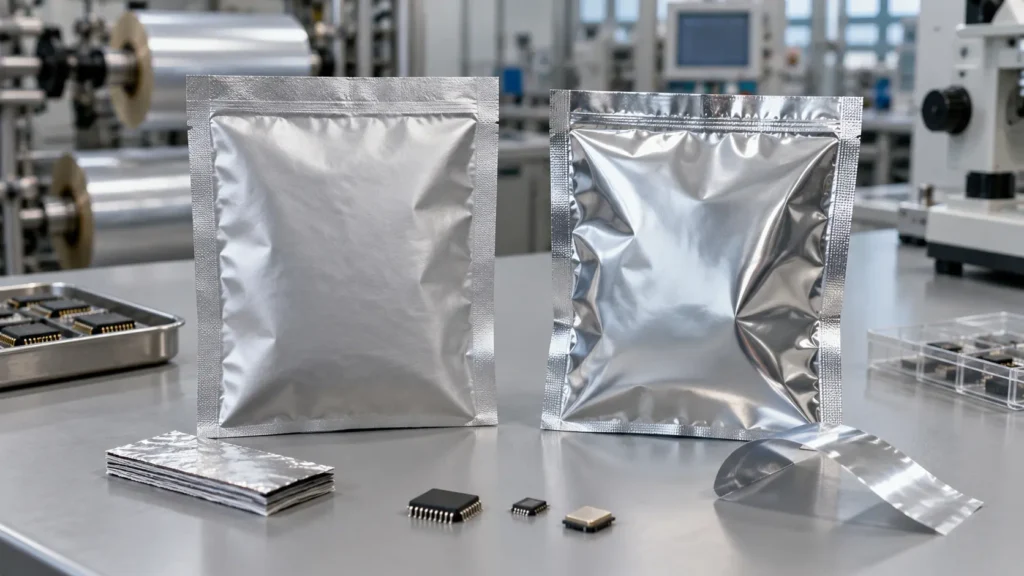
Aluminum foil bags and metallized bags may look similar from the outside, but their barrier layers, performance characteristics and suitable applications are different.
An aluminum foil laminate contains a continuous layer of aluminum foil. A metallized laminate normally uses a polymer film, such as PET, with a very thin layer of aluminum deposited onto its surface.
Both structures can reduce the transmission of moisture, oxygen and light. However, they should not be treated as interchangeable simply because both have a silver appearance.
The correct choice depends on the required barrier level, storage period, product sensitivity, bag construction, handling conditions, sealing process and budget.
This guide compares aluminum foil bags vs metallized bags and explains the information buyers should confirm before selecting a material.
For a broader overview of barrier material selection, read our How to Choose Moisture Barrier Bag Materials guide.
Quick Answer: Aluminum Foil Bags or Metallized Bags?
When comparing aluminum foil bags vs metallized bags, aluminum foil structures are generally considered when the product requires a very strong barrier against moisture, oxygen and light.They may be suitable for sensitive electronics, precision components, instruments, powders and products intended for protected or extended storage.
Metallized bags may be suitable when moderate-to-high barrier performance is sufficient and the buyer wants a lighter, more flexible or more economical structure. They are widely considered for food, coffee, supplements, pet products and selected industrial applications.
Neither material is automatically the better choice.
Choose according to verified barrier requirements and actual use conditions rather than appearance, layer count or material name alone.
For an overview of available barrier formats, visit our Moisture Barrier and Aluminum Foil Bags page.
What Is an Aluminum Foil Bag?
An aluminum foil bag is normally made from a multilayer laminate containing a continuous aluminum foil layer.
The foil itself is not usually used as a finished bag without supporting layers. It is combined with other materials to provide mechanical strength, printability, sealing and product-contact performance.
A possible laminate may include:
- An outer PET or nylon layer
- An adhesive layer
- Aluminum foil
- An inner polyethylene or other heat-seal layer
The exact construction varies by application. The buyer should not assume that every foil bag uses the same layers or foil thickness.
The outer layer may support printing and abrasion resistance. The foil provides the primary barrier. The inner layer allows the bag to be heat sealed and may provide the required product-contact surface.
Additional layers may be used when greater puncture resistance, mechanical strength or processing performance is required.
What Is a Metallized Bag?
A metallized bag uses a polymer film coated with a very thin deposited metal layer, commonly aluminum.
Metallized PET, often abbreviated as VMPET, is one frequently used option. Metallized polypropylene and other coated films may also be used according to the application.
A possible metallized structure may include:
- An outer printed PET or BOPP layer
- Metallized PET or metallized polypropylene
- An inner polyethylene or CPP heat-seal layer
The deposited aluminum layer is much thinner than a separate aluminum foil layer. It can improve moisture, oxygen and light resistance while allowing the laminate to remain relatively light and flexible.
However, the performance of metallized film depends on coating uniformity, optical density, pinholes, flexing, laminate construction and converting quality.
A silver or reflective appearance does not confirm a specific barrier value.
The Main Difference Is the Barrier Layer
The central difference between these materials is how aluminum is incorporated into the structure.
In an aluminum foil laminate, a separate continuous foil layer acts as the principal barrier.
In a metallized laminate, aluminum is deposited as a very thin coating on a polymer film.
This difference affects:
- Moisture barrier
- Oxygen barrier
- Light protection
- Flexibility
- Flex-crack behavior
- Puncture resistance
- Package appearance
- Material weight
- Cost
- Metal detection and inspection options
- Suitability for different storage periods
The complete laminate still matters. It is not enough to compare only “foil” with “metallized PET” without reviewing the supporting layers, thicknesses, sealant and finished-bag construction.
Moisture Barrier Performance
Aluminum foil laminates generally provide stronger resistance to water-vapor transmission when the foil remains undamaged and the package is properly sealed.
This can make foil structures appropriate for products that are highly sensitive to humidity or require protected storage for an extended period.
Metallized films can also provide useful moisture resistance, but their performance is normally below that of an intact foil laminate.
The required level should be defined using a target water vapor transmission rate rather than descriptions such as “good barrier” or “high barrier.”
WVTR results should always be reviewed together with:
- Test method
- Temperature
- Relative humidity
- Material thickness
- Laminate construction
- Sample condition
- Test date
- Whether the value applies to film or finished packaging
ASTM F1249 is one recognized method for measuring water vapor transmission through plastic film and sheeting using a modulated infrared sensor.
Test values obtained under different conditions should not be compared as if they were equivalent.
Oxygen Barrier Performance
Products sensitive to oxidation may require control of oxygen entering the package.
An intact foil layer can provide a very strong oxygen barrier. Metallized film can also reduce oxygen transmission, but the result depends on the quality and continuity of the deposited metal layer and the overall laminate.
Oxygen barrier may be important for:
- Sensitive electronic components
- Coffee
- Foods containing fats or oils
- Nutritional powders
- Selected chemicals
- Products affected by oxidation
- Long-term protected storage
If oxygen protection is critical, request the oxygen transmission rate, test conditions and applicable acceptance criteria.
Do not rely only on the bag’s opaque or metallic appearance.
Light Protection
Aluminum foil provides complete opacity when the foil layer is continuous and undamaged. This makes it useful for products that require strong protection from visible light or ultraviolet exposure.
Metallized films also reduce light transmission, but the level depends on the coating and film construction.
Some metallized films may appear highly reflective while still allowing more light transmission than foil.
For light-sensitive products, buyers should confirm whether complete opacity is required or whether reduced light transmission is sufficient.
Puncture and Flex-Crack Considerations
Foil provides excellent barrier performance, but a thin foil layer can be vulnerable to repeated bending, sharp folds and flex cracking.
Damage may occur during:
- Bag converting
- Folding
- Vacuum packing
- Loading irregular products
- Compression
- Repeated handling
- Long-distance transportation
- Contact with sharp product edges
A foil laminate may therefore require a nylon layer, stronger outer film, thicker sealant layer, protective wrapping or another form of cushioning.
Metallized laminates are generally more flexible and may tolerate repeated flexing better in suitable constructions. However, abrasion, stretching or damage to the deposited metal coating can still reduce barrier performance.
A laboratory value measured on flat film does not automatically represent the performance of a folded, handled and filled bag.
The finished package should be evaluated under realistic packing and transportation conditions.
Puncture Resistance Is Not Determined by the Metal Layer Alone
It is a mistake to assume that aluminum foil automatically makes a bag puncture resistant.
Puncture resistance is influenced by:
- Outer film
- Nylon or other reinforcing layers
- Total laminate thickness
- Sealant thickness
- Bag dimensions
- Product weight
- Sharp edges
- Vacuum level
- Handling conditions
A metallized nylon-PE structure may provide better resistance to puncture than a poorly specified foil laminate, even though the foil laminate offers a stronger moisture barrier.
The correct structure must balance barrier and mechanical protection.
Appearance and Product Visibility
Both aluminum foil and metallized laminates can create a metallic appearance, but their visual characteristics are not identical.
Foil laminates are normally fully opaque.
Metallized films may have a bright reflective appearance. Depending on the structure and coating, some products may also use partially metallized or patterned formats.
If product visibility is needed, neither a standard opaque foil bag nor a fully metallized bag may be ideal. A transparent high-barrier structure or a bag with a carefully designed window may be considered.
Adding a window can reduce the overall barrier performance of the package. The window material and exposed area should therefore be reviewed as part of the complete package.
Weight, Flexibility and Handling
Metallized laminates are generally lighter and more flexible because the deposited aluminum layer is extremely thin.
This may support:
- Easier handling
- Lower material weight
- Softer package feel
- Efficient converting
- Retail packaging formats
- Lower material cost in suitable applications
Foil laminates may feel stiffer, especially when combined with reinforcing layers. This stiffness can be useful for some package formats but may be less suitable where frequent folding or a soft retail feel is required.
Material feel should be evaluated using actual laminate samples rather than photographs.
Cost Considerations
Cost is another important factor when comparing aluminum foil bags vs metallized bags.Metallized laminates are often more economical than aluminum foil laminates, but the lowest material price does not always produce the lowest total packaging cost.
A lower-cost material may become unsuitable if it cannot meet the required:
- Storage period
- Moisture protection
- Oxygen protection
- Light barrier
- Seal integrity
- Puncture resistance
- Transportation conditions
- Product-loss limits
At the same time, specifying foil for every product may create unnecessary cost when a properly tested metallized structure already meets the required performance.
The purchasing decision should be based on the minimum verified performance needed for the application, with an appropriate safety margin.
Aluminum Foil Bags for Electronics and Precision Components
Foil-based moisture barrier bags may be considered for electronic components, sensors, circuit boards, instruments and precision parts that require controlled humidity during storage or transportation.
The packaging system may include:
- A foil or moisture-barrier laminate
- Heat sealing
- Desiccant
- A humidity indicator card
- ESD protection where required
- Vacuum or controlled air removal
- Lot identification
- Protective secondary packaging
A standard foil bag is not automatically ESD protective.
If the product is sensitive to electrostatic discharge, the buyer should separately specify the required electrical performance. Some moisture barrier shielding bags are designed to combine humidity control with electrostatic shielding.
For more information about electrical protection, read ESD Bags: Types, Materials and Applications.
Aluminum Foil and Metallized Bags for Food and Coffee
Both structures may be used for food, coffee, pet products and powdered products, depending on the required shelf life and product sensitivity.
Important factors include:
- Oxygen sensitivity
- Moisture sensitivity
- Aroma retention
- Light sensitivity
- Fat or oil content
- Filling temperature
- Required shelf life
- Seal integrity
- Valve requirements
- Product-contact compliance
- Storage and distribution conditions
Coffee packaging may use metallized laminates when the selected structure provides the required barrier and sealing performance.
Foil laminates may be considered when a stronger barrier is required, but the material alone does not determine shelf life. Degassing valves, residual oxygen, seal quality, filling conditions and storage environment also affect performance.
No shelf-life claim should be made solely from the material name.
Use in Cleanroom and Controlled Environments
An aluminum foil or metallized laminate is not automatically suitable for cleanroom use.
Cleanliness and barrier performance are separate characteristics.
For cleanroom or contamination-sensitive applications, confirm:
- Film-production environment
- Bag-converting environment
- Particles and visible contamination
- Residue requirements
- Ionic contamination requirements
- Additives
- Outgassing
- Inner and outer packaging
- Handling and transfer procedures
A high-barrier bag may still fail the project’s cleanliness requirements.
For additional guidance, read Cleanroom Packaging Materials and Cleanliness Considerations.
Sealing Performance
The barrier material cannot protect the product if the finished bag is not sealed correctly.
Important sealing factors include:
- Inner sealant material
- Sealing temperature
- Dwell time
- Pressure
- Seal width
- Bag opening design
- Product contamination in the seal area
- Wrinkles or folds
- Sealing-equipment compatibility
- Inspection method
Foil and metallized laminates may require different sealing conditions depending on their sealant layers and total constructions.
Samples should be tested using the customer’s intended packing equipment whenever possible.
Can Aluminum Foil Bags Be Vacuum Sealed?
Many aluminum foil laminates can be vacuum sealed, but suitability must be confirmed for the specific bag structure and product.
Vacuum packing can place additional stress on the laminate, folds and product edges. Irregular or sharp components may puncture the bag or damage the foil barrier.
Before approving the structure, evaluate:
- Product shape
- Sharp edges
- Vacuum level
- Film flexibility
- Puncture resistance
- Seal strength
- Wrinkling
- Need for cushioning or protective wrapping
A nylon-reinforced foil structure may be considered when additional toughness is required.
How to Identify Foil and Metallized Structures
Appearance alone is not a reliable identification method.
A supplier should provide the complete material structure, including:
- Layer sequence
- Material of each layer
- Thickness of each layer
- Total thickness
- Aluminum foil thickness, if applicable
- Metallized film type, if applicable
- Sealant material
- Adhesive or lamination system
- Relevant test data
Descriptions such as “silver bag,” “aluminum bag,” “foil-look bag” or “Mylar bag” are not precise material specifications.
The word “Mylar” is also frequently used informally for different types of polyester-based bags. It should not replace a complete laminate description.
Questions to Ask Before Choosing
Before comparing aluminum foil bags vs metallized bags, provide the following information.
What product will be packed?
Include the product dimensions, weight, shape, surface condition and any sharp edges.
Which risks must be controlled?
Identify moisture, oxygen, light, electrostatic discharge, particles, puncture, abrasion or odor requirements.
How long will the product be stored?
Provide the expected production, storage, transportation and end-use period.
What are the storage and shipping conditions?
Include temperature, relative humidity, transportation method and destination where relevant.
Is a target WVTR or OTR required?
Provide the required value, test method and test conditions.
Is ESD protection required?
Specify whether the product needs low-charging, static-dissipative, conductive or discharge-shielding packaging.
Will desiccant or a humidity indicator card be used?
Confirm the dry-packing process and required accessory quantities.
How will the bag be sealed?
Identify the sealing equipment, seal width, vacuum requirements and packing procedure.
Are there product-contact requirements?
Provide the applicable market, product type and requested declarations or test reports.
What quantity and bag size are required?
Include internal dimensions, thickness, format, printing and estimated order quantity.
Documents and Test Data Buyers May Request
Documentation depends on the product and application.
Possible requirements include:
- Complete laminate specification
- Material and layer thicknesses
- Certificate of analysis
- Dimensional inspection
- WVTR data
- Oxygen transmission data
- Seal-strength data
- Puncture or mechanical test data
- ESD performance data
- Product-contact documentation
- Restricted-substance declarations
- Lot traceability
- Change-notification requirements
Testing and documentation availability should be confirmed before sample approval. Not every structure or order quantity includes the same test package.
Common Selection Mistakes
Choosing by Appearance
A shiny silver bag may be foil, metallized film or another coated structure.
Request the complete material specification.
Assuming More Layers Always Mean Better Performance
Layer count alone does not determine barrier, puncture resistance or sealing quality.
Review the function and thickness of each layer.
Comparing Barrier Values Under Different Conditions
WVTR and OTR values cannot be compared correctly unless the test methods and conditions are consistent.
Ignoring Flex Cracking
A strong initial foil barrier may be reduced if the laminate is repeatedly folded or damaged.
Evaluate the filled package, not only unused flat film.
Treating Foil as Automatically ESD Protective
Moisture barrier and electrostatic protection are different requirements.
Specify both when necessary.
Selecting Only by Price
A cheaper metallized structure may be unsuitable for a highly moisture-sensitive product. An expensive foil structure may be unnecessary for a less demanding application.
Define the required performance first.
Ignoring Seals and Closures
Barrier film cannot compensate for weak seals, contaminated seal areas or unsuitable closures.
Review the complete packaging system.
Sampling and Evaluation
Samples should be tested with the actual product and intended packing process whenever possible.
Check:
- Product fit
- Loading procedure
- Film flexibility
- Puncture risk
- Fold and flex behavior
- Vacuum performance
- Seal quality
- Appearance
- Package integrity
- ESD performance where required
- Desiccant and humidity-card placement
- Secondary packaging
- Transportation conditions
Laboratory testing may also be required according to the buyer’s specification and risk assessment.
Jinhong Packaging supports material comparison, custom bag specifications, sampling and project coordination through selected manufacturing partners. Final structures, performance requirements, documentation and order conditions are confirmed according to the selected project.
For a broader overview of moisture, ESD and clean packaging options, explore our Protective and Clean Packaging Solutions.
Frequently Asked Questions
Are aluminum foil bags better than metallized bags?
Not in every application. Aluminum foil bags generally provide a stronger moisture, oxygen and light barrier, while metallized bags may offer a more economical and flexible solution. The correct choice depends on the product and verified performance requirements.
Can metallized bags replace aluminum foil bags?
They can replace foil in some applications when the metallized structure meets the required barrier, sealing, durability and storage conditions. They should not be treated as equivalent without reviewing test data.
How can I tell whether a bag contains aluminum foil?
Do not rely only on appearance. Request the complete laminate structure and the thickness of every layer from the supplier.
Are metallized bags transparent?
Fully metallized films are generally reflective and substantially opaque, although their light barrier may differ from aluminum foil. Partially metallized and window structures are also possible.
Which material provides the better moisture barrier?
An intact aluminum foil laminate generally provides the stronger moisture barrier. Actual package performance still depends on foil condition, flex cracking, seals and finished-bag integrity.
Are aluminum foil bags puncture resistant?
Not automatically. Puncture resistance depends on the supporting films, total structure, product shape and handling conditions. Foil can develop pinholes or flex cracks if it is damaged.
Are aluminum foil bags ESD safe?
A standard foil laminate is not automatically an ESD packaging system. Required surface resistance, shielding or other electrical properties must be specified and verified separately.
Which material is more suitable for coffee packaging?
Both may be suitable. Selection depends on the required shelf life, oxygen and moisture barrier, aroma retention, valve, filling process and storage conditions.
Should I compare WVTR values before ordering?
Yes, when moisture protection is important. Compare values only when the test method, temperature, relative humidity, laminate structure and thickness are clearly stated.
Start Your Moisture Barrier Packaging Project
Choosing aluminum foil bags vs metallized bags requires more than comparing appearance or price.
Tell us what product you need to pack, its dimensions and weight, the required storage period, moisture or oxygen sensitivity, handling conditions, sealing method, ESD requirements, estimated quantity and delivery destination.
We can help compare suitable structures, coordinate specifications and samples, and follow the project through the selected supply arrangement.