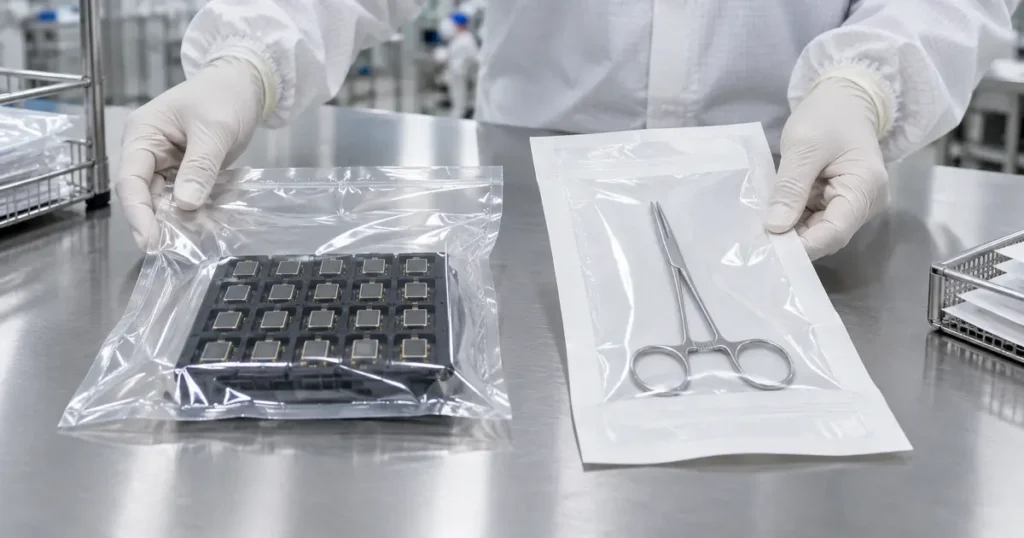
Cleanroom packaging vs sterile packaging is an important distinction for electronics, precision products and medical devices. A package produced or filled in a controlled cleanroom is not automatically sterile, and a sterile medical device package requires more than clean manufacturing conditions.
The correct packaging approach depends on the product, contamination risks, intended use, sterilization process, required shelf life and applicable quality or regulatory requirements.
This guide explains seven important differences between cleanroom packaging and sterile packaging, helping electronics, precision-product and medical-device buyers define the correct material, processing environment and documentation requirements.
Cleanroom Packaging vs Sterile Packaging: Quick Answer
No. Cleanroom packaging is produced, converted or packed in an environment where airborne particles and other contamination risks are controlled according to defined procedures.
Sterile packaging is part of a system intended to maintain the sterility of a product after a validated sterilization process until the package is opened or damaged.
A cleanroom can support the production of sterile-barrier packaging, but cleanroom processing alone does not prove that either the packaging or the packed product is sterile.
What Is Cleanroom Packaging?
Cleanroom packaging refers to bags, films, liners, trays or other packaging components produced or handled under controlled environmental conditions.
The requirements may include controls for:
- Airborne particles
- Surface cleanliness
- Personnel clothing and movement
- Cleaning procedures
- Material entry
- Equipment suitability
- Temperature and humidity
- Static electricity
- Bioburden, when specified
- Documentation and traceability
ISO 14644-1 classifies cleanrooms according to airborne particle concentration. However, an ISO cleanroom class does not by itself define the sterility, bioburden, chemical cleanliness or ESD performance of the packaging.
The purchaser must identify which contamination risks matter for the actual product.
Learn more about our cleanroom packaging bags for electronics, precision components and medical clean non-sterile applications.
What Is Sterile Packaging?
Sterile packaging for medical devices normally includes a sterile barrier system designed to allow sterilization, protect the device and maintain sterility until the point of use.
Depending on the device and sterilization method, common sterile-barrier formats include:
- Paper-film sterilization pouches
- Medical-grade paper rolls
- Tyvek pouches
- Header bags
- Formed trays with compatible lidding
- High-barrier medical pouches
- Double-barrier packaging systems
The packaging material and sealing process must be compatible with the intended sterilization method. The completed system may require validation for forming, sealing, assembly, sterilization, distribution and shelf-life performance.
ISO 11607-1 addresses materials, sterile barrier systems and packaging systems for terminally sterilized medical devices. ISO 11607-2 addresses validation requirements for forming, sealing and assembly processes.
Difference 1: Environmental Control Is Not the Same as Sterility
A cleanroom controls environmental contamination to a defined level. It does not automatically eliminate all viable microorganisms from the packaging or product.
Sterility is achieved through a validated sterilization process appropriate for the device and packaging system. Common methods include:
- Steam sterilization
- Ethylene oxide sterilization
- Radiation sterilization
- Low-temperature sterilization processes
- Dry heat for compatible products
The packaging must allow the selected sterilization process to work where required while maintaining package integrity afterward.
For example, a pouch manufactured in a controlled cleanroom may still be supplied as non-sterile. It only becomes part of a sterile packaging system after the device is packed, sealed, sterilized and validated according to the applicable process.
Difference 2: The Required Standards Are Different
The standards for cleanroom packaging vs sterile packaging address different risks, processes and performance requirements.
Cleanroom Packaging Standards
The ISO 14644 series addresses cleanrooms and associated controlled environments. ISO 14644-1 classifies air cleanliness by particle concentration, while other parts address monitoring, testing, design, operation and surface cleanliness.
The relevant cleanroom class should be specified together with the actual contamination-control requirements.
Sterile Packaging Standards
ISO 11607 is a principal reference for packaging systems used with terminally sterilized medical devices.
Depending on the market, device and packaging format, projects may also refer to:
- EN 868 series
- ASTM packaging test methods
- Sterilization-specific standards
- Customer validation protocols
- Medical-device quality-system requirements
- Transportation simulation standards
A packaging supplier’s cleanroom certificate does not replace sterile-barrier-system validation.
Difference 3: Cleanliness and Microbial Control Are Evaluated Differently
Cleanliness can involve several different types of contamination:
- Airborne particles
- Surface particles
- Fibres
- Oils and residues
- Ionic contamination
- Chemical contamination
- Microbial contamination
- Foreign matter
A cleanroom classification normally focuses on airborne particle concentration. It should not be interpreted as a complete statement about every other type of contamination.
Medical-device packaging may also require bioburden control. Bioburden refers to the population of viable microorganisms present on a product or packaging before sterilization.
The required level of microbial monitoring depends on the product, process and quality plan. A low-particle package is not automatically a low-bioburden package unless the appropriate controls and evidence are available.
Difference 4: Material Selection Follows Different Priorities
Cleanroom packaging materials are often selected for properties such as:
- Low particle generation
- Low outgassing
- Clean surfaces
- Controlled additive levels
- Chemical compatibility
- Static-control properties
- Moisture-barrier performance
- Puncture resistance
- Clean sealing
Sterile packaging materials must also support the sterilization and sterile-barrier requirements of the medical device.
Important considerations may include:
- Sterilant penetration
- Microbial barrier performance
- Seal strength
- Peel characteristics
- Breathability
- Film transparency
- Puncture resistance
- Compatibility with sterilization exposure
- Package integrity
- Shelf-life performance
A material suitable for a cleanroom liner or electronics bag may not be suitable as a sterile barrier for a medical device.
Similarly, a medical-grade paper pouch intended for steam or ethylene oxide sterilization may not provide the moisture barrier, ESD shielding or low-outgassing performance needed for sensitive electronic components.
See our overview of medical-grade paper and films for related material considerations.
Difference 5: The Sealing Process Has Different Validation Requirements
Both cleanroom packaging and sterile packaging require reliable seals, but the level and purpose of process control may differ.
Cleanroom Packaging Seals
Cleanroom bags may be heat sealed to:
- Limit particle entry
- Protect clean surfaces
- Provide moisture protection
- Maintain ESD performance
- Prevent leakage or product loss
- Support controlled transfer between environments
The required controls depend on the product and packaging specification.
Sterile-Barrier Seals
A sterile-barrier seal must support the integrity of the validated packaging system.
Important parameters may include:
- Sealing temperature
- Pressure
- Dwell time
- Seal width
- Seal continuity
- Seal strength
- Peel behaviour
- Visual appearance
- Equipment calibration
- Process limits
- Operator procedures
Seal testing alone does not establish the full suitability of the package. The final system may also require package-integrity, distribution and ageing evaluations.
Difference 6: Sterilization Compatibility Must Be Confirmed
Cleanroom packaging that will not be sterilized does not need to withstand a sterilization cycle unless the project specifically requires it.
Sterile packaging must be compatible with the intended sterilization method.
Steam Sterilization
Steam requires materials that allow steam penetration and tolerate heat and moisture. Medical-grade paper and compatible transparent films are commonly used.
Ethylene Oxide Sterilization
Ethylene oxide packaging typically requires sufficient gas penetration and aeration. Medical-grade paper and Tyvek are common porous components, depending on the product and process.
Radiation Sterilization
Radiation can affect polymer strength, colour, brittleness and seal performance. Material compatibility must be evaluated at the applicable dose and over the intended shelf life.
Other Sterilization Processes
Low-temperature processes and dry heat may require different material structures and performance checks.
A packaging material should not be described as universally compatible with every sterilization method. Compatibility must be confirmed for the specific material, process and device.
Difference 7: Documentation and Validation Expectations Are Different
Cleanroom packaging buyers may request documentation such as:
- Cleanroom classification
- Environmental monitoring information
- Material specification
- Particle-control procedures
- Surface cleanliness data
- ESD test information
- Moisture-barrier data
- Lot identification
- Inspection records
- Certificate of conformance
Sterile medical-device packaging projects may additionally require:
- Material compliance documentation
- Seal-process validation support
- Sterilization compatibility data
- Package-integrity test results
- Microbial-barrier information
- Bioburden-related controls
- Distribution testing
- Accelerated and real-time ageing plans
- Change-control procedures
- Traceability records
The precise documentation package should be agreed before sampling and production. Requirements vary considerably between a clean non-sterile component bag and a validated sterile barrier system.
Clean Non-Sterile Medical Packaging
Some medical products require clean packaging but are not supplied sterile.
Examples may include:
- Components that will undergo further processing
- Device parts transferred between controlled areas
- Non-sterile diagnostic components
- Cleanroom consumables
- Medical-device subassemblies
- Products sterilized later by another facility
- Protective packaging outside the sterile barrier
For these applications, the packaging may focus on particle control, cleanliness, traceability and product protection without claiming sterility.
This is the distinction behind our medical clean non-sterile packaging category.
The package should be clearly identified as non-sterile when necessary to prevent confusion during handling and use.
When Is Double Packaging Used?
Double packaging uses an inner and outer package to support controlled transfer between areas.
It may be used when:
- A product moves through multiple cleanliness zones
- The outer package is removed before entry into a cleaner area
- A sterile item needs an additional protective layer
- A clean component requires protection during transportation
- The inner package must remain protected from external contamination
Double packaging does not automatically create sterility. The role of each layer, opening sequence, sterilization exposure and transfer procedure must be clearly defined.
Cleanroom Packaging for Electronics
Electronics and precision components often require cleanroom-compatible packaging without sterile-barrier requirements.
Important considerations may include:
- Particle generation
- Ionic contamination
- Outgassing
- ESD protection
- Moisture control
- Surface compatibility
- Product contact
- Sharp-edge protection
- Heat-seal performance
- Double-bagging procedures
Some components require a combination of cleanroom, ESD and moisture-barrier performance.
For a wider review, see our protective and clean packaging solutions.
Sterile Packaging for Medical Devices
Medical-device sterile packaging begins with the requirements of the device and sterilization process.
The project should define:
- Device dimensions and weight
- Sharp edges or delicate components
- Sterilization method
- Required microbial barrier
- Opening and presentation method
- Seal and peel requirements
- Transportation risks
- Intended shelf life
- Labelling requirements
- Applicable standards
- Required validation documentation
Common structures may include porous webs combined with transparent films or rigid trays sealed with compatible lidding materials.
Read our guide to medical blister tray and lidding selection for rigid sterile-barrier considerations.
Common Selection Mistakes
Assuming “Made in a Cleanroom” Means Sterile
Cleanroom production controls contamination but does not replace sterilization.
Choosing a Cleanroom Class Without Defining the Product Risk
A cleanroom class alone does not describe surface cleanliness, bioburden, ESD performance or chemical residues.
Using a Clean Bag as a Sterile Barrier Without Validation
A clean bag may protect against particles but may not provide a validated microbial barrier or sterilization-compatible seal.
Describing Non-Sterile Packaging as Sterile
Sterile claims require an appropriate sterilization process and supporting validation.
Ignoring the Outer Packaging
Shipping cartons, cushioning and secondary packaging can introduce particles, puncture the primary package or interfere with clean transfer procedures.
Selecting Materials Before Confirming Sterilization
The sterilization method can affect film, paper, Tyvek, adhesives, inks and seals. It should be confirmed early in the project.
Treating Every Medical Package as a Sterile Barrier
Many medical components need controlled clean packaging without being supplied sterile. The packaging requirement should match the actual intended use.
Information Needed Before Selecting the Packaging
To compare cleanroom or sterile packaging options, prepare:
- Product description and intended use
- Product dimensions and weight
- Whether the product is supplied sterile
- Required sterilization method
- Cleanroom or controlled-environment requirements
- Particle and cleanliness requirements
- Bioburden requirements, if applicable
- Material preferences
- Required barrier properties
- Seal and opening requirements
- Double-bagging requirements
- Transportation method
- Intended shelf life
- Applicable standards
- Required testing and documentation
- Estimated quantity
If the requirements are still being developed, the review can begin with the product, current packaging format, intended process and primary contamination risks.
How Jinhong Packaging Supports Packaging Projects
Jinhong Packaging supports packaging sourcing and project coordination through selected production partners.
Our role may include:
- Comparing cleanroom-compatible bag structures
- Coordinating medical packaging material options
- Confirming clean or non-sterile requirements
- Reviewing available supplier documentation
- Coordinating samples
- Confirming dimensions and sealing formats
- Supporting printing and labelling requirements
- Following production specifications
- Coordinating project documentation
We do not describe cleanroom packaging as sterile unless the complete product, packaging and sterilization system supports that claim.
Frequently Asked Questions
Is packaging produced in an ISO Class 7 cleanroom sterile?
No. ISO Class 7 refers to airborne particle concentration under defined conditions. It does not mean that the package has undergone sterilization or that sterility has been validated.
Can cleanroom packaging be used for medical devices?
Yes. Cleanroom packaging may be used for medical-device components, non-sterile devices, clean transfers or as part of a sterile-barrier-system production process. The exact requirements depend on the product and intended use.
What is a sterile barrier system?
A sterile barrier system is the minimum package that prevents microorganism entry and allows the product to be presented aseptically at the point of use.
Is low bioburden the same as sterile?
No. Low bioburden means the microbial population is controlled or reduced before sterilization. Sterile means the product has undergone an appropriate validated sterilization process and meets the applicable sterility requirements.
Does every sterile package require a cleanroom?
The required manufacturing environment depends on the product, packaging process, quality system and applicable requirements. Cleanroom controls are commonly used, but the required classification and controls must be determined for the specific process.
Can the same film be used for steam, EO and radiation sterilization?
Not automatically. Material and seal compatibility must be evaluated for the intended sterilization method and exposure conditions.
Discuss Your Packaging Requirements
Send us your product type, dimensions, cleanliness requirements, sterilization method, packaging format, quantity and applicable standards.
Jinhong Packaging can help compare cleanroom bags, clean non-sterile medical packaging, sterile-barrier material options and related project documentation according to your requirements.