Choosing the correct sterilization pouch size is essential for package integrity, effective processing, safe handling and controlled opening.
A pouch that is too small may place excessive stress on the materials, seals or closure area. A pouch that is too large may allow unnecessary instrument movement, create folds or increase packaging waste.
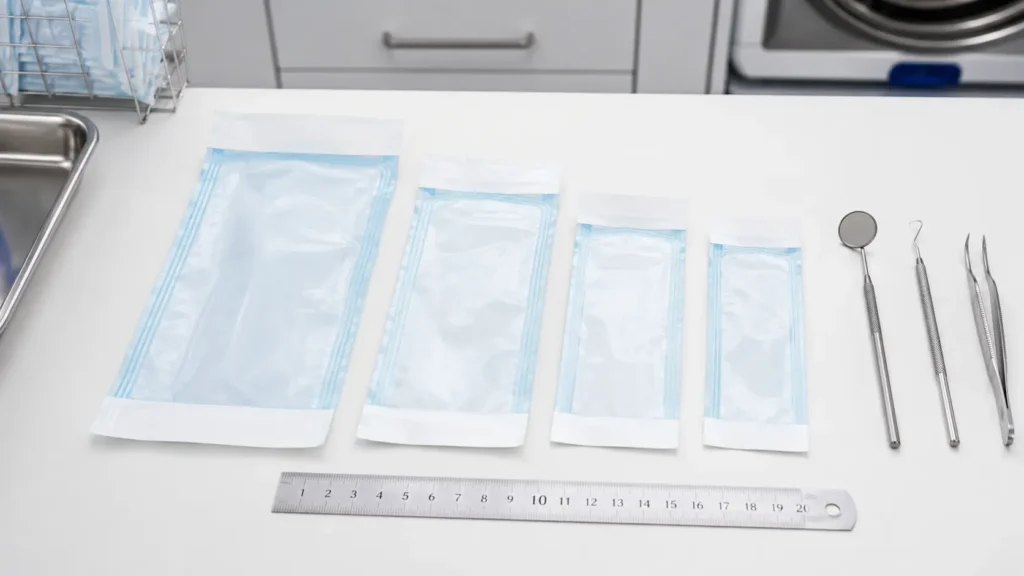
The correct size depends on more than the length and width of the instrument. Buyers should also consider device thickness, shape, weight, loading direction, required seal area, sterilization method and opening requirements.
This guide explains how to choose sterilization pouch sizes for medical devices, dental instruments and healthcare applications.
Quick Answer: How Should a Sterilization Pouch Be Sized?
Select a pouch that provides enough internal space for the instrument or device without stretching the film, paper, side seals or final closure.
The package should allow:
- The device to fit without excessive pressure on the seals
- Sufficient space for the final adhesive or heat-sealed closure
- Appropriate loading and unloading
- Compatible sterilant penetration where required
- Controlled opening and device presentation
- Protection during sterilization, handling, storage and transportation
Do not select a pouch from the device length and width alone. Thickness, protruding parts, sharp edges, device orientation and required opening direction can change the appropriate pouch dimensions.
For available pouch formats and material options, review our Sterilization Pouches & Rolls page.
Start with the Complete Device Dimensions
The first step is to record the maximum dimensions of the device or instrument in its intended packaging configuration.
Provide:
- Overall length
- Maximum width
- Maximum height or thickness
- Total weight
- Product photograph
- Technical drawing where available
- Intended loading direction
- Number of instruments placed in one pouch
Measurements should include handles, connectors, hinges, tubing, protruding components and other areas that may affect how the product fits inside the pouch.
If several instruments are packed together, measure the complete arranged set rather than adding the dimensions of each instrument separately.
Why Device Thickness Matters
A flat measurement does not fully describe the space required inside a sterilization pouch.
When a three-dimensional device is placed inside a flat pouch, part of the pouch width and length is used to accommodate the device thickness. This can make the usable internal area smaller than expected.
Thickness becomes especially important for:
- Instrument sets
- Hinged devices
- Dental handpieces
- Clamps and forceps
- Tubing sets
- Components with connectors
- Irregularly shaped medical devices
- Multiple instruments placed in one pouch
A pouch that appears wide enough when laid flat may become too tight after the device is inserted.
The product should therefore be evaluated inside an actual pouch sample whenever possible.
Allow Space Around the Device
The device should not press tightly against the pouch edges or closure area.
Adequate clearance can help reduce:
- Stress on the side seals
- Film puncture
- Paper tearing
- Creases in the sealing area
- Incomplete adhesive closure
- Uneven heat sealing
- Difficulty during opening
- Uncontrolled instrument movement
There is no single universal allowance that is correct for every pouch and device. Required clearance depends on the pouch construction, device geometry, sealing process and packaging instructions.
The pouch supplier’s specifications and the medical device company’s approved packaging process should be followed.
Keep the Device Away from the Final Closure
The instrument or device should not extend into the area used for adhesive closure or heat sealing.
For a self-sealing pouch, sufficient space is required for:
- Removing the release liner
- Folding the flap at the correct position
- Applying even pressure across the closure
- Avoiding creases in the adhesive area
- Keeping the instrument away from the closure
For a heat-sealing pouch, sufficient material is required to create a complete and consistent seal using the approved equipment and process settings.
The sealing area should remain clean, flat and free from device components, dust, moisture and other contamination.
Learn more about the differences between closure formats in our guide to self-seal vs heat-seal sterilization pouches.
Consider the Opening Direction
Sterilization pouch sizing should also consider how the package will be opened and how the device will be presented at the point of use.
The package should support controlled opening without:
- Pulling the device through the seal area
- Allowing the device to fall from the package
- Creating excessive fibre tear
- Producing an uncontrolled opening path
- Making the instrument difficult to remove
- Increasing the risk of contact with the outer package surface
The device orientation, peel direction and expected handling procedure should be considered before the final pouch size is approved.
A pouch that fits the device physically may still be unsuitable if it cannot be opened and presented in the intended manner.
Account for Sharp or Irregular Device Features
Sharp edges, corners and protruding components can create concentrated pressure against the pouch film, paper or seals.
Examples include:
- Dental explorers and probes
- Scissors
- Burs
- Needle-like components
- Bone screws
- Metal connectors
- Rigid tray components
- Instruments with locking mechanisms
- Devices with exposed edges
These devices may require additional internal space, protective caps, tip protectors, retention features or a different packaging format.
A larger pouch alone does not automatically solve puncture risk. The complete material structure and device-protection method must be evaluated.
For heavier, larger or irregular devices, Tyvek medical packaging, medical header bags or medical blister trays and lidding may be more appropriate than a conventional paper–plastic pouch.
Choose Between a Preformed Pouch and a Sterilization Roll
Preformed pouches are supplied in fixed widths and lengths. They can be practical when the instrument range is relatively consistent and suitable standard sizes are available.
Sterilization rolls are supplied in continuous lengths. The user selects the roll width, cuts the required length and seals the open ends.
A sterilization roll may be considered when:
- Instruments have several different lengths
- Standard pouch lengths do not provide an efficient fit
- The user wants to reduce the number of preformed pouch sizes held in stock
- The packaging operation has suitable cutting and heat-sealing equipment
- The cutting and sealing process can be controlled consistently
When selecting a roll, confirm:
- Roll width
- Roll length
- Device dimensions
- Required cutting length
- Space needed for both end seals
- Sealing equipment
- Recommended sealing conditions
- Sterilization compatibility
- Printing or indicator requirements
Rolls provide dimensional flexibility, but they also introduce additional cutting and sealing steps that must be controlled.
Self-Seal Pouch Size Considerations
Self-sealing sterilization pouches include a pre-applied adhesive strip and folding flap.
They are commonly considered for dental practices, clinics, laboratories and healthcare instrument-preparation activities where a separate heat sealer is not used for the final closure.
Before selecting the size, confirm:
- Usable internal pouch dimensions
- Device length, width and thickness
- Required flap-folding area
- Correct loading orientation
- Space between the instrument and adhesive closure
- Pouch instructions supplied with the product
- Intended sterilization method
- Process-indicator requirements
Do not overfill a self-seal pouch. Overfilling can interfere with correct folding, create creases across the adhesive closure or place stress on the pouch materials.
Heat-Seal Pouch Size Considerations
Heat-sealing pouches are supplied with an open end that is closed using compatible sealing equipment after the device has been inserted.
Before selecting the size, confirm:
- Usable internal dimensions
- Device geometry and loading clearance
- Required final seal width
- Position of the device relative to the sealing area
- Sealer dimensions and operating range
- Recommended temperature, pressure and dwell time
- Opening direction
- Sterilization method
- Package-testing and validation requirements
Heat sealing provides a controllable closure process, but package performance still depends on the material combination, pouch size, equipment, process settings and operator procedures.
ISO 11607-2 addresses requirements for developing and validating forming, sealing and assembly processes for terminally sterilized medical device packaging.
Dental Sterilization Pouch Size Selection
Dental sterilization pouches may be used for mirrors, probes, scalers, forceps, burs, hand instruments and instrument sets.
When choosing a dental pouch size:
- Arrange the instruments in their intended loading position.
- Measure the complete arranged set.
- Include the maximum thickness of stacked or hinged instruments.
- Confirm that sharp tips are protected.
- Allow sufficient space around the instruments.
- Keep all instruments away from the closure area.
- Confirm that the pouch can be opened in a controlled manner.
- Evaluate an actual sample before purchasing a large quantity.
If several instruments are packed together, the arrangement should not create excessive weight, pressure or movement inside the pouch.
The instrument manufacturer’s reprocessing instructions and the pouch supplier’s instructions should also be followed.
Common Sterilization Pouch Sizing Mistakes
Choosing Only by Instrument Length
Length alone does not account for width, thickness, handles, connectors or loading clearance.
Ignoring Usable Internal Dimensions
The external pouch size may include side seals, the sealed end, flap or other areas that are not available for loading.
Selecting the Smallest Possible Pouch
A tight pouch may place stress on the materials and seals or make closure and opening more difficult.
Using an Oversized Pouch Without Evaluation
A pouch that is unnecessarily large may allow excessive movement, create folds, increase material use or affect presentation.
Placing the Device in the Closure Area
The closure area should remain clear so that the adhesive or heat seal can be formed consistently.
Ignoring Sharp Edges
A pouch may be dimensionally large enough but still lack suitable puncture resistance or internal device protection.
Assuming One Size Fits Every Instrument
Different instrument shapes, thicknesses and loading arrangements may require different pouch sizes or packaging formats.
Skipping Sample Evaluation
A calculated pouch size should be confirmed through actual loading, sealing, sterilization and opening evaluation before final approval.
Information to Provide When Requesting a Quotation
To request suitable sterilization pouch or roll options, provide:
- Medical device or instrument name
- Intended use
- Product photograph or drawing
- Length, width and thickness
- Total weight
- Number of instruments per pouch
- Preferred self-seal, heat-seal or roll format
- Intended sterilization method
- Required paper, film or existing material specification
- Indicator requirements
- Printing requirements
- Quantity for each size
- Destination country
- Required quality or technical documents
Providing this information at the beginning can reduce repeated size adjustments adjustments and unnecessary sampling.
Sample Evaluation Before Final Approval
Pouch size should be confirmed with representative devices and the intended packaging process.
The evaluation may consider:
- Loading clearance
- Device movement
- Stress on the materials and seals
- Closure consistency
- Sealing conditions
- Sterilization exposure
- Package integrity
- Opening performance
- Device presentation
- Handling and transportation
- Aging requirements where applicable
ISO 11607-1 specifies requirements and test methods for materials, sterile barrier systems and packaging systems intended to maintain the sterility of terminally sterilized medical devices until the point of use.
The final medical device packaging system and associated processes remain subject to the medical device company’s evaluation, testing and validation requirements.
For testing preparation and documentation considerations, visit our Medical Packaging Testing and Validation Support page.
Frequently Asked Questions
How much space should be left inside a sterilization pouch?
The pouch should provide sufficient clearance so the device does not place excessive pressure on the paper, film, side seals or final closure. There is no universal allowance for every product. Device dimensions, thickness, shape, pouch construction and supplier instructions should be considered together.
Should I use the external or internal pouch dimensions?
Use the available internal loading dimensions. External measurements may include side seals, the sealed end, flap and other areas that cannot hold the device. Ask the supplier to confirm the usable internal dimensions.
Can several dental instruments be placed in one pouch?
Several instruments may be packaged together when the approved procedure and pouch specification allow it. The complete set should fit without overloading the pouch, damaging the materials or interfering with sterilization, closure and opening.
What if the device has sharp edges?
Sharp edges may require additional clearance, tip protection, retention features, stronger materials or another packaging format. Selecting a larger pouch alone does not automatically prevent puncture.
Is a sterilization roll better for different instrument lengths?
A roll can provide adjustable package length and reduce the number of preformed pouch sizes required. However, the user must control cutting, loading clearance and sealing at the open ends.
Can one pouch size be used for both EO and steam sterilization?
Pouch dimensions alone do not determine sterilization compatibility. The complete paper, film, adhesive, coating, indicator and seal structure must be confirmed for the intended sterilization process and cycle conditions.
How Jinhong Packaging Supports Pouch Size Selection
Jinhong Packaging supports medical packaging sourcing and project coordination through selected manufacturing partners.
Based on the information provided, we can help coordinate:
- Standard or customized pouch dimensions
- Self-sealing sterilization pouches
- Heat-sealing sterilization pouches
- Flat and gusseted sterilization rolls
- Dental sterilization pouches
- Medical-grade paper and film structures
- Samples and available supporting documents
- Printing and private-label requirements
Our role may include communicating device dimensions and packaging requirements, comparing available formats, coordinating samples, collecting applicable supplier information and following confirmed production details.
Final pouch suitability depends on the medical device, sterilization process, sealing method, target market and validation requirements.
Discuss Your Sterilization Pouch Requirements
Choosing the correct sterilization pouch size begins with the actual device—not a general size chart.
Send us the device dimensions, thickness, weight, photograph or drawing, preferred pouch format, sterilization method and estimated quantity. We can review the project information and coordinate suitable pouch or roll options with selected manufacturing partners.