Purchasing sterilization packaging involves more than selecting a pouch size and comparing unit prices.
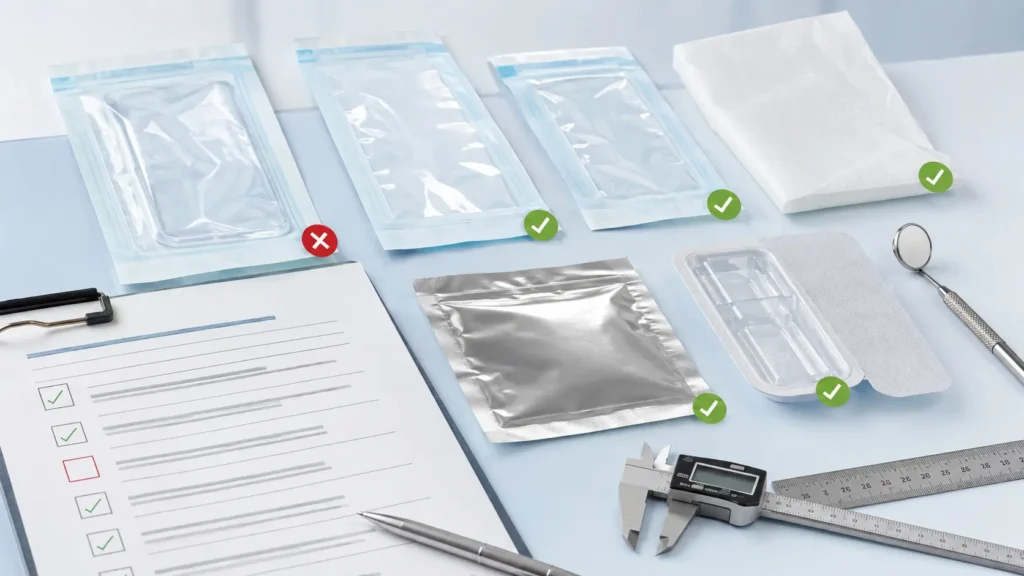
The package must be considered together with the medical device, material structure, sealing process, sterilization method, handling conditions, intended shelf life and validation requirements.
A pouch that appears suitable during an initial visual inspection may behave differently after sealing, sterilization, aging or transportation. Documents supplied for one material or product may also be irrelevant to another packaging configuration.
This guide explains common sterilization packaging purchasing mistakes and the information buyers should confirm before approving samples or placing an order.
Quick Answer: What Should Buyers Confirm Before Ordering?
Before ordering sterilization packaging, confirm:
- The packaged medical device or instrument
- Device dimensions, thickness, weight and shape
- Required pouch, roll, tray or bag format
- Complete material structure
- Intended sterilization method
- Sealing equipment and process
- Required opening performance
- Printing and indicator requirements
- Applicable standards and documents
- Sample and testing requirements
- Quantity for each size and design
- Target market and delivery destination
The supplier’s general product description should not replace a project-specific specification.
For available pouch and roll formats, review our Sterilization Pouches & Rolls page.
Mistake 1: Selecting Packaging Before Understanding the Device
The medical device should be the starting point for packaging selection.
Buyers sometimes request a “standard medical pouch” without providing enough information about the packaged product. This makes it difficult to determine whether the proposed size, material, strength and package format are suitable.
Important device information includes:
- Device name and intended use
- Length, width and thickness
- Total weight
- Sharp edges or protruding components
- Flexible or rigid construction
- Number of components per package
- Required loading orientation
- Product photograph or technical drawing
- Opening and presentation requirements
A lightweight dental instrument and a heavy irregular medical device may require completely different packaging systems, even when their external dimensions appear similar.
Mistake 2: Choosing the Pouch Size from Length and Width Alone
Length and width do not describe the complete loading space required inside a pouch.
Device thickness, handles, hinges, tubing, connectors and multiple components can reduce the usable internal area. Space is also required for the final closure and controlled opening.
A pouch that is too small may:
- Place stress on the side seals
- Create folds in the closure area
- Increase puncture risk
- Make sealing inconsistent
- Make opening more difficult
A pouch that is unnecessarily large may:
- Allow excessive device movement
- Create folds or air pockets
- Increase material use
- Reduce packing efficiency
- Affect controlled presentation
Use the available internal loading dimensions rather than relying only on the external pouch dimensions.
Our guide on how to choose sterilization pouch sizes explains the main sizing and clearance considerations.
Mistake 3: Assuming All Medical-Grade Paper Is the Same
The term “medical-grade paper” does not identify one universal material.
Medical papers may differ in:
- Basis weight
- Fibre composition
- Porosity
- Tensile strength
- Tear resistance
- Wet strength
- Surface treatment
- Heat-seal coating
- Printability
- Peel behaviour
- Microbial barrier performance
- Sterilization compatibility
Two papers with the same basis weight may still perform differently because of their fibre structure, coating, processing and intended application.
Before purchasing, confirm the exact paper specification, coating status, intended film combination and relevant supporting information.
For material considerations, visit our Medical-Grade Paper and Films page.
Mistake 4: Treating Every Transparent Film as Equivalent
The transparent film side of a medical pouch is also part of the complete sterile barrier system.
Film structures may use PET, PE, PA, PP or other polymers in laminated or coextruded combinations. Different structures can provide different levels of:
- Clarity
- Flexibility
- Puncture resistance
- Heat resistance
- Sealability
- Peel performance
- Dimensional stability
- Sterilization compatibility
A supplier should identify the proposed film structure and thickness rather than describing it only as “transparent medical film.”
The film, paper or Tyvek, coating, printing and sealing conditions must work together.
Mistake 5: Selecting Packaging Without Confirming the Sterilization Method
A pouch format or material name does not automatically establish sterilization compatibility.
Packaging may respond differently to:
- Ethylene oxide
- Steam
- Gamma irradiation
- Electron-beam irradiation
- Low-temperature oxidative processes
- Other project-specific sterilization methods
Ethylene oxide generally requires a suitable gas-permeable package configuration so the sterilant can enter and leave the package. Steam exposes packaging to heat, moisture and pressure changes. Radiation may affect polymers, adhesives, inks, coatings and seals.
A package described as suitable for one general sterilization method may still require confirmation for the actual process conditions.
Buyers should provide the intended sterilization method and available cycle information before material selection.
For a broader comparison, read our guide to medical packaging for sterilization methods.
Mistake 6: Assuming a High-Barrier Pouch Is Always Better
Higher barrier performance is not automatically better for every medical packaging application.
Aluminum foil and other high-barrier laminates may provide strong moisture, oxygen or light protection, but many are nonporous. A fully sealed nonporous package does not allow EO or steam to pass through in the same way as medical-grade paper or Tyvek.
Before selecting high-barrier packaging, define:
- The required moisture protection
- The required oxygen protection
- Light-sensitivity requirements
- Target shelf life
- Packaging function
- Sterilization sequence
- Whether breathability is required
- Whether the pouch is a primary package, sterile barrier or protective overwrap
Barrier requirements should be based on the packaged product and measurable performance needs—not the assumption that more layers or aluminum foil automatically produce a better package.
Learn more on our High-Barrier Medical Device Packaging page.
Mistake 7: Choosing Tyvek Only Because It Appears More Premium
Tyvek can provide important benefits for selected medical device packaging applications, including strength, puncture resistance, low linting and controlled opening.
However, Tyvek is not automatically necessary for every device.
Medical-grade paper may be a practical and economical option for many suitable lightweight instruments and devices. Tyvek may be more appropriate where the project requires:
- Greater tear resistance
- Higher puncture resistance
- Lower particle generation
- Cleaner opening
- More demanding handling performance
- A strong porous component for a tray or header bag
- Compatibility with selected specialized sterilization processes
The decision should consider the device, package format, sterilization method, sealing process, risk assessment and validation plan.
Different Tyvek styles and coatings are also not interchangeable.
For a detailed comparison, read Tyvek vs Medical-Grade Paper for sterile barrier packaging.
Mistake 8: Comparing Prices Without Comparing Specifications
The lowest quoted unit price may not represent the lowest total project cost.
Two quotations may refer to different:
- Paper grades
- Film structures
- Material thicknesses
- Tyvek styles
- Coating systems
- Seal widths
- Printing methods
- Indicator systems
- Packaging quantities
- Inspection requirements
- Document scopes
- Delivery terms
Before comparing prices, place the proposed specifications side by side.
A lower-cost package may create additional expenses if it leads to repeated sampling, sealing problems, testing delays, package failures or rejected production.
The quotation should identify the exact product format, dimensions, material structure, printing, packing method, MOQ, lead time and available documents.
Mistake 9: Treating a Supplier Certificate as Finished-Package Validation
A supplier’s ISO 13485 certificate may support supplier qualification, but it does not automatically validate the finished medical device packaging system.
Similarly, a material certificate, product specification or test report does not automatically prove that the customer’s final package is suitable for:
- The specific medical device
- The intended sterilization cycle
- The customer’s sealing equipment
- The proposed shelf life
- The distribution environment
- The target regulatory market
ISO 11607-1 addresses materials, sterile barrier systems and packaging systems for terminally sterilized medical devices. ISO 11607-2 addresses the development and validation of forming, sealing and assembly processes.
The medical device company or other responsible organization must determine the applicable requirements, approve the validation plan and evaluate the finished packaging system.
Jinhong Packaging can coordinate available supplier documents and third-party testing enquiries but does not replace the medical device manufacturer or validation laboratory.
Visit our Medical Packaging Testing and Validation Support page for further information.
Mistake 10: Requesting Documents Without Checking Their Scope
A document may be genuine but still irrelevant to the product being purchased.
Before accepting a certificate or test report, check:
- Issuing organization
- Company named on the document
- Manufacturing site
- Certificate number
- Validity period
- Product or material covered
- Test method
- Sample identification
- Material structure
- Test conditions
- Report date
- Relationship to the quoted product
A test report for one pouch, material grade or film structure should not be assumed to cover every product made by the same supplier.
Document applicability should be confirmed before the order is approved.
Mistake 11: Approving a Sample Without Confirming Production Specifications
A visually acceptable sample is not enough if the production specification remains unclear.
Before approving the sample, record:
- Pouch or roll dimensions
- Usable internal dimensions
- Material structure
- Paper or Tyvek grade
- Film structure and thickness
- Seal width
- Opening direction
- Adhesive closure where applicable
- Printing artwork and colours
- Indicator type and position
- Packing quantity
- Carton requirements
- Agreed inspection criteria
- Approved reference sample
The final production order should be linked to a controlled specification or approved sample.
Otherwise, the buyer and supplier may have different interpretations of what was approved.
Mistake 12: Skipping Sealing and Equipment Compatibility
Heat-sealing performance depends on more than the pouch material.
Important variables may include:
- Sealing temperature
- Pressure
- Dwell time
- Line speed
- Seal width
- Equipment condition
- Material orientation
- Cleanliness of the sealing area
- Cooling and handling after sealing
A pouch may perform differently on different sealing machines or production lines.
Before a large order, confirm whether the customer’s equipment can process the proposed structure and produce a consistent seal.
For closure-format considerations, see our guide to self-seal vs heat-seal sterilization pouches.
Mistake 13: Ordering Custom Printing Too Early
Custom printing can affect MOQ, cost, lead time and technical evaluation.
Buyers should not finalize printing before confirming:
- Pouch dimensions
- Material structure
- Seal areas
- Opening direction
- Device loading direction
- Indicator placement
- Required symbols and information
- Printing surface
- Artwork orientation
- Target-market requirements
A dimension or material change after artwork approval may require the design to be adjusted again.
For early samples, an unprinted structure may be sufficient for initial fit, sealing and handling evaluation.
Mistake 14: Ignoring Packing and Transportation Conditions
Sterilization packaging must remain suitable through handling, storage and transportation.
The buyer should consider:
- Inner packing quantity
- Carton dimensions
- Compression risk
- Puncture and abrasion risk
- Humidity exposure
- Transportation route
- Storage temperature
- Pallet configuration
- International delivery conditions
- Protection of rolls and pouch edges
A package that performs well immediately after production may still be damaged by unsuitable carton packing or demanding distribution conditions.
Finished-package and distribution evaluation should reflect the intended shipping environment.
Mistake 15: Placing a Large Order Before Sample Evaluation
Standard or customized samples can help identify basic problems before full production.
Sample review may include:
- Device fit
- Loading clearance
- Material handling
- Closure operation
- Heat-sealing compatibility
- Seal appearance
- Opening performance
- Printing position
- Instrument movement
- Puncture risk
- Sterilization response
- Document availability
A sample does not replace formal validation, but it can identify obvious specification problems before a larger financial commitment is made.
Sterilization Packaging Purchasing Checklist
Before placing an order, confirm the following.
Device Information
- Device name and intended use
- Dimensions and weight
- Sharp or irregular features
- Number of components
- Photo or drawing
Packaging Specification
- Pouch, roll, tray or header bag
- External and usable internal dimensions
- Paper, film or Tyvek specification
- Seal width and closure method
- Opening direction
- Printing and indicator requirements
Process Requirements
- Sterilization method
- Sealing equipment
- Expected process conditions
- Packaging environment
- Shelf-life and distribution requirements
Commercial Requirements
- Quantity per size
- Number of printed designs
- MOQ
- Sample cost
- Tooling or printing charges
- Production lead time
- Packing method
- Delivery terms and destination
Documentation Requirements
- Quality-management certificates
- Material specifications
- Certificates of analysis where applicable
- Declarations
- Relevant test reports
- Inspection requirements
- Required third-party laboratory scope
Frequently Asked Questions
What information should I send before requesting a sterilization packaging quotation?
Provide the device name, dimensions, thickness, weight, photograph or drawing, preferred packaging format, sterilization method, sealing process, material requirements, printing, quantity for each size, required documents and delivery destination.
Does an ISO 13485 certificate mean the packaging is validated?
No. ISO 13485 may support evaluation of a supplier’s quality-management system, but it does not validate the customer’s finished medical device packaging system. Device-specific package and process evaluation remains necessary.
Can one test report cover every sterilization pouch from the same supplier?
Not automatically. The report may apply only to a particular material, structure, size, process or sample. The report scope and relationship to the quoted product must be checked.
Should I choose Tyvek instead of medical-grade paper?
Not automatically. Tyvek may provide greater tear resistance, puncture resistance and lower linting, while medical-grade paper may be suitable and more economical for many lightweight devices. Selection depends on the complete project.
Is the cheapest sterilization pouch usually the best purchasing option?
Not necessarily. Quotations may include different materials, thicknesses, indicators, printing, packing and documentation. Buyers should compare complete specifications and total project risk, not unit price alone.
Should samples be tested before a production order?
Representative samples should normally be evaluated according to the project stage and packaging requirements. Initial sample review can support fit and process assessment, while formal testing and validation requirements remain specific to the finished medical device packaging system.
How Jinhong Packaging Supports Sterilization Packaging Projects
Jinhong Packaging is a packaging supplier and project coordination partner working with selected manufacturing partners.
Based on customer-provided project information, we can help coordinate:
- Sterilization pouches and rolls
- Medical-grade paper and films
- Tyvek medical packaging
- High-barrier medical pouches
- Medical blister trays and lidding
- Medical header bags
- Standard and customized dimensions
- Samples and specification communication
- Available supplier documents
- Production and delivery follow-up
Our role is to help organize requirements, communicate specifications, compare suitable options and coordinate the agreed project steps.
Final material selection, packaging validation, sterilization-process approval and regulatory responsibility remain with the medical device company and its qualified technical partners.
Discuss Your Sterilization Packaging Requirements
Avoiding sterilization packaging purchasing mistakes begins with a clear specification.
Send us the device information, package format, dimensions, sterilization method, sealing process, expected quantity, target market and documentation requirements. We can review the available information and coordinate suitable packaging options with selected manufacturing partners.